EV Charger Installation in Gadsden, AL
Charging where you park, in Gadsden: the utility programs, state law, permit process and housing facts behind a home charger install, gathered in one place.
The overnight plug is the least glamorous and most consequential part of owning an electric car, and Gadsden households have been adopting it at pace: 24,400 battery-electric vehicles and 8,300 plug-in hybrids were registered across Alabama by the end of 2025. Gadsden itself is home to about 33,374 people. What follows is the local field guide — utility programs as they actually stand, the association law as it actually reads, the permit as it is actually filed, and the housing numbers that predict your install before anyone opens the panel.
PlugReady USA is a matching service, not the installer: you tell us the job, and we route the request to licensed local electricians and EV-installer companies who work in Gadsden. Use the local detail below to arrive at that conversation informed — the sections are ordered the way an installer will think about your project, from the panel outward.
The registration ledger for the Gadsden metro reads: AL coverage. Ledgers like this are what installer rounds are built from — they show where the cars already are, which is where the circuits get requested, permitted and inspected week after week.
Survey context for Gadsden, in the three lines installers actually use: median household income $40,345; owner-occupation at 56%; single-unit detached homes at 75%. Income tracks adoption pace, tenure decides whose signature a job needs, and structure decides whether the answer is a garage circuit or a building negotiation.

Every city charges differently, and Gadsden's difference is legible in the data: an older housing fabric, where panel archaeology is a normal part of the first visit; overwhelmingly a detached-house city, so most installs are the simple garage pattern; buildings of five or more units are a visible minority of the stock; owners hold a working majority, with renters a significant minority. Read the sections below through that profile and the local advice resolves into specifics — which questions are routine here, and which are rare.
Keep six figures and you keep Gadsden's whole electrical character: 16,513 housing units; 12,746 occupied homes; 7,097 owner-occupied; 12,432 detached houses; 13,447 pre-1980 homes; 1,950 homes in buildings of five or more units. Percentages elsewhere on this page are these numbers in disguise — the counts are the originals, and they are the numbers a local installer's experience is actually made of. The page's geography is equally concrete: 6 ZIP codes across Etowah, centred near 34.05 degrees north latitude. The city anchors the Gadsden metropolitan area, home to roughly 105,000 people on the research file's metro estimate — the wider labour and housing market this page's installers work across.
The same survey release fills in the household economics around the housing stock: a median home value of $116,800, median gross rent of $808, per-capita income of $22,914, and a median resident age of 39. And the daily rhythms behind the housing numbers: 82% of Gadsden workers drive to work alone — the commute pattern home charging is built around; 4% work from home, a population whose cars charge on daytime and overnight schedules alike; 0% commute by public transit; 16% of adults hold a bachelor's degree or higher. And the fleet in the driveways: 4,842 households in Gadsden have exactly one vehicle, 6,966 have two or more, and 938 have none.
Two burden statistics frame the economics: in Gadsden, 45% of renters and 0% of mortgage-holding owners are housing-cost burdened at the standard 30% threshold. And 57% of households are family households, the segment most likely to run the two-vehicle, two-schedule pattern the second-vehicle planning notes address.
What follows is the city read as an electrical place rather than a dot on a map. The oldest housing throws the longest shadows over an install: knob-and-tube remnants in the attic, ungrounded receptacles, services sized for iceboxes and radios that now feed induction ranges and heat pumps. House-by-house urbanism gives the metro a house-by-house charging pattern — no building-scale projects, just thousands of individual circuits appearing one permit at a time.
Neither renter-heavy nor owner-dominated, the market rewards installers who can work both sides of the tenure line: the domestic circuit and the negotiated one. At this income band the phantom-rebate problem bites hardest, which is why this page states the verified incentive position in plain terms and dates it. The commission's calendar quietly schedules the market: when a new time-of-use design is approved, installer phones ring in a pattern the docket predicted months earlier.
Early-market conditions have their own economics: fewer specialist installers, general electricians carrying the work, and a premium on the household arriving informed — which is the gap this page exists to close. A smaller metro runs on relationships: the electrical firms are few, known, and booked through reputations maintained across decades of local work. Boards here decide without a statutory script, which makes precedent the currency: the first well-built application in a community quietly writes the policy for everyone after it.
The electrical reality in Gadsden homes
Tenure first, because tenure allocates the decisions: 56% of Gadsden's occupied homes are owner-occupied, free to commission electrical work outright. The stock they occupy has a median build year of 1959; 81% predates 1980; 75% is detached single-unit. For the owner-occupied majority, the charger question is purely electrical, and these are the electrical facts. Age shows up electrically before it shows up anywhere else: services sized for a house with a third of today's appliances. Expect the first conversation to be about capacity — what the panel is, what it already feeds, and which of the three routes (circuit, management, upgrade) your numbers support. Porches, carports and parking pads carry a real share of this city's charging, because the stock predates the two-car garage as a standard feature — outdoor-rated equipment is a local staple, not an edge case.
One further survey line belongs in any Gadsden install conversation: 54% of the city's homes heat with electricity — 6,863 households whose panels already carry a major winter load before a charger is contemplated. Electric heat and EV charging are the two largest discretionary loads a house can host, and where they coincide, the load calculation stops being a formality.
One further split matters for how this page is organised: about 5,649 of Gadsden's occupied homes are renter-occupied. Everything above assumes you can approve your own electrical work; where you cannot, the approval layer — landlord or association — becomes part of the job, which is why the law section carries unusual weight here.
And 12% of Gadsden's homes are in buildings with five or more units — apartments and condominiums where charging is a building decision before it is an electrical one. If that is your situation, the law and multifamily sections of this page are the ones written for you.
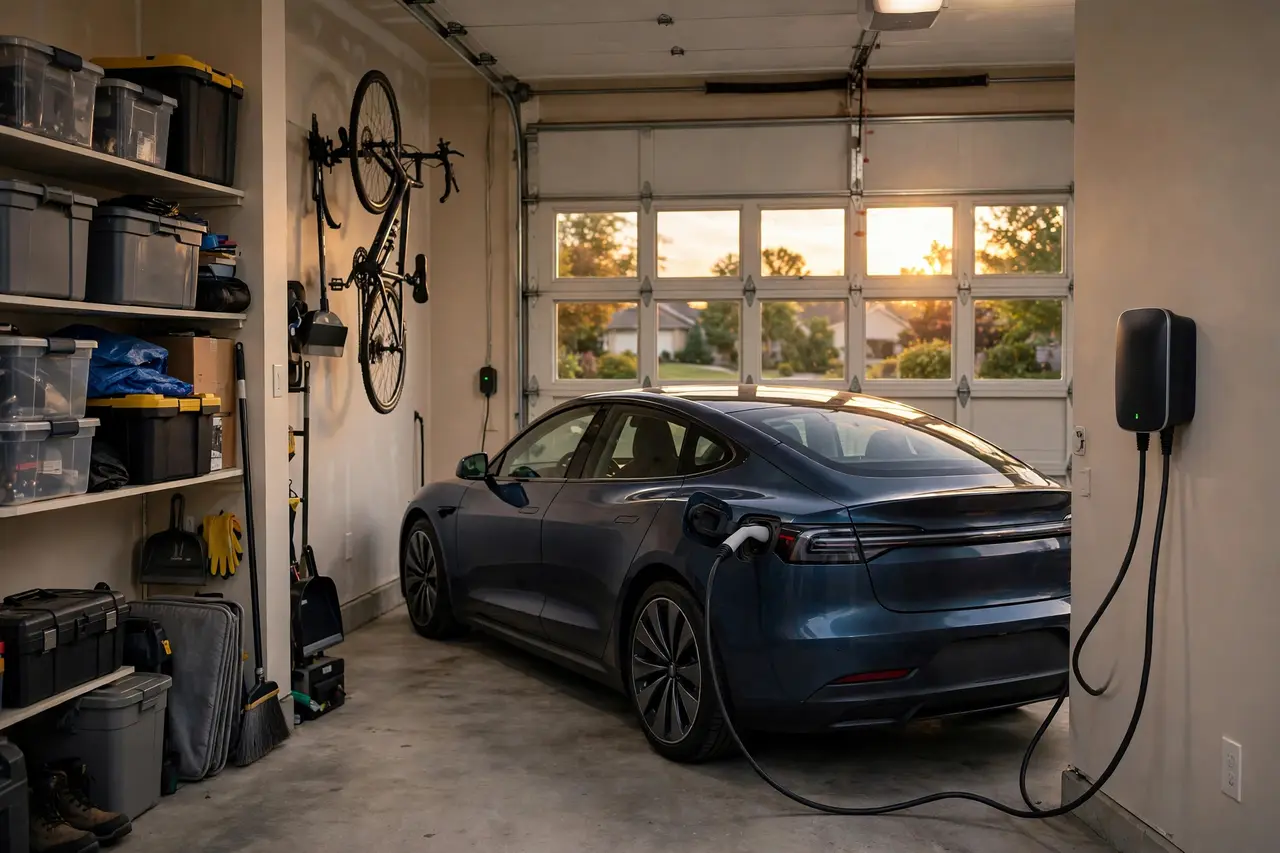
EV charging services in Gadsden
An installer's work in Gadsden usually starts with one of the three lead services below. The cards describe the job as it is actually scoped; the grid underneath carries the rest of the menu.
Home EV Charger Installation in Gadsden
The residential standard: a station where the car sleeps, on a circuit of its own, installed under permit. Variations are all local — the panel's spare room, the run's route through the house's fabric, and the parking pattern the cable has to serve.
In Gadsden: the install Gadsden's new EV households book first, and the one the rest of this page keeps returning to.
Dedicated Circuit & Electrical Panel Upgrade in Gadsden
Capacity work wears three costumes — more amps, a fresh panel, or management electronics that make the existing amps behave like more. The load calculation is the fitting room: it shows which costume your house actually needs, and a trustworthy quote names the calculation before the costume.
In Gadsden: the capacity answer when Gadsden's older panels meet a continuous load.
Level 2 Charger Installation in Gadsden
Level 2's numbers explain its dominance: several times the overnight recovery of a wall outlet, on equipment sized to the circuit by a factor the code fixes. The install is a circuit project with a station at the end of it, and it is quoted that way by anyone who does it weekly.
In Gadsden: the upgrade from a wall outlet to a dedicated 240-volt circuit, and the end of range arithmetic at bedtime.
Utility programs and electricity in Gadsden
Electricity in Gadsden comes from Alabama Power Co. Parts of the wider metro are served by Cherokee Electric Coop, Marshall-De Kalb Electric Coop, Coosa Valley Electric Coop Inc. The utility matters twice over for a charger install: it sets the time-of-use rates that decide what overnight charging costs you, and it is the organisation that may — or may not — currently help pay for the equipment.
Do not budget for a rebate in Gadsden right now. As of the sources checked for this page, Alabama Power Co publishes no residential charger rebate, Alabama offers no state program for typical home installs, and the federal 30C credit ended on September 30, 2025. If that changes, the utility's program page will say so with an as-of date — and this page will be updated to match. Until then, judge quotes on the work itself.
Solar households should read the export terms alongside the charging ones: the pair decides whether midday charging on home-working days beats the overnight window, and the answer is written in your tariff, not in general advice.
Condos, HOAs and the law in Alabama
There is no Alabama right-to-charge statute to lean on. Some national roundups list protection that does not exist in this state's code; the statute indexes checked for this page are clear. In Gadsden, a condo or HOA charger is approved — or not — under the community's own documents, which makes the quality of your application the whole ballgame.
Timing helps too. Boards plan capital work annually; an application that arrives with the community's budget cycle, offering to coordinate with any planned electrical or repaving work, reads as a contribution rather than a demand.
For the full playbook — application contents, metering designs, the questions boards ask — see the condo and HOA charging guide. In Gadsden it should be read as a negotiation manual, because negotiation is what the absence of a statute leaves you.
Climate, garages and charger placement
Humidity does quiet electrical work of its own: connections in damp garages live harder lives than their desert counterparts, which is one more reason the installer's torque and the enclosure's seal deserve their moment at commissioning. The charger itself is sealed and rated for this climate; the discipline is in the joints.
Shade structures — carports, pergolas, the live-oak side of the lot — are charging infrastructure in a hot climate whether they were built as such or not. A car that starts the session twenty degrees cooler spends its first charging hour on energy rather than on cooling itself.

Permits and inspection in Gadsden
Timelines are set by the city's counter, not the installer: the electrical work itself is typically a day, while permit issuance and the inspection visit follow the department's queue. A quote that promises a date should tell you which parts of that date the installer actually controls.

Neighbourhoods and ZIP codes served
The page covers 6 ZIP codes in and around Gadsden — including 35901, 35902, 35903, 35904, 35905, 35907 — across Etowah. If your ZIP is not in the first set shown, ask anyway: installer coverage follows the metro, not a postcode fence.
The same working area takes in the neighbouring localities of Attalla, Rainbow City, Altoona, Gallant, Walnut Grove — the county ring an installer based in Gadsden actually drives. Requests from those communities route exactly as city requests do: same services, same permit discipline, same local facts where they differ.
Etowah County accounts for 11 of the ZIP codes and 6 named postal localities in the research file, the nearest of them Attalla, Rainbow City, Altoona, Gallant, Walnut Grove. The survey counts 103,105 residents in the county, with a median household income of $54,563 and a median home value of $167,100. Measured across its ZIP codes, the Gadsden footprint runs about 10 miles north to south and 8 east to west, from ZIP 35901 to 35907 — the ground an installer based here actually covers in a working week.
Beyond the county seats, the working area takes in Attalla, Rainbow City, Leesburg, Boaz, Collinsville, Crossville, Altoona, Gallant, Centre, Steele, Walnut Grove, Spring Garden, Dawson, Albertville, Geraldine, Cedar Bluff, Ashville, Douglas, Horton, Fyffe, Groveoak, Guntersville, Fort Payne, Allgood, Rainsville, Oneonta, Blountsville, Sylvania — the named localities for which Gadsden is the nearest metro in the network (neighbouring metros' pages cover their own ground), each routing to the same installer-matching service.
The wider working area also reaches Jacksonville, Ohatchee, Bynum, De Armanville, Weaver, Piedmont, Choccolocco, Esom Hill, Oxford, Cave Spring, Edwardsville, Langston, Section, Munford, Heflin, Cleveland, Grant, Arab, Odenville, Lyerly, Pell City, Valley Head, Felton, Tallapoosa, Remlap, Cook Springs, Henagar, Baileyton, Lindale, Rome, Coosa, Shannon, Delta, Silver Creek, Menlo — ground shared with neighbouring metros, where installers cross the same county lines in both directions.
ZIP codes in that shared ground include 30124, 30129, 30138, 30140, 30147, 30164, 30165, 30172, 30173, 30176, 30730, 35016, 35052, 35054, 35083, 35087, 35097, 35128, 35146, 35160, 35161, 35175, 35744, 35755, 35760, 35771, 35978, 35989, 36201, 36203, 36205, 36207, 36250, 36262, 36264, 36265, 36271, 36272, 36277, 36279.
The largest communities in that working area after Gadsden itself, by the GeoNames populated-place file: Albertville (population 21,462), Fort Payne (population 14,150), Boaz (population 9,688), Rainbow City (population 9,580), Southside (population 8,572), Oneonta (population 6,615), Attalla (population 5,899), Glencoe (population 5,153), Rainsville (population 5,031), Piedmont (population 4,714), Horton (population 4,450), Hokes Bluff (population 4,301), Centre (population 3,570), Ashville (population 2,256), Whitesboro (population 2,138), Carlisle-Rockledge (population 2,137), Collinsville (population 1,973), Sylvania (population 1,854), Crossville (population 1,848), Cedar Bluff (population 1,802). Charging demand follows those populations — the subdivisions and town centres where the next driveways, and the next panels, are.
DeKalb County reaches into the working area with 72,269 residents, a median household income of $51,204 and a median home value of $152,700; its localities on this page include Collinsville, Crossville, Dawson, Geraldine, Fyffe. Marshall County reaches into the working area with 99,748 residents, a median household income of $62,571 and a median home value of $201,500; its localities on this page include Boaz, Albertville, Douglas, Horton. Cherokee County reaches into the working area with 25,443 residents, a median household income of $53,863 and a median home value of $179,700; its localities on this page include Leesburg, Centre, Spring Garden, Cedar Bluff. Blount County reaches into the working area with 59,518 residents, a median household income of $64,190 and a median home value of $175,200; its localities on this page include Allgood, Oneonta, Blountsville. St. Clair County reaches into the working area with 94,166 residents, a median household income of $77,463 and a median home value of $226,300; its localities on this page include Steele, Ashville.
| ZIP | Locality | County |
|---|---|---|
| 35901 | Gadsden | Etowah |
| 35903 | Gadsden | Etowah |
| 35902 | Gadsden | Etowah |
| 35904 | Gadsden | Etowah |
| 35905 | Gadsden | Etowah |
| 35954 | Attalla | Etowah |
| 35907 | Gadsden | Etowah |
| 35906 | Rainbow City | Etowah |
| 35983 | Leesburg | Cherokee |
| 35956 | Boaz | Marshall |
| 35961 | Collinsville | DeKalb |
| 35962 | Crossville | DeKalb |
| 35952 | Altoona | Etowah |
| 35972 | Gallant | Etowah |
| 35957 | Boaz | Marshall |
| 35960 | Centre | Cherokee |
| 35987 | Steele | St. Clair |
| 35990 | Walnut Grove | Etowah |
| 36275 | Spring Garden | Cherokee |
| 35963 | Dawson | DeKalb |
| 35950 | Albertville | Marshall |
| 35974 | Geraldine | DeKalb |
| 35959 | Cedar Bluff | Cherokee |
| 35953 | Ashville | St. Clair |
| 35964 | Douglas | Marshall |
| 35980 | Horton | Marshall |
| 35951 | Albertville | Marshall |
| 35971 | Fyffe | DeKalb |
| 35975 | Groveoak | DeKalb |
| 35976 | Guntersville | Marshall |
| 35967 | Fort Payne | DeKalb |
| 35013 | Allgood | Blount |
| 35986 | Rainsville | DeKalb |
| 35121 | Oneonta | Blount |
| 35968 | Fort Payne | DeKalb |
| 35031 | Blountsville | Blount |
| 35988 | Sylvania | DeKalb |

Planning the install: from panel to parking
The order of operations protects you. Load calculation before equipment choice, because the circuit sizes the station's settings. Route before purchase, because reach decides models. Permit before work, because inspection closes the file the insurer will one day read. In Gadsden the sequence is the same as everywhere — what varies is only how much of it your particular house asks for, and finding that out is the site visit's entire purpose.
Finally, photograph the finished work — station, nameplate, panel directory with the new breaker labelled — and file it with the inspection record. When the car changes, the house sells or a second station joins the first, that folder is the difference between a five-minute answer and an archaeological dig.
Home charging know-how for Gadsden households
What commissioning actually includes
Commissioning is the install's final examination, and it has a syllabus: torque verified on the terminations, the station's output configured to the circuit rather than the nameplate, the network connection and schedule set with the household present, a test session run and observed, the paperwork handed over. Households sometimes mistake it for ceremony. It is the opposite — it is the moment latent errors cost least to fix, with the installer still in the driveway and the tools still out.
The autumn checklist
Households in seasonal country develop a small autumn ritual around the charger: the connector and holster checked before the weather turns, the cable's route confirmed clear of the snow-storage corner and the plough's line, the schedule revisited against winter tariffs and winter range. Ten minutes, once a year, timed with the rest of the house's changeover. It belongs to the same family as the inspection file — the unglamorous habits that make an installation feel, five winters later, like it was designed by someone who had met the climate before.
Vehicles that work from home
A growing class of households runs a business from the drive: trades vans, delivery vehicles, a car that is also the office. Their charging arithmetic differs from the commuter's — higher daily miles, tighter morning deadlines, and a vehicle whose readiness is revenue. The design answers scale accordingly: capacity with headroom, a schedule set against the working day rather than the night, and occasionally the second circuit sooner than a private household would need it. If the vehicle earns, say so at the site visit; it changes the specification.
Orientation: the garage's compass
A garage's orientation decides its microclimate: south- and west-facing doors take the day's heat load, north-facing ones hold the cold. The charger inherits the microclimate — electronics ageing in the hot wall's summer, cables stiffening in the cold one's January. Orientation is nobody's choice by install time, but it informs placement inside the room: the interior wall over the door wall, the shaded corner over the sun line, decided by someone who has read the room's compass.

Frequently asked questions
Can I still get the federal tax credit for a home charger in Gadsden, AL?
Treat the answer as a standing no with a watching brief. The 30C credit is finished, Alabama has not replaced it for homeowners, and no verified Alabama Power Co rebate was running in the sources checked for this page. Should that change, the utility's program page will say so first — and this page will be updated to match.
What can my HOA in Gadsden, AL do about a charger install?
As the law stands, yes: without a Alabama right-to-charge statute, an association in Gadsden may refuse or condition a charger under its own documents. The practical counterweight is preparation — a complete written package, a metering answer, and a request that the refusal, if it comes, be issued in writing with the covenant cited.
Panel upgrade or not — how do Gadsden, AL homeowners find out?
Nobody can answer that from a photograph of your panel's door, and you should be suspicious of anyone who tries. In a city where the median home dates to 1959 and about 81% of units predate 1980, the honest answer is a load calculation: what your service is, what it already carries, and what a continuous charger load does to the total. Then the options — circuit, load management, or upgrade — compare on paper.
How quickly will a Level 2 charger fill my car in Gadsden, AL?
Think of it in parked hours. Level 1 gives you back 3–5 miles for each of them; Level 2 gives back about 25–40, set by the circuit's amperage and what the car can accept. Overnight, that is the gap between 'enough for tomorrow' and 'full, every morning'.
What happens next after I send a request?
Three things happen, in order. Your request is routed to licensed installers who work in Gadsden; one of them contacts you to book a site visit; and the visit produces a written quote based on your actual panel and parking. PlugReady USA runs the matching, not the tools — the contractor on the job is the installer who visits.
Can a charger be added to a detached garage in Gadsden?
It can. With roughly 75% of Gadsden's stock in detached houses, the detached-garage run is a routine local job: conduit buried at code depth from the panel, or a subpanel that also serves the workshop. The trench, not the charger, is what the quote is really about.
Nearby cities in Alabama
- EV charger installation in Anniston — about 28 miles from Gadsden, metro population 115,000
- EV charger installation in Huntsville — about 59 miles from Gadsden, metro population 525,000
- EV charger installation in Birmingham — about 61 miles from Gadsden, metro population 1,150,000
- EV charger installation in Decatur — about 70 miles from Gadsden, metro population 155,000
- EV charger installation in Auburn — about 107 miles from Gadsden, metro population 185,000
- EV charger installation in Tuscaloosa — about 108 miles from Gadsden, metro population 250,000
- EV charger installation in Rome, GA — about 45 miles from Gadsden, metro population 100,000
- EV charger installation in Dalton, GA — about 72 miles from Gadsden, metro population 145,000
- EV charger installation in Chattanooga, TN — about 77 miles from Gadsden, metro population 575,000
Ready to charge at home in Gadsden?
Send the essentials — what you need, where, and what kind of property — and a licensed local installer will pick it up from there.