EV Charger Installation in Amarillo, TX
Everything a Amarillo homeowner needs before booking a charger install — the panel question, the utility's current programs, the HOA law and the permit — sourced, dated and local.
A decade of EV adoption has quietly sorted Amarillo's streets into two kinds: the ones where charging already happens behind garage doors, and the ones where the first charger on the block is about to arrive. Either way, the questions are identical and local. Amarillo itself is home to about 197,979 people. Across Texas, 387,400 battery-electric vehicles and 79,900 plug-in hybrids were registered through 2025. Which utility serves the address and what it currently offers, what the panel can honestly carry, what an association may and may not refuse, what the permit office expects — this page answers each for Amarillo, from sources, with the dates attached.
How this page is organised matters less than what is in it: verified local facts, stated with their sources, so you can check them yourself. PlugReady USA matches homeowners in Amarillo with licensed local installers; the detail below is the homework we would want done before anyone quotes the job.
The demand picture for the Amarillo metro, from the registration data this site is built on: Panhandle anchor. Registration counts are the honest way to size a charging market — they count households, not headlines — and they are why Amarillo sits where it does in our build order (rank 264 of 300 metros, Tier C).
Survey context for Amarillo, in the three lines installers actually use: median household income $67,187; owner-occupation at 58%; single-unit detached homes at 69%. Income tracks adoption pace, tenure decides whose signature a job needs, and structure decides whether the answer is a garage circuit or a building negotiation.

The composite picture matters more than any single statistic. In Amarillo: an older housing fabric, where panel archaeology is a normal part of the first visit; a detached-house majority with a real attached and multifamily minority; buildings of five or more units are a visible minority of the stock; meanwhile, owners hold a working majority, with renters a significant minority. A page that ignored that profile would give the same advice everywhere; this one is ordered by it.
The counts behind the percentages, for the record: Amarillo has 87,454 housing units on the survey's count, 78,852 of them occupied, and 45,981 owner-occupied households making their own electrical decisions. Detached houses number 60,277; homes built before 1980 number 52,581; units in buildings of five or more number 16,247. An installer's week in this city is a walk through exactly that distribution. The page's geography is equally concrete: 27 ZIP codes across Potter, Randall, centred near 35.20 degrees north latitude. The city anchors the Amarillo metropolitan area, home to roughly 310,000 people on the research file's metro estimate — the wider labour and housing market this page's installers work across.
The same survey release fills in the household economics around the housing stock: a median home value of $213,900, median gross rent of $1,123, per-capita income of $37,945, and a median resident age of 36. And the daily rhythms behind the housing numbers: 74% of Amarillo workers drive to work alone — the commute pattern home charging is built around; 8% work from home, a population whose cars charge on daytime and overnight schedules alike; 1% commute by public transit; 30% of adults hold a bachelor's degree or higher. And the fleet in the driveways: 28,683 households in Amarillo have exactly one vehicle, 45,750 have two or more, and 4,419 have none.
Two burden statistics frame the economics: in Amarillo, 50% of renters and 0% of mortgage-holding owners are housing-cost burdened at the standard 30% threshold. And 61% of households are family households, the segment most likely to run the two-vehicle, two-schedule pattern the second-vehicle planning notes address.
The signature matters because installs follow it, street by street. A stock this old wires its history into the walls: cloth-wrapped conductors in the deepest streets, fuse boxes that outlived their century, panels added in layers by generations of electricians each solving their own decade's problem. The built form refuses a single story: houses with garages on one side of the arterial, garden apartments and mid-rise condos on the other, each population charging by different rules.
A balanced tenure map makes the landlord conversation a standard local genre — proposal letters, metering arrangements, restoration clauses — familiar to installers and property managers alike. Middle-income arithmetic governs the metro's installs: the circuit specced to the need, the schedule set to the overnight window, the tariff read carefully because the monthly difference is real money over a car's life. The commission's calendar quietly schedules the market: when a new time-of-use design is approved, installer phones ring in a pattern the docket predicted months earlier.
At this volume the binding constraints move upstream — panel capacity in older districts, transformer headroom on particular streets, the diary of the good installer rather than the existence of one. Smaller metros adopt on their own clock: the fleet follows the dealers and the demographics, and each install is a visible event a street notices. The association dimension here runs on persuasion rather than statute — no state charging law frames the application, so the complete, professional proposal carries the whole argument, as the law section above explains.
The electrical reality in Amarillo homes
The Census Bureau's latest American Community Survey puts the median Amarillo home's build year at 1974: about 60% of the city's housing units were built before 1980, 69% are single-unit detached houses, and 58% of occupied homes are owner-occupied. Those three numbers predict most of what an installer will find. Age shows up electrically before it shows up anywhere else: services sized for a house with a third of today's appliances. Expect the first conversation to be about capacity — what the panel is, what it already feeds, and which of the three routes (circuit, management, upgrade) your numbers support. Housing age also tracks wire-run reality: older homes more often place the panel in a basement or interior wall far from the garage, and distance is copper, conduit and labour.
The fuel table adds one more local fact: 28,340 Amarillo homes — 36% of the stock — heat with electricity. Those households already think in kilowatts through the winter, their panels carry the load to prove it, and a charger's overnight appetite joins a system that is, in the useful sense, already electrified.
The tenure split cuts the other way too: roughly 32,871 occupied homes in Amarillo are rented. For those households the charger question is a negotiation with a property owner — written proposal, licensed installer, metering clarity — and it succeeds often enough that installers here keep the pattern ready.
And 19% of Amarillo's homes are in buildings with five or more units — apartments and condominiums where charging is a building decision before it is an electrical one. If that is your situation, the law and multifamily sections of this page are the ones written for you.
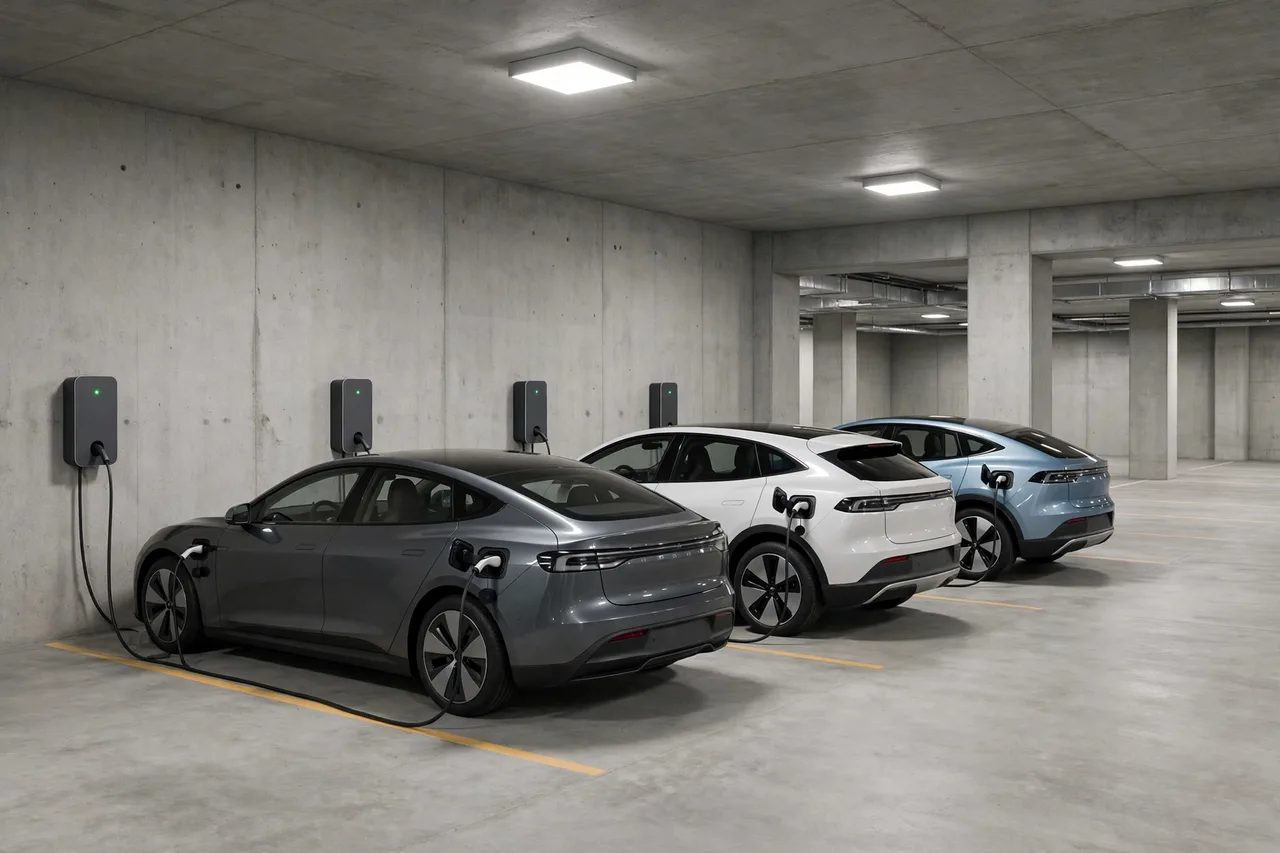
EV charging services in Amarillo
Installers in Amarillo book the same ten services as everywhere — but not in the same proportions. The three leading cards below are this city's pattern, set by its panels, its buildings and its statute book.
Home EV Charger Installation in Amarillo
The residential standard: a station where the car sleeps, on a circuit of its own, installed under permit. Variations are all local — the panel's spare room, the run's route through the house's fabric, and the parking pattern the cable has to serve.
In Amarillo: the core residential job in Amarillo: circuit, mounting, configuration and inspection in one visit pattern.
Dedicated Circuit & Electrical Panel Upgrade in Amarillo
Where the load calculation fails the existing service, the upgrade is not an upsell — it is the finding. Done under permit with the utility's meter work coordinated, it converts the charger project into the house's electrical reset, and every later project inherits the headroom.
In Amarillo: the capacity fix that lets the charger circuit go in without the rest of the house living at its limit.
Level 2 Charger Installation in Amarillo
Level 2's numbers explain its dominance: several times the overnight recovery of a wall outlet, on equipment sized to the circuit by a factor the code fixes. The install is a circuit project with a station at the end of it, and it is quoted that way by anyone who does it weekly.
In Amarillo: the upgrade from a wall outlet to a dedicated 240-volt circuit, and the end of range arithmetic at bedtime.
Utility programs and electricity in Amarillo
Electricity in Amarillo comes from Southwestern Public Service Co. Parts of the wider metro are served by Greenbelt Electric Coop, Inc, Rita Blanca Electric Coop, Inc, Swisher Electric Coop, Inc. The utility matters twice over for a charger install: it sets the time-of-use rates that decide what overnight charging costs you, and it is the organisation that may — or may not — currently help pay for the equipment.
Rebate archaeology is a local sport: an old Southwestern Public Service Co program page, a neighbour's 2023 install story, a screenshot of terms nobody can date. The record for Amarillo, as checked for this page, is simpler. The federal credit closed on September 30, 2025; Texas operates no home-charger program; and no active Southwestern Public Service Co residential charger rebate appears in current published sources. Funded rounds do reopen in this industry — on the utility's timetable, announced on the utility's site, and worth exactly what their published terms say on the day you read them.
Solar households should read the export terms alongside the charging ones: the pair decides whether midday charging on home-working days beats the overnight window, and the answer is written in your tariff, not in general advice.
Condos, HOAs and the law in Texas
No statute promises a charger approval in Texas. Unlike the states that have enacted right-to-charge laws, Texas leaves the question entirely to each community's covenants and board discretion. For Amarillo owners that is not the end of the road — it is a sign that the negotiation, the metering design and the written application carry the weight a statute would otherwise carry.
Timing helps too. Boards plan capital work annually; an application that arrives with the community's budget cycle, offering to coordinate with any planned electrical or repaving work, reads as a contribution rather than a demand.
The negotiation playbook — application contents, metering options, the wording that answers boards' standard objections — is set out in our condo and HOA guide, read here as a persuasion manual rather than a rights manual.
Climate, garages and charger placement
Heat also argues for headroom in the circuit decision. A car managing a hot battery after a hot commute draws on its own schedule; a generously sized circuit finishes the session inside the cool window instead of straddling the morning. It is a small thing, decided once, felt all summer.
Afternoon is the design hour: a station, a cable and a car that all sit in the day's peak heat age on the local schedule, not the brochure's. West-facing walls are the last choice here; the shaded side of the garage, the eave's shadow and the overnight schedule are the three cheap protections every local installer reaches for.

Permits and inspection in Amarillo
If your install is part of a larger job — a panel upgrade, a garage build — the charger usually rides on the same permit set. Ask for the charger circuit to be listed explicitly so the inspection record shows it.

Neighbourhoods and ZIP codes served
The page covers 27 ZIP codes in and around Amarillo — including 79101, 79102, 79103, 79104, 79105, 79106, 79107, 79108, 79109, 79110, 79111, 79114, 79116, 79117, 79118, 79119, 79120, 79121, 79124, 79159, 79166, 79168, 79172, 79174, 79178, 79185, 79189 — across Potter, Randall. If your ZIP is not in the first set shown, ask anyway: installer coverage follows the metro, not a postcode fence.
The same working area takes in the neighbouring localities of Bushland, Canyon, Umbarger — the county ring an installer based in Amarillo actually drives. Requests from those communities route exactly as city requests do: same services, same permit discipline, same local facts where they differ.
Potter County accounts for 22 of the ZIP codes and 2 named postal localities in the research file, the nearest of them Bushland. The survey counts 115,975 residents in the county, with a median household income of $53,249 and a median home value of $147,300. Randall County accounts for 9 of the ZIP codes and 3 named postal localities in the research file, the nearest of them Canyon, Umbarger. The survey counts 146,070 residents in the county, with a median household income of $83,864 and a median home value of $238,800. Measured across its ZIP codes, the Amarillo footprint runs about 24 miles north to south and 19 east to west, from ZIP 79101 to 79189 — the ground an installer based here actually covers in a working week.
Beyond the county seats, the working area takes in Bushland, Canyon, Wildorado, Umbarger, Panhandle, Claude, Dawn, Masterson, Vega, Boys Ranch, Wayside, Happy, Fritch, Sanford, Groom, White Deer, Hereford, Borger, Channing, Tulia, Skellytown — the named localities for which Amarillo is the nearest metro in the network (neighbouring metros' pages cover their own ground), each routing to the same installer-matching service.
The largest communities in that working area after Amarillo itself, by the GeoNames populated-place file: Clovis (population 39,480), Pampa (population 18,177), Hereford (population 15,021), Dumas (population 15,001), Canyon (population 14,887), Borger (population 12,964), Dalhart (population 8,370), Tulia (population 4,760), Dimmitt (population 4,195), Friona (population 3,894), Spearman (population 3,375), Cactus (population 3,197), Canadian (population 3,013), Panhandle (population 2,341), Wellington (population 2,174), Memphis (population 2,138), Stratford (population 2,073), Fritch (population 2,066), Shamrock (population 1,989), Clarendon (population 1,944). Charging demand follows those populations — the subdivisions and town centres where the next driveways, and the next panels, are.
Carson County reaches into the working area with 5,801 residents, a median household income of $85,231 and a median home value of $143,000; its localities on this page include Panhandle, Groom, White Deer, Skellytown. Hutchinson County reaches into the working area with 20,184 residents, a median household income of $67,228 and a median home value of $119,100; its localities on this page include Fritch, Sanford, Borger. Oldham County reaches into the working area with 2,249 residents, a median household income of $79,900 and a median home value of $162,800; its localities on this page include Wildorado, Vega, Boys Ranch. Armstrong County reaches into the working area with 1,822 residents, a median household income of $72,750 and a median home value of $171,500; its localities on this page include Claude, Wayside. Deaf Smith County reaches into the working area with 18,460 residents, a median household income of $60,799 and a median home value of $121,300; its localities on this page include Dawn, Hereford.
| ZIP | Locality | County |
|---|---|---|
| 79101 | Amarillo | Potter |
| 79102 | Amarillo | Potter |
| 79159 | Amarillo | Potter |
| 79120 | Amarillo | Potter |
| 79104 | Amarillo | Potter |
| 79107 | Amarillo | Potter |
| 79106 | Amarillo | Potter |
| 79103 | Amarillo | Potter |
| 79109 | Amarillo | Randall |
| 79110 | Amarillo | Randall |
| 79108 | Amarillo | Potter |
| 79121 | Amarillo | Randall |
| 79124 | Amarillo | Potter |
| 79117 | Amarillo | Potter |
| 79118 | Amarillo | Randall |
| 79116 | Amarillo | Potter |
| 79111 | Amarillo | Potter |
| 79114 | Amarillo | Randall |
| 79119 | Amarillo | Randall |
| 79105 | Amarillo | Potter |
| 79166 | Amarillo | Potter |
| 79168 | Amarillo | Potter |
| 79172 | Amarillo | Potter |
| 79174 | Amarillo | Potter |
| 79178 | Amarillo | Potter |
| 79185 | Amarillo | Potter |
| 79189 | Amarillo | Potter |
| 79012 | Bushland | Potter |
| 79016 | Canyon | Randall |
| 79015 | Canyon | Randall |
| 79098 | Wildorado | Oldham |
| 79091 | Umbarger | Randall |
| 79068 | Panhandle | Carson |
| 79019 | Claude | Armstrong |
| 79025 | Dawn | Deaf Smith |
| 79058 | Masterson | Moore |
| 79092 | Vega | Oldham |
| 79010 | Boys Ranch | Oldham |
| 79094 | Wayside | Armstrong |
| 79042 | Happy | Swisher |
| 79036 | Fritch | Hutchinson |
| 79078 | Sanford | Hutchinson |
| 79039 | Groom | Carson |
| 79097 | White Deer | Carson |
| 79045 | Hereford | Deaf Smith |
| 79007 | Borger | Hutchinson |
| 79008 | Borger | Hutchinson |
| 79018 | Channing | Hartley |
| 79088 | Tulia | Swisher |
| 79080 | Skellytown | Carson |

Planning the install: from panel to parking
Walk the route before anyone quotes the route. Between Amarillo's panels and its parking spaces lie the job's real variables: a finished ceiling or an open one, a straight shot through a shared wall or a tour of the attic, forty feet of conductor or a hundred and forty. Installers who quote from photographs quote the average of all routes; installers who walk yours quote the one you actually have. The site visit is where the quote stops being a genre and becomes a document.
Finally, photograph the finished work — station, nameplate, panel directory with the new breaker labelled — and file it with the inspection record. When the car changes, the house sells or a second station joins the first, that folder is the difference between a five-minute answer and an archaeological dig.
Home charging know-how for Amarillo households
When the garage is detached
A detached garage changes the install's centre of gravity: the circuit must travel. The route is usually a buried conduit run from the house panel, with depth, conduit type and the trench's path past roots, irrigation and paving all settled at the design stage — or, where the run is long and the loads justify it, a subpanel in the garage that also serves the workshop the building inevitably becomes. The charger at the end of that run behaves exactly like any other; it is the journey, measured in copper and digging, that defines the job.
Getting onto the board's agenda
Association decisions happen inside a procedure, and the procedure has a door: the agenda. Applications that miss the submission deadline wait a full cycle regardless of merit, so the first question for any board is clerical — when do items close for the next meeting, and in what format. Arrive inside the procedure with a complete package and the discussion is about your design; arrive outside it and the discussion is about process, and process always wins the evening. Property managers, asked politely, will tell you the format they prefer applications in.
Outdoor and carport positions
Plenty of charging happens without a garage at all — on driveway walls, posts and carports. The outdoor version of the job adds its own discipline: equipment listed for the exposure, an enclosure that sheds rather than traps water, cable reach checked against the car's real nose-in position, and protection from the ordinary impacts of a working driveway. A pedestal adds a foundation and a conduit approach below grade. None of it is exotic, and all of it is cheaper decided on paper than corrected in concrete.
The labelled breaker
Panel directories are autobiographies written in pencil, and a charger install adds a chapter. The new breaker gets labelled — circuit, station, date — in the directory and, in thorough households, on the panel schedule taped inside the door. It reads as pedantry until the night something trips at 11 pm and the labelled directory turns a flashlight search into a ten-second answer. It also serves the future: the next electrician, the inspector, the buyer, each reads the panel's story faster when the latest chapter is legible.

Frequently asked questions
Can I still get the federal tax credit for a home charger in Amarillo, TX?
No. The federal Alternative Fuel Refueling Property Credit (30C) ended for equipment placed in service after September 30, 2025. In the sources checked for this page, Southwestern Public Service Co had no verified residential charger rebate running either — if an installer names a current program, ask for its published terms.
Can my association in Amarillo, TX say no to a home charger?
They hold the stronger hand in Texas: with no right-to-charge statute on the books, a Amarillo association's covenants are the law of the car park. The applications that succeed anyway share a shape — owner-funded, licensed installer, metered energy, insured, reversible — because they answer the board's risk questions in advance and in writing.
Panel upgrade or not — how do Amarillo, TX homeowners find out?
Sometimes — and Amarillo's housing stock is exactly why the question is worth asking properly. With a median build year of 1974 and roughly 60% of homes predating 1980, plenty of local panels are 100-amp units already carrying a full modern load. Those homes choose between an upgrade and load management; newer 200-amp homes usually just add the circuit. The site visit's load calculation is the decider.
How quickly will a Level 2 charger fill my car in Amarillo, TX?
A Level 1 cord on a household outlet adds roughly 3–5 miles of range per hour; a Level 2 station on a 240-volt circuit typically adds about 25–40 miles per hour depending on the circuit's amperage and the vehicle. For most drivers that is the difference between rationing the battery and never thinking about it.
What happens after I request an installer through this page?
Three steps: the request routes to installers who work Amarillo, Texas; one contacts you to walk the property; the walk produces the written quote. Everything on this page — the utility position, the law, the housing data — is yours to check that quote against.
How long does a typical home charger installation take in Amarillo, TX?
Separate the three clocks. The installer's clock: typically a day of electrical work for the standard layout. The permit office's clock: issuance on the department's queue. The inspector's clock: a visit scheduled after the work. A realistic quote in Amarillo, Texas names all three; the total is usually days to a few weeks, dominated by the two clocks nobody on the crew controls.
Nearby cities in Texas
- EV charger installation in Lubbock — about 112 miles from Amarillo, metro population 330,000
- EV charger installation in Wichita Falls — about 205 miles from Amarillo, metro population 150,000
- EV charger installation in Midland — about 222 miles from Amarillo, metro population 180,000
- EV charger installation in Abilene — about 222 miles from Amarillo, metro population 180,000
- EV charger installation in Odessa — about 239 miles from Amarillo, metro population 170,000
- EV charger installation in San Angelo — about 268 miles from Amarillo, metro population 125,000
- EV charger installation in Santa Fe, NM — about 231 miles from Amarillo, metro population 155,000
- EV charger installation in Oklahoma City, OK — about 237 miles from Amarillo, metro population 1,450,000
- EV charger installation in Albuquerque, NM — about 265 miles from Amarillo, metro population 915,000
Ready to charge at home in Amarillo?
Two minutes of form, and the request is in front of licensed installers who cover this city — quotes follow site visits, in writing.