EV Charger Installation in Spartanburg, SC
Everything a Spartanburg homeowner needs before booking a charger install — the panel question, the utility's current programs, the HOA law and the permit — sourced, dated and local.
Start with the vehicle you already own and the driveway it already sleeps in: home charging succeeds when the electrical side is treated as a small building project rather than an accessory purchase. In Spartanburg that project has local coordinates. Spartanburg itself is home to about 38,910 people, inside a state counting 35,700 battery-electric vehicles and 13,700 plug-in hybrids through 2025. The utility serving your street, the vintage of your panel, the rules of your community and the habits of your permit office are the four coordinates — this page fixes each one for Spartanburg.
How this page is organised matters less than what is in it: verified local facts, stated with their sources, so you can check them yourself. PlugReady USA matches homeowners in Spartanburg with licensed local installers; the detail below is the homework we would want done before anyone quotes the job.
Why Spartanburg ranks 216 in this network's 300-metro build order: auto plant corridor; SC growth. Those are registration figures, not projections, and they translate directly into installation work — every newly registered plug-in vehicle is a household deciding where it will charge.
The Census Bureau's portrait of Spartanburg — median household income $51,964, 54% of occupied homes owner-occupied, 63% of units in single-unit detached houses — is, read correctly, a charging forecast. Owners approve their own work; detached houses host their own circuits; the remaining share is where the interesting projects live.

The composite picture matters more than any single statistic. In Spartanburg: an older housing fabric, where panel archaeology is a normal part of the first visit; a detached-house majority with a real attached and multifamily minority; buildings of five or more units hold a substantial share of homes, which keeps the multifamily sections of this page in daily use; meanwhile, owners hold a working majority, with renters a significant minority. A page that ignored that profile would give the same advice everywhere; this one is ordered by it.
In absolute terms, the survey counts 17,458 housing units in Spartanburg — 15,924 occupied, 8,577 of them by their owners. The stock resolves into 10,945 single-unit detached houses, 11,806 homes standing since before 1980, and 3,540 units in larger buildings. Those six counts are the city's charging map drawn without percentages, and every section of this page is a consequence of one of them. The page's geography is equally concrete: 8 ZIP codes across Spartanburg, centred near 34.94 degrees north latitude. The city anchors the Spartanburg metropolitan area, home to roughly 355,000 people on the research file's metro estimate — the wider labour and housing market this page's installers work across.
The same survey release fills in the household economics around the housing stock: a median home value of $203,700, median gross rent of $1,099, per-capita income of $33,214, and a median resident age of 36. How the city moves completes the picture: 78% of Spartanburg workers drive to work alone — the commute pattern home charging is built around; 7% work from home, a population whose cars charge on daytime and overnight schedules alike; 1% commute by public transit; 33% of adults hold a bachelor's degree or higher. The survey's vehicle table is the one an EV page should quote first: 1,908 of Spartanburg's households have no vehicle at all, while 7,587 have two or more — the multi-car households for whom the second circuit is a when, not an if.
Two burden statistics frame the economics: in Spartanburg, 50% of renters and 0% of mortgage-holding owners are housing-cost burdened at the standard 30% threshold. And 57% of households are family households, the segment most likely to run the two-vehicle, two-schedule pattern the second-vehicle planning notes address.
What follows is the city read as an electrical place rather than a dot on a map. Pre-war and immediate post-war streets dominate the map, and their electrical fabric is stratified — original services beneath mid-century additions beneath modern subpanels, an archaeology the load calculation reads layer by layer. The mixed stock means the city's charging statistics will always be two statistics wearing one coat: a domestic-circuit count and a building-project count, growing on different clocks for different reasons.
Where renting dominates, the successful install is a document before it is a device — installer licence, insurance, metering clarity, end-of-tenancy position — assembled to make a landlord's yes the path of least resistance. Modest incomes make the overnight tariff the headline act: the difference between peak and off-peak charging, compounded nightly for years, is the largest single number in the ownership equation. Scale brings a call centre, but it also brings published everything — interconnection standards, programme terms, complaint statistics — and the published page, not the phone call, is where this utility is most honest.
In a growing market the installer you want is bookable but not yet booked out; the diaries fill as the fleet does, and the household that plans a season ahead keeps its choice of firms. The permit counter in a smaller city is a conversation, not a queue: applications are read by people who may know the street, and complete paperwork is remembered kindly. The association dimension here runs on persuasion rather than statute — no state charging law frames the application, so the complete, professional proposal carries the whole argument, as the law section above explains.
The electrical reality in Spartanburg homes
Spartanburg's housing, in Census Bureau survey numbers: a median build year of 1968, 68% of units predating 1980, a stock that is 63% single-unit detached, and 54% of occupied homes owned by their occupants. Everything in this section is commentary on those four facts. A housing stock this age leans on smaller electrical services — 100-amp panels are common, and fuse-era equipment still turns up in the oldest streets. For many of those homes the honest answer is a panel upgrade or a load-management device before the charger circuit goes in, and a good installer will show you the load calculation rather than asking you to take it on faith. Housing age also tracks wire-run reality: older homes more often place the panel in a basement or interior wall far from the garage, and distance is copper, conduit and labour.
One further survey line belongs in any Spartanburg install conversation: 58% of the city's homes heat with electricity — 9,265 households whose panels already carry a major winter load before a charger is contemplated. Electric heat and EV charging are the two largest discretionary loads a house can host, and where they coincide, the load calculation stops being a formality.
One further split matters for how this page is organised: about 7,347 of Spartanburg's occupied homes are renter-occupied. Everything above assumes you can approve your own electrical work; where you cannot, the approval layer — landlord or association — becomes part of the job, which is why the law section carries unusual weight here.
One more structural fact shapes Spartanburg's charging map: 20% of the city's housing units sit in buildings of five or more units. Those households cannot simply book a circuit — their charger runs through a building, a board and a shared electrical service, which is why the multifamily service and the law section below carry unusual weight on this page.
EV charging services in Spartanburg
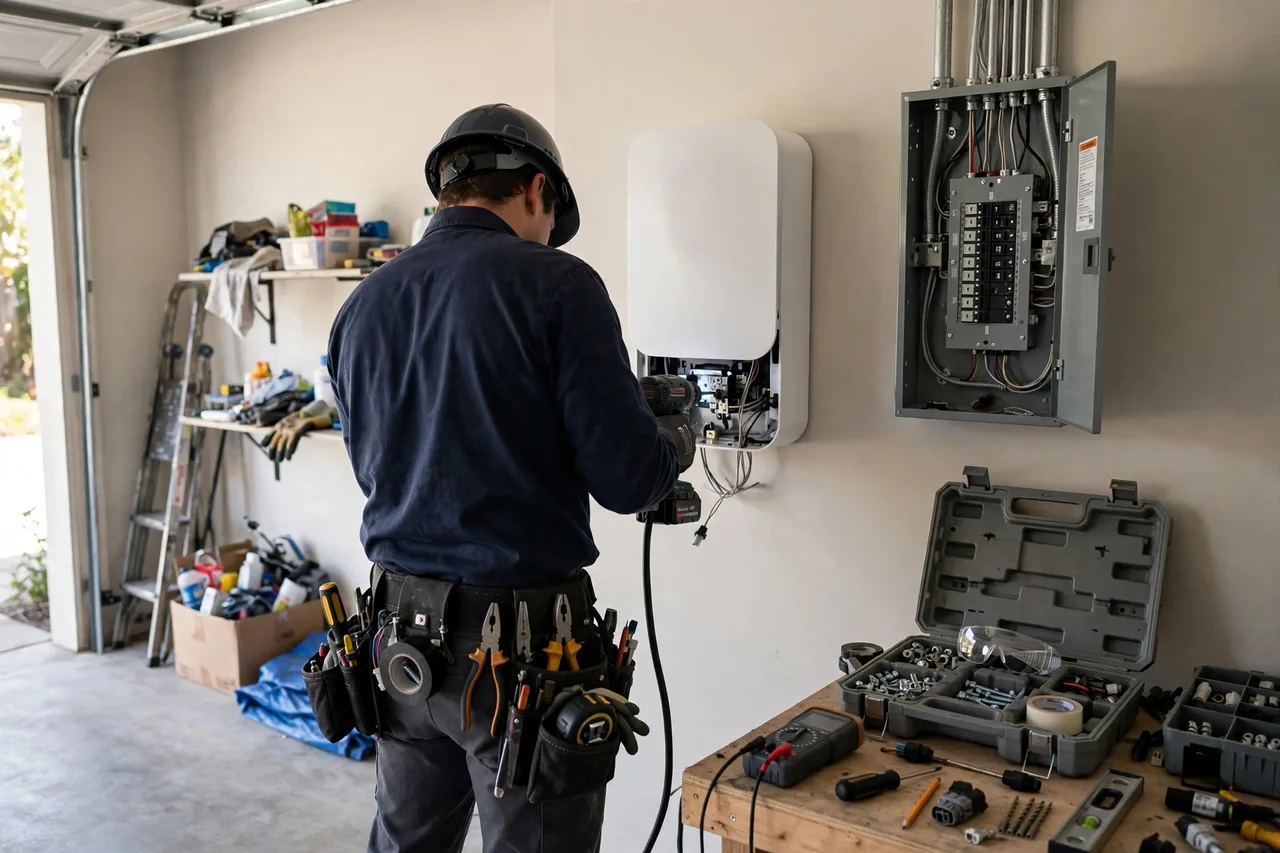
Installers in Spartanburg book the same ten services as everywhere — but not in the same proportions. The three leading cards below are this city's pattern, set by its panels, its buildings and its statute book.
Home EV Charger Installation in Spartanburg
The residential standard: a station where the car sleeps, on a circuit of its own, installed under permit. Variations are all local — the panel's spare room, the run's route through the house's fabric, and the parking pattern the cable has to serve.
In Spartanburg: the install Spartanburg's new EV households book first, and the one the rest of this page keeps returning to.
Dedicated Circuit & Electrical Panel Upgrade in Spartanburg
When the arithmetic says the service is full, this is the enabling job: a larger panel, or a new dedicated circuit with capacity planned in, done under the same permit umbrella as the charger it feeds. It is also the upgrade the rest of the house quietly benefits from for decades.
In Spartanburg: the capacity answer when Spartanburg's older panels meet a continuous load.
Level 2 Charger Installation in Spartanburg
What is being bought is time: the hours between arriving home and leaving again, converted into range at 240 volts. The conversion hardware is ordinary — breaker, conductor, station — and the design work is matching the three to the household's miles and the panel's arithmetic.
In Spartanburg: the upgrade from a wall outlet to a dedicated 240-volt circuit, and the end of range arithmetic at bedtime.
Utility programs and electricity in Spartanburg
Electricity in Spartanburg comes from Duke Energy Carolinas, LLC. Parts of the wider metro are served by Blue Ridge Electric Coop Inc, Laurens Electric Coop, Inc, Broad River Electric Coop, Inc. The utility matters twice over for a charger install: it sets the time-of-use rates that decide what overnight charging costs you, and it is the organisation that may — or may not — currently help pay for the equipment.
Rebate archaeology is a local sport: an old Duke Energy Carolinas, LLC program page, a neighbour's 2023 install story, a screenshot of terms nobody can date. The record for Spartanburg, as checked for this page, is simpler. The federal credit closed on September 30, 2025; South Carolina operates no home-charger program; and no active Duke Energy Carolinas, LLC residential charger rebate appears in current published sources. Funded rounds do reopen in this industry — on the utility's timetable, announced on the utility's site, and worth exactly what their published terms say on the day you read them.
One more utility habit worth copying from Spartanburg's EV owners: charge on the overnight rate window if your plan has one. The charger itself can usually be scheduled from the car or the station, so the habit costs nothing once it is set.
Condos, HOAs and the law in South Carolina
There is no South Carolina right-to-charge statute to lean on. Some national roundups list protection that does not exist in this state's code; the statute indexes checked for this page are clear. In Spartanburg, a condo or HOA charger is approved — or not — under the community's own documents, which makes the quality of your application the whole ballgame.
No law does not mean no path. Boards approve chargers every week when the proposal answers their real concerns in advance: a licensed installer, a dedicated circuit that touches nothing shared, metering that keeps the electricity cost on the owner, insurance, and a commitment to restore the space on removal. Bring that package, in writing, before the meeting — not during it.
Our condo and HOA guide covers both kinds of state; in Spartanburg the chapters on complete applications and cost allocation are the operative ones.
Climate, garages and charger placement
Thermal habits separate durable installs from tired ones in this region: connectors holstered out of the sun, enclosures with room to breathe, and charge sessions pushed past midnight when the air gives the equipment its easiest working conditions of the day.
Shade structures — carports, pergolas, the live-oak side of the lot — are charging infrastructure in a hot climate whether they were built as such or not. A car that starts the session twenty degrees cooler spends its first charging hour on energy rather than on cooling itself.

Permits and inspection in Spartanburg
Inspection day itself is undramatic by design: access to the panel and the station, the calculation on hand, the equipment's settings matching the circuit. Jobs fail inspection on paperwork mismatches far more often than on wiring — a fact that quietly grades installers.

Neighbourhoods and ZIP codes served
The page covers 8 ZIP codes in and around Spartanburg — including 29301, 29302, 29303, 29304, 29305, 29306, 29307, 29319 — across Spartanburg. If your ZIP is not in the first set shown, ask anyway: installer coverage follows the metro, not a postcode fence.
The same working area takes in the neighbouring localities of Arcadia, Una, Fairforest, White Stone, Drayton, Roebuck, Moore, Glendale, Wellford, Startex, Boiling Springs, Converse, Clifton, Duncan — the county ring an installer based in Spartanburg actually drives. Requests from those communities route exactly as city requests do: same services, same permit discipline, same local facts where they differ.
Spartanburg County accounts for 38 of the ZIP codes and 31 named postal localities in the research file, the nearest of them Arcadia, Una, Fairforest, White Stone, Drayton. The survey counts 347,852 residents in the county, with a median household income of $66,234 and a median home value of $233,300. Measured across its ZIP codes, the Spartanburg footprint runs about 6 miles north to south and 8 east to west, from ZIP 29301 to 29319 — the ground an installer based here actually covers in a working week.
Beyond the county seats, the working area takes in Arcadia, Una, Fairforest, White Stone, Drayton, Roebuck, Moore, Glendale, Wellford, Startex, Boiling Springs, Converse, Clifton, Duncan, Reidville, Inman, Lyman, Cowpens, Pacolet, Mayo, Pauline, Pacolet Mills, Woodruff, Gramling, Chesnee, Fingerville, Jonesville, Campobello, Gaffney, Enoree, Landrum, Harris, Buffalo, Cross Anchor, Mooresboro, Cliffside, Union, Henrietta, Tryon, Columbus, Lynn, Caroleen, Forest City, Blacksburg, Spindale, Ellenboro, Lockhart, Hickory Grove, Earl, Rutherfordton, Laurens, Lattimore, Clinton, Smyrna, Sharon, Grover, Shelby, Whitmire, Carlisle, Joanna, Kinards, Mountville, Chester — the named localities for which Spartanburg is the nearest metro in the network (neighbouring metros' pages cover their own ground), each routing to the same installer-matching service.
The wider working area also reaches Taylors, Mauldin, Travelers Rest, Mill Spring, Slater, Marietta, Tuxedo, Zirconia, Flat Rock, Pelzer, Easley, Cleveland, Bostic, Polkville, Union Mills, Hendersonville, Kings Mountain, Bat Cave, Cedar Mountain, Ware Shoals, Mc Connells, Pickens, York, Liberty, Mountain Home, Penrose, Honea Path, Lawndale, Fallston, Clover, Gerton, Rock Hill, Etowah, Bowling Green, Pisgah Forest — ground shared with neighbouring metros, where installers cross the same county lines in both directions.
ZIP codes in that shared ground include 28016, 28018, 28150, 28169, 28710, 28718, 28726, 28727, 28731, 28735, 28742, 28746, 28756, 28758, 28760, 28773, 28784, 28790, 29601, 29602, 29603, 29605, 29607, 29610, 29611, 29612, 29614, 29615, 29616, 29635, 29642, 29645, 29654, 29662, 29671, 29681, 29692, 29710, 29731, 29733.
The largest communities in that working area after Spartanburg itself, by the GeoNames populated-place file: Gaffney (population 12,566), Laurens (population 9,166), Clinton (population 8,637), Boiling Springs (population 8,219), Union (population 8,045), Forest City (population 7,282), Valley Falls (population 6,299), Chester (population 5,486), Boiling Springs (population 4,674), Spindale (population 4,263), Rutherfordton (population 4,182), Woodruff (population 4,129), Southern Shops (population 3,767), Saxon (population 3,424), Lyman (population 3,423), Duncan (population 3,317), East Gaffney (population 3,085), Arcadia (population 2,634), Wellford (population 2,526), Landrum (population 2,493). Charging demand follows those populations — the subdivisions and town centres where the next driveways, and the next panels, are.
Union County reaches into the working area with 26,885 residents, a median household income of $41,621 and a median home value of $103,600; its localities on this page include Jonesville, Buffalo, Union, Lockhart. Cherokee County reaches into the working area with 56,647 residents, a median household income of $50,288 and a median home value of $142,000; its localities on this page include Gaffney, Blacksburg. Laurens County reaches into the working area with 68,666 residents, a median household income of $57,623 and a median home value of $170,600; its localities on this page include Laurens, Clinton, Joanna, Mountville. Newberry County reaches into the working area with 38,435 residents, a median household income of $61,780 and a median home value of $173,300; its localities on this page include Whitmire, Kinards.
| ZIP | Locality | County |
|---|---|---|
| 29301 | Spartanburg | Spartanburg |
| 29305 | Spartanburg | Spartanburg |
| 29319 | Spartanburg | Spartanburg |
| 29320 | Arcadia | Spartanburg |
| 29378 | Una | Spartanburg |
| 29336 | Fairforest | Spartanburg |
| 29386 | White Stone | Spartanburg |
| 29306 | Spartanburg | Spartanburg |
| 29333 | Drayton | Spartanburg |
| 29303 | Spartanburg | Spartanburg |
| 29376 | Roebuck | Spartanburg |
| 29304 | Spartanburg | Spartanburg |
| 29369 | Moore | Spartanburg |
| 29346 | Glendale | Spartanburg |
| 29385 | Wellford | Spartanburg |
| 29377 | Startex | Spartanburg |
| 29316 | Boiling Springs | Spartanburg |
| 29302 | Spartanburg | Spartanburg |
| 29307 | Spartanburg | Spartanburg |
| 29329 | Converse | Spartanburg |
| 29324 | Clifton | Spartanburg |
| 29334 | Duncan | Spartanburg |
| 29375 | Reidville | Spartanburg |
| 29349 | Inman | Spartanburg |
| 29365 | Lyman | Spartanburg |
| 29330 | Cowpens | Spartanburg |
| 29372 | Pacolet | Spartanburg |
| 29368 | Mayo | Spartanburg |
| 29374 | Pauline | Spartanburg |
| 29373 | Pacolet Mills | Spartanburg |
| 29388 | Woodruff | Spartanburg |
| 29348 | Gramling | Spartanburg |
| 29323 | Chesnee | Spartanburg |
| 29338 | Fingerville | Spartanburg |
| 29395 | Jonesville | Union |
| 29322 | Campobello | Spartanburg |
| 29342 | Gaffney | Cherokee |
| 29341 | Gaffney | Cherokee |
| 29335 | Enoree | Spartanburg |
| 29340 | Gaffney | Cherokee |
| 29353 | Jonesville | Union |
| 29356 | Landrum | Spartanburg |
| 28074 | Harris | Rutherford |
| 29321 | Buffalo | Union |
| 29331 | Cross Anchor | Spartanburg |
| 28114 | Mooresboro | Cleveland |
| 28024 | Cliffside | Rutherford |
| 29379 | Union | Union |
| 28076 | Henrietta | Rutherford |
| 28782 | Tryon | Polk |
| 28722 | Columbus | Polk |
| 28750 | Lynn | Polk |
| 28019 | Caroleen | Rutherford |
| 28017 | Boiling Springs | Cleveland |
| 28043 | Forest City | Rutherford |
| 29702 | Blacksburg | Cherokee |
| 28160 | Spindale | Rutherford |
| 28040 | Ellenboro | Rutherford |
| 29364 | Lockhart | Union |
| 29717 | Hickory Grove | York |
| 28038 | Earl | Cleveland |
| 28139 | Rutherfordton | Rutherford |
| 29360 | Laurens | Laurens |
| 28089 | Lattimore | Cleveland |
| 29325 | Clinton | Laurens |
| 29743 | Smyrna | York |
| 29742 | Sharon | York |
| 28073 | Grover | Cleveland |
| 28152 | Shelby | Cleveland |
| 29178 | Whitmire | Newberry |
| 29031 | Carlisle | Union |
| 29351 | Joanna | Laurens |
| 29355 | Kinards | Newberry |
| 29370 | Mountville | Laurens |
| 29706 | Chester | Chester |

Planning the install: from panel to parking
Two decisions shape every Spartanburg install, and both are made before any equipment is ordered. The first is electrical: the load calculation that decides between a straight circuit, a panel upgrade and load management. The second is physical: where the station lives — which wall, which side of the car the charge port sits on, and whether the cable reaches a second vehicle or a future one. Installers in Spartanburg see the same housing patterns repeat street by street, which is why a ten-minute site visit produces a firmer quote than any online form: the form starts the conversation, the visit settles it.
Future-proofing, in this trade, is mostly conduit and capacity: an oversized conduit run costs little during the first install and everything later; a panel position reserved is a breaker that never has to move. If a second EV, a workshop or an electrified water heater is anywhere in your five-year picture, say so at the site visit.
Home charging know-how for Spartanburg households
Planning the second visit on the first
Nearly every install leaves a known future: a second car, a workshop circuit, a battery or a heat pump queuing for capacity. The first visit is when that future costs least to serve — conduit runs made while walls are open, panel positions reserved, the load study documented so the next calculation starts from evidence. Installers call it roughing in the future; households experience it, years later, as the second project that was mysteriously half done already.
Two kinds of protection, one circuit
Modern charging circuits sit at the meeting point of two protection philosophies: the breaker's ground-fault protection watching the circuit, and the station's own ground-fault and monitoring systems watching the session. Coordinating them is a specification task — which device leads, which breaker types the station manufacturer lists as compatible, whether the installation is hardwired or receptacle-fed. Done at design time, the two systems coexist silently for decades; done by trial, they announce themselves at 3 am.
Outdoor and carport positions
Plenty of charging happens without a garage at all — on driveway walls, posts and carports. The outdoor version of the job adds its own discipline: equipment listed for the exposure, an enclosure that sheds rather than traps water, cable reach checked against the car's real nose-in position, and protection from the ordinary impacts of a working driveway. A pedestal adds a foundation and a conduit approach below grade. None of it is exotic, and all of it is cheaper decided on paper than corrected in concrete.
Making the rate window automatic
Time-of-use tariffs reward households whose charging happens while the grid sleeps, and the reward compounds silently: every night, for the life of the car. The mechanism is trivial — a schedule set in the vehicle or the station — but the details decide whether it survives contact with real life: the window must fit the household's latest departure, the schedule must yield gracefully on the nights the car comes home empty, and the settings must live somewhere the household can find them again. Set it up at commissioning, with the installer, and the saving becomes infrastructure rather than intention.

Frequently asked questions
What happened to the federal home-charger credit in Spartanburg, SC?
That credit is finished: 30C ended on September 30, 2025. What about locally? In the utility and state sources checked for this page, nothing verified was running for Spartanburg homeowners — no Duke Energy Carolinas, LLC rebate, no state scheme. If one opens, it will appear on the utility's site with dates; plan your install without it meanwhile.
Can my HOA or condo board in Spartanburg, SC refuse my charger?
They hold the stronger hand in South Carolina: with no right-to-charge statute on the books, a Spartanburg association's covenants are the law of the car park. The applications that succeed anyway share a shape — owner-funded, licensed installer, metered energy, insured, reversible — because they answer the board's risk questions in advance and in writing.
Panel upgrade or not — how do Spartanburg, SC homeowners find out?
The answer lives in your panel's directory and its arithmetic, not in the car's requirements. With 68% of Spartanburg's homes predating 1980 (median build 1968), local installers see both situations weekly: the 200-amp panel that takes the circuit directly, and the full 100-amp service that needs capacity work first. The site visit exists to sort your house into one of those two piles, on numbers.
How quickly will a Level 2 charger fill my car in Spartanburg, SC?
Think of it in parked hours. Level 1 gives you back 3–5 miles for each of them; Level 2 gives back about 25–40, set by the circuit's amperage and what the car can accept. Overnight, that is the gap between 'enough for tomorrow' and 'full, every morning'.
What happens next after I send a request?
Your request — service, Spartanburg ZIP, property type and timing — goes to licensed local installers who cover Spartanburg. They contact you directly to arrange a site visit and quote. PlugReady USA is the matching service, not the installer, and the sections above exist so you can judge any quote against the local facts.
Do installers cover the communities around Spartanburg, SC?
They do. Coverage follows the metro: Arcadia, Una, Fairforest, White Stone, Drayton and their neighbouring communities are worked by the same installers who cover Spartanburg itself, and a request from those ZIP codes routes identically — service, property type and timing are all the form asks for.
Nearby cities in South Carolina
- EV charger installation in Greenville — about 25 miles from Spartanburg, metro population 975,000
- EV charger installation in Columbia — about 83 miles from Spartanburg, metro population 850,000
- EV charger installation in Sumter — about 113 miles from Spartanburg, metro population 110,000
- EV charger installation in Florence — about 132 miles from Spartanburg, metro population 200,000
- EV charger installation in Charleston — about 186 miles from Spartanburg, metro population 825,000
- EV charger installation in Myrtle Beach — about 192 miles from Spartanburg, metro population 550,000
- EV charger installation in Asheville, NC — about 56 miles from Spartanburg, metro population 470,000
- EV charger installation in Hickory, NC — about 67 miles from Spartanburg, metro population 370,000
- EV charger installation in Charlotte, NC — about 68 miles from Spartanburg, metro population 2,900,000
Ready to charge at home in Spartanburg?
Send the essentials — what you need, where, and what kind of property — and a licensed local installer will pick it up from there.