EV Charger Installation in Asheville, NC
Charging where you park, in Asheville: the utility programs, state law, permit process and housing facts behind a home charger install, gathered in one place.
Every home charger installation is the same four decisions wearing local clothes: capacity in the panel, a route for the circuit, a position for the station, and paperwork that proves it was done properly. What changes from city to city is the content of those decisions — and in Asheville the content is specific. Asheville itself is home to about 94,983 people. North Carolina's registered fleet stood at 121,000 battery-electric vehicles and 35,500 plug-in hybrids at the end of 2025, and this page works through the local version of each decision: your utility and its programs, your state's association law, your permit counter, and your housing stock's electrical habits.
How PlugReady USA works, in one breath: you describe the job once, licensed local installers who cover Asheville receive it, and the conversations happen with them directly. The rest of this page exists so those conversations start from facts — yours about the house, ours about the metro — rather than from a sales script.
The demand picture for the Asheville metro, from the registration data this site is built on: Duke territory; affluent retiree/tech mix. Registration counts are the honest way to size a charging market — they count households, not headlines — and they are why Asheville sits where it does in our build order (rank 112 of 300 metros, Tier C).
Three percentages describe the working conditions for charging in Asheville: 55% owner-occupied, 54% single-unit detached, and a median household income of $78,996 standing behind both. Everything in the sections below — panels, permissions, metering — is commentary on those proportions.

The composite picture matters more than any single statistic. In Asheville: an older housing fabric, where panel archaeology is a normal part of the first visit; a detached-house majority with a real attached and multifamily minority; buildings of five or more units hold a substantial share of homes, which keeps the multifamily sections of this page in daily use; meanwhile, owners hold a working majority, with renters a significant minority. A page that ignored that profile would give the same advice everywhere; this one is ordered by it.
Keep six figures and you keep Asheville's whole electrical character: 54,967 housing units; 38,210 occupied homes; 21,008 owner-occupied; 29,455 detached houses; 25,472 pre-1980 homes; 17,448 homes in buildings of five or more units. Percentages elsewhere on this page are these numbers in disguise — the counts are the originals, and they are the numbers a local installer's experience is actually made of. The page's geography is equally concrete: 11 ZIP codes across Buncombe, centred near 35.60 degrees north latitude. The city anchors the Asheville metropolitan area, home to roughly 470,000 people on the research file's metro estimate — the wider labour and housing market this page's installers work across.
The same survey release fills in the household economics around the housing stock: a median home value of $440,000, median gross rent of $1,402, per-capita income of $45,430, and a median resident age of 41. And the daily rhythms behind the housing numbers: 66% of Asheville workers drive to work alone — the commute pattern home charging is built around; 20% work from home, a population whose cars charge on daytime and overnight schedules alike; 1% commute by public transit; 53% of adults hold a bachelor's degree or higher. The survey's vehicle table is the one an EV page should quote first: 2,659 of Asheville's households have no vehicle at all, while 20,667 have two or more — the multi-car households for whom the second circuit is a when, not an if.
The cost-burden lines say who feels housing costs most in Asheville: 51% of renters spend 30% or more of income on rent, and 0% of owners with mortgages spend the same share on housing costs. Family households are 53% of all households — the two-car, school-run demographic whose charging patterns this page's planning sections keep circling back to.
This is the context an installer works against, whether it is written down or not. A stock this old wires its history into the walls: cloth-wrapped conductors in the deepest streets, fuse boxes that outlived their century, panels added in layers by generations of electricians each solving their own decade's problem. The renter-and-condo share makes the law section of this page load-bearing: statutory rights, application windows and metering rules are not fine print here, they are the project's first phase.
Neither renter-heavy nor owner-dominated, the market rewards installers who can work both sides of the tenure line: the domestic circuit and the negotiated one. The specification pattern at this income band is disciplined: capacity for today's car and a conduit sized for tomorrow's, the upgrade deferred until the load calculation insists. The regulatory calendar is the programme calendar: rate cases, electrification plans and pilot approvals move through the commission on public timetables, and installers plan their marketing around them.
The state fleet is well past the early-adopter chapter: dealer lots, workplace car parks and school runs all show it, and the installer market has professionalised in response. A smaller metro runs on relationships: the electrical firms are few, known, and booked through reputations maintained across decades of local work. Boards here decide without a statutory script, which makes precedent the currency: the first well-built application in a community quietly writes the policy for everyone after it.
The electrical reality in Asheville homes
Asheville's housing, in Census Bureau survey numbers: a median build year of 1984, 46% of units predating 1980, a stock that is 54% single-unit detached, and 55% of occupied homes owned by their occupants. Everything in this section is commentary on those four facts. A housing stock this age leans on smaller electrical services — 100-amp panels are common, and fuse-era equipment still turns up in the oldest streets. For many of those homes the honest answer is a panel upgrade or a load-management device before the charger circuit goes in, and a good installer will show you the load calculation rather than asking you to take it on faith. Garages here earn their keep across the year — workshop, storage and storm shelter by turns — so a station position that survives the household's real parking pattern matters more than the technically neatest wall.
The fuel table adds one more local fact: 25,609 Asheville homes — 67% of the stock — heat with electricity. Those households already think in kilowatts through the winter, their panels carry the load to prove it, and a charger's overnight appetite joins a system that is, in the useful sense, already electrified.
Renters are the other constituency in these numbers: about 17,202 of Asheville's occupied homes are rented rather than owned. Their charging route runs through a landlord conversation instead of a panel they control — a different project, covered by the rentals guide and the law section below, but a routine one in a city with this many renting households.
The city's stock is not all houses: 32% of units are in structures of five or more. Shared buildings mean shared panels, assigned parking and association process — the substance of the multifamily sections below.
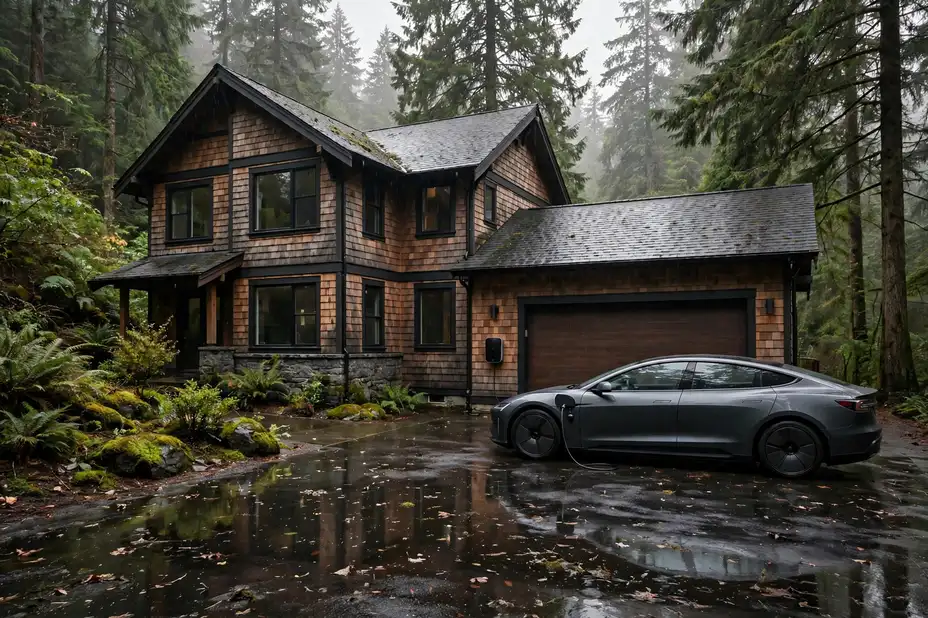
EV charging services in Asheville
The full menu runs to ten services; the three cards at the top are the ones Asheville's housing stock and state law push to the front. Everything links to its national service page for scope and process in full.
Home EV Charger Installation in Asheville
One circuit, one station, one inspection: the residential install in its usual form. An installer sizes the circuit to the household's driving, mounts the station where the cable reaches the port without drama, sets its output to the circuit it landed on, and leaves the paperwork filed with the house.
In Asheville: the core residential job in Asheville: circuit, mounting, configuration and inspection in one visit pattern.
Dedicated Circuit & Electrical Panel Upgrade in Asheville
Some homes meet the charger at the panel door: the service is already spoken for by cooking, heating and hot water. This service is the honest fix — capacity added properly, grounding brought current, and a panel schedule that finally matches the house it feeds.
In Asheville: the capacity answer when Asheville's older panels meet a continuous load.
Level 2 Charger Installation in Asheville
Level 2 earns its keep on the worst week of the year: the cold snap, the back-to-back long days, the evening the car comes home empty with a dawn departure. A circuit sized for those weeks makes the ordinary ones invisible.
In Asheville: the 240-volt step that turns overnight charging in Asheville from a trickle into a full battery by morning.
Utility programs and electricity in Asheville
Electricity in Asheville comes from Duke Energy Carolinas, LLC. Parts of the wider metro are served by Duke Energy Progress, French Broad Elec Member Corp, Haywood Electric Member Corp. The utility matters twice over for a charger install: it sets the time-of-use rates that decide what overnight charging costs you, and it is the organisation that may — or may not — currently help pay for the equipment.
No verified residential charger rebate was in place for Duke Energy Carolinas, LLC in the sources checked for this page (the federal Alternative Fuel Refueling Property Credit ended on September 30, 2025, and no North Carolina state program replaced it for typical home installs). That can change — utilities open and close funded rounds — so an installer quoting you today should be able to name any current program precisely, with its published terms. If they cannot name it, it is not part of your job.
Before the install, it is worth a two-minute look at your tariff. Many Duke Energy Carolinas, LLC customers can move to a time-of-use plan where overnight energy is charged at a lower rate, and a scheduled charger makes that saving automatic.
Condos, HOAs and the law in North Carolina
There is no North Carolina right-to-charge statute to lean on. Some national roundups list protection that does not exist in this state's code; the statute indexes checked for this page are clear. In Asheville, a condo or HOA charger is approved — or not — under the community's own documents, which makes the quality of your application the whole ballgame.
If the board says no, ask for the refusal in writing with the covenant cited. Rules change — several states added right-to-charge laws in 2025 alone — and a documented refusal is what a future rule change, or a future board, works from.
For the full playbook — application contents, metering designs, the questions boards ask — see the condo and HOA charging guide. In Asheville it should be read as a negotiation manual, because negotiation is what the absence of a statute leaves you.
Climate, garages and charger placement
Coastal charging inherits the coast's oldest rule — everything metal near salt water is on a clock. Listed outdoor equipment, stainless fixings, sealed entries: the specification is short, and local installers recite it from memory.
Coastal weather also argues for the short version of every run — fewer exterior junction points, conduit sealed properly, and a station position that storm water does not visit. The electrical design is the same as anywhere; the corrosion discipline is what this coastline adds to it, and local installers carry it as routine.

Permits and inspection in Asheville
The permit trail also protects the next transaction: a charger circuit on the inspection record is an asset a buyer's inspector reads in one line, while an undocumented circuit is a question that follows the sale. Installers who work this metro treat the filing as part of the deliverable, not an errand.

Neighbourhoods and ZIP codes served
The page covers 11 ZIP codes in and around Asheville — including 28801, 28802, 28803, 28804, 28805, 28806, 28810, 28813, 28814, 28815, 28816 — across Buncombe. If your ZIP is not in the first set shown, ask anyway: installer coverage follows the metro, not a postcode fence.
The same working area takes in the neighbouring localities of Weaverville, Skyland, Swannanoa, Alexander, Candler, Leicester, Arden, Fairview, Enka, Barnardsville, Montreat, Ridgecrest, Mills River, Black Mountain — the county ring an installer based in Asheville actually drives. Requests from those communities route exactly as city requests do: same services, same permit discipline, same local facts where they differ.
Buncombe County accounts for 25 of the ZIP codes and 15 named postal localities in the research file, the nearest of them Weaverville, Skyland, Swannanoa, Alexander, Candler. The survey counts 274,360 residents in the county, with a median household income of $74,436 and a median home value of $391,800. Measured across its ZIP codes, the Asheville footprint runs about 11 miles north to south and 10 east to west, from ZIP 28801 to 28816 — the ground an installer based here actually covers in a working week.
Beyond the county seats, the working area takes in Weaverville, Skyland, Swannanoa, Alexander, Candler, Leicester, Arden, Fairview, Fletcher, Enka, Barnardsville, Montreat, Gerton, Ridgecrest, Mills River, Black Mountain, Naples, Mountain Home, Canton, Hendersonville, Horse Shoe, Mars Hill, Bat Cave, Edneyville, Etowah, Marshall, Clyde, Chimney Rock, Dana, Old Fort, Flat Rock, East Flat Rock, Waynesville, Lake Junaluska, Lake Lure, Hot Springs, Penrose, Pisgah Forest, Burnsville, Hazelwood, Brevard, Mill Spring, Micaville, Glenwood, Maggie Valley, Marion, Balsam Grove, Little Switzerland, Balsam, Del Rio, Union Mills, Hartford, Tuckasegee, Sylva, Parrottsville, Webster, Glenville, Cullowhee, Whittier, Dillsboro, Cherokee — the named localities for which Asheville is the nearest metro in the network (neighbouring metros' pages cover their own ground), each routing to the same installer-matching service.
The wider working area also reaches Tuxedo, Saluda, Flag Pond, Lynn, Columbus, Tryon, Green Mountain, Penland, Spruce Pine, Rosman, Rutherfordton, Landrum, Nebo, Bakersville, Cleveland, Lake Toxaway, Erwin, Spindale, Johnson City, Slater, Cosby, Greeneville, Campobello, Travelers Rest, Linville Falls, Gramling, Newport, Plumtree, Glen Alpine, Unicoi, Fingerville, Sapphire, Afton, Telford, Jonas Ridge — ground shared with neighbouring metros, where installers cross the same county lines in both directions.
ZIP codes in that shared ground include 28018, 28043, 28139, 28160, 28628, 28641, 28647, 28664, 28705, 28718, 28722, 28740, 28750, 28761, 28765, 28772, 28773, 28774, 28777, 28782, 28790, 29322, 29338, 29348, 29635, 29661, 29683, 29688, 29690, 37614, 37616, 37650, 37657, 37690, 37692, 37722, 37743, 37744, 37821, 37822.
The largest communities in that working area after Asheville itself, by the GeoNames populated-place file: Hendersonville (population 13,814), Waynesville (population 9,809), Black Mountain (population 8,278), Marion (population 7,861), Brevard (population 7,735), Fletcher (population 7,582), Mills River (population 7,162), Etowah (population 6,944). Charging demand follows those populations — the subdivisions and town centres where the next driveways, and the next panels, are.
Henderson County reaches into the working area with 118,484 residents, a median household income of $68,187 and a median home value of $351,400; its localities on this page include Fletcher, Gerton, Naples, Mountain Home, Hendersonville. Jackson County reaches into the working area with 43,771 residents, a median household income of $55,815 and a median home value of $284,700; its localities on this page include Balsam, Tuckasegee, Sylva, Webster, Glenville. Haywood County reaches into the working area with 62,662 residents, a median household income of $61,912 and a median home value of $279,200; its localities on this page include Canton, Clyde, Waynesville, Lake Junaluska.
| ZIP | Locality | County |
|---|---|---|
| 28801 | Asheville | Buncombe |
| 28810 | Asheville | Buncombe |
| 28815 | Asheville | Buncombe |
| 28816 | Asheville | Buncombe |
| 28804 | Asheville | Buncombe |
| 28806 | Asheville | Buncombe |
| 28805 | Asheville | Buncombe |
| 28803 | Asheville | Buncombe |
| 28814 | Asheville | Buncombe |
| 28802 | Asheville | Buncombe |
| 28813 | Asheville | Buncombe |
| 28787 | Weaverville | Buncombe |
| 28776 | Skyland | Buncombe |
| 28778 | Swannanoa | Buncombe |
| 28701 | Alexander | Buncombe |
| 28715 | Candler | Buncombe |
| 28748 | Leicester | Buncombe |
| 28704 | Arden | Buncombe |
| 28730 | Fairview | Buncombe |
| 28732 | Fletcher | Henderson |
| 28728 | Enka | Buncombe |
| 28709 | Barnardsville | Buncombe |
| 28757 | Montreat | Buncombe |
| 28735 | Gerton | Henderson |
| 28770 | Ridgecrest | Buncombe |
| 28759 | Mills River | Buncombe |
| 28711 | Black Mountain | Buncombe |
| 28760 | Naples | Henderson |
| 28758 | Mountain Home | Henderson |
| 28716 | Canton | Haywood |
| 28791 | Hendersonville | Henderson |
| 28742 | Horse Shoe | Henderson |
| 28754 | Mars Hill | Madison |
| 28792 | Hendersonville | Henderson |
| 28710 | Bat Cave | Henderson |
| 28727 | Edneyville | Henderson |
| 28739 | Hendersonville | Henderson |
| 28729 | Etowah | Henderson |
| 28753 | Marshall | Madison |
| 28721 | Clyde | Haywood |
| 28720 | Chimney Rock | Rutherford |
| 28724 | Dana | Henderson |
| 28793 | Hendersonville | Henderson |
| 28762 | Old Fort | McDowell |
| 28731 | Flat Rock | Henderson |
| 28726 | East Flat Rock | Henderson |
| 28785 | Waynesville | Haywood |
| 28745 | Lake Junaluska | Haywood |
| 28746 | Lake Lure | Rutherford |
| 28743 | Hot Springs | Madison |
| 28766 | Penrose | Transylvania |
| 28768 | Pisgah Forest | Transylvania |
| 28786 | Waynesville | Haywood |
| 28714 | Burnsville | Yancey |
| 28738 | Hazelwood | Haywood |
| 28712 | Brevard | Transylvania |
| 28756 | Mill Spring | Polk |
| 28755 | Micaville | Yancey |
| 28737 | Glenwood | McDowell |
| 28751 | Maggie Valley | Haywood |
| 28752 | Marion | McDowell |
| 28708 | Balsam Grove | Transylvania |
| 28749 | Little Switzerland | McDowell |
| 28707 | Balsam | Jackson |
| 37727 | Del Rio | Cocke |
| 28167 | Union Mills | Rutherford |
| 37753 | Hartford | Cocke |
| 28783 | Tuckasegee | Jackson |
| 28779 | Sylva | Jackson |
| 37843 | Parrottsville | Cocke |
| 28788 | Webster | Jackson |
| 28736 | Glenville | Jackson |
| 28723 | Cullowhee | Jackson |
| 28789 | Whittier | Jackson |
| 28725 | Dillsboro | Jackson |
| 28719 | Cherokee | Swain |

Planning the install: from panel to parking
The order of operations protects you. Load calculation before equipment choice, because the circuit sizes the station's settings. Route before purchase, because reach decides models. Permit before work, because inspection closes the file the insurer will one day read. In Asheville the sequence is the same as everywhere — what varies is only how much of it your particular house asks for, and finding that out is the site visit's entire purpose.
One more piece of sequencing advice Asheville installers give consistently: if the panel is being opened anyway, settle the other electrical maybes in the same visit — the circuit you will want next year costs least while the permit and the electrician are already in the house.
Home charging know-how for Asheville households
Two kinds of protection, one circuit
Modern charging circuits sit at the meeting point of two protection philosophies: the breaker's ground-fault protection watching the circuit, and the station's own ground-fault and monitoring systems watching the session. Coordinating them is a specification task — which device leads, which breaker types the station manufacturer lists as compatible, whether the installation is hardwired or receptacle-fed. Done at design time, the two systems coexist silently for decades; done by trial, they announce themselves at 3 am.
Charging with an accessory dwelling
Houses with a second unit — a garage apartment, a granny flat, a rented studio — add a cast member to the charging design: another household. The questions multiply politely. Whose panel carries the circuit? Whose meter records the energy? Does the tenancy agreement mention the charger at all? None are hard questions, and all are cheaper answered at design time than at the first shared bill. Where the second unit has its own meter and panel, the design is simply two small domestic installs sharing an address.
The autumn checklist
Households in seasonal country develop a small autumn ritual around the charger: the connector and holster checked before the weather turns, the cable's route confirmed clear of the snow-storage corner and the plough's line, the schedule revisited against winter tariffs and winter range. Ten minutes, once a year, timed with the rest of the house's changeover. It belongs to the same family as the inspection file — the unglamorous habits that make an installation feel, five winters later, like it was designed by someone who had met the climate before.
Etiquette for shared stations
Shared stations run on norms before they run on rules. The norms that work: move the car when the session ends, coil the cable for the next driver, report a fault rather than stepping over it, and never unplug a stranger's session except under the building's posted arrangement. Buildings formalise this gradually — a group message thread, a simple rota in high season — and the households that start with courtesy rarely need the formal version. The equipment is shared; so is the goodwill it runs on.

Frequently asked questions
Can I still get the federal tax credit for a home charger in Asheville, NC?
Treat the answer as a standing no with a watching brief. The 30C credit is finished, North Carolina has not replaced it for homeowners, and no verified Duke Energy Carolinas, LLC rebate was running in the sources checked for this page. Should that change, the utility's program page will say so first — and this page will be updated to match.
Can my HOA or condo board in Asheville, NC refuse my charger?
Possibly, yes. North Carolina has no statewide right-to-charge law in the authoritative indexes checked for this page, so your community's covenants govern. A complete written application — licensed installer, dedicated circuit, owner-paid metering and insurance — is the approach that gets approvals here.
Does a Level 2 charger mean a panel upgrade for a Asheville, NC home?
Start from the median, then verify: the median Asheville home was built in 1984, and 46% of the stock predates 1980, so 100-amp panels are a normal sight here — and a normal candidate for either an upgrade or a load-management device. The load calculation distinguishes the two in one visit, and any quote that skips it is guessing with your money.
How quickly will a Level 2 charger fill my car in Asheville, NC?
In parked hours: a Level 1 cord returns about 3–5 miles for each of them, and a Level 2 circuit returns roughly 25–40, set by its amperage and the car's acceptance. For a Asheville household parking ten hours, that is the difference between recovering a short errand day and recovering any day the car can legally drive.
What happens after I request an installer through this page?
Your request — service, Asheville ZIP, property type and timing — goes to licensed local installers who cover Asheville. They contact you directly to arrange a site visit and quote. PlugReady USA is the matching service, not the installer, and the sections above exist so you can judge any quote against the local facts.
How long does a typical home charger installation take in Asheville, NC?
Plan on a day of electrical work for the standard layout, plus the permit and inspection appointments that bracket it on the city's calendar. Capacity work — an upgrade or a subpanel — extends the electrical day; approvals in a condo or HOA extend the calendar, not the tools. Your site visit ends with all three durations stated separately.
Nearby cities in North Carolina
- EV charger installation in Hickory — about 69 miles from Asheville, metro population 370,000
- EV charger installation in Charlotte — about 99 miles from Asheville, metro population 2,900,000
- EV charger installation in Winston-Salem — about 133 miles from Asheville, metro population 700,000
- EV charger installation in Greensboro — about 157 miles from Asheville, metro population 800,000
- EV charger installation in Durham — about 204 miles from Asheville, metro population 600,000
- EV charger installation in Fayetteville — about 206 miles from Asheville, metro population 525,000
- EV charger installation in Johnson City, TN — about 52 miles from Asheville, metro population 210,000
- EV charger installation in Greenville, SC — about 52 miles from Asheville, metro population 975,000
- EV charger installation in Spartanburg, SC — about 56 miles from Asheville, metro population 355,000
Ready to charge at home in Asheville?
Two minutes of form, and the request is in front of licensed installers who cover this city — quotes follow site visits, in writing.