EV Charger Installation in Fayetteville, NC
Charging where you park, in Fayetteville: the utility programs, state law, permit process and housing facts behind a home charger install, gathered in one place.
Charging at home is the version of EV ownership that actually works day to day, and in Fayetteville it starts with a straightforward question: where will the car sleep, and what can the electrical panel behind that wall honestly support? Fayetteville itself is home to about 209,485 people, and 121,000 battery-electric vehicles plus 35,500 plug-in hybrids were registered across North Carolina by the end of 2025 — every one of them a household that charges somewhere. This page gathers what a homeowner in Fayetteville needs to know before booking an installer: the local utility and its current charger programs, the state law that applies in condos and HOA communities, the permit process, and the housing realities that decide how simple or involved an installation will be.
How this page is organised matters less than what is in it: verified local facts, stated with their sources, so you can check them yourself. PlugReady USA matches homeowners in Fayetteville with licensed local installers; the detail below is the homework we would want done before anyone quotes the job.
What the Experian and AFDC registration data say about Fayetteville: NC No. 4 cluster. Translated out of market language: your neighbours are already charging at home, the permit office already knows the paperwork, and the installers already know the housing stock.
Three survey lines do most of the predictive work on this page. Income — a median of $54,562 per household — tracks the pace at which Fayetteville households adopt EVs at all. Tenure — 52% owner-occupied — decides whose signature the work needs. And structure — 63% single-unit detached — decides how often the answer is a simple garage circuit rather than a building negotiation.

Every city charges differently, and Fayetteville's difference is legible in the data: a housing stock of mixed vintages, where both electrical eras appear on the same street; a detached-house majority with a real attached and multifamily minority; buildings of five or more units hold a substantial share of homes, which keeps the multifamily sections of this page in daily use; owners hold a working majority, with renters a significant minority. Read the sections below through that profile and the local advice resolves into specifics — which questions are routine here, and which are rare.
In absolute terms, the survey counts 93,506 housing units in Fayetteville — 83,705 occupied, 43,295 of them by their owners. The stock resolves into 58,785 single-unit detached houses, 40,420 homes standing since before 1980, and 21,925 units in larger buildings. Those six counts are the city's charging map drawn without percentages, and every section of this page is a consequence of one of them. The page's geography is equally concrete: 10 ZIP codes across Cumberland, centred near 35.07 degrees north latitude. The city anchors the Fayetteville metropolitan area, home to roughly 525,000 people on the research file's metro estimate — the wider labour and housing market this page's installers work across.
The same survey release fills in the household economics around the housing stock: a median home value of $211,300, median gross rent of $1,372, per-capita income of $32,096, and a median resident age of 31. The movement data matters as much as the money data: 71% of Fayetteville workers drive to work alone — the commute pattern home charging is built around; 8% work from home, a population whose cars charge on daytime and overnight schedules alike; 1% commute by public transit; 28% of adults hold a bachelor's degree or higher. Vehicle ownership, from the same release: 41,552 households in Fayetteville run two or more vehicles, and 6,877 run none — the two ends of the market this page serves and does not serve.
The cost-burden lines say who feels housing costs most in Fayetteville: 60% of renters spend 30% or more of income on rent, and 0% of owners with mortgages spend the same share on housing costs. Family households are 59% of all households — the two-car, school-run demographic whose charging patterns this page's planning sections keep circling back to.
The signature matters because installs follow it, street by street. The building booms left their fingerprints in the panel stock — each era's standard service size still legible in the directory cards of its streets. Mixed form means mixed timelines: a homeowner's install is a fortnight's scheduling, a condo's is a season's governance; the metro's charging growth arrives on both clocks at once.
High renter share also means charging follows the lease cycle: applications cluster at move-in, installations at renewal leverage, and the whole market breathes on the rental calendar. At this income band the phantom-rebate problem bites hardest, which is why this page states the verified incentive position in plain terms and dates it. Investor-owned utility territory runs on published tariffs and regulator-approved programmes: everything material about charging economics here exists in a filed document with an effective date, findable by anyone who reads filings.
The used-EV wave has arrived at this fleet scale, and it democratises the install question: households that bought electric second-hand, at family-car money, asking the same panel questions as the pioneers — with better local answers available. At this scale the city's charging infrastructure is legible — a household can learn the whole local system, its programmes, precedents and people, in an evening's reading. This page is most of that evening. Boards here decide without a statutory script, which makes precedent the currency: the first well-built application in a community quietly writes the policy for everyone after it.
The electrical reality in Fayetteville homes
Read the stock the way a panel schedule reads it. Median build year 1984 means half of Fayetteville's homes were wired to codes of that era or earlier; 43% predate 1980 entirely. 63% of units are detached houses, and 52% of occupied homes are owned by their occupants — so most charger conversations here happen between a homeowner and an electrician, with no third party at the table. The metro's building booms left two electrical eras side by side. Post-1990s subdivisions were wired for modern loads and usually take a charger circuit directly; the established in-town stock asks harder questions of its panels. Knowing which era your street belongs to tells you most of what your site visit will conclude. Porches, carports and parking pads carry a real share of this city's charging, because the stock predates the two-car garage as a standard feature — outdoor-rated equipment is a local staple, not an edge case.
Heating fuel is the survey's quiet clue to panel life: in Fayetteville, 72% of homes heat electrically (60,182 households), against 26% heating with gas. A house already heating electrically has a service sized with that load in its history; a gas-heated house may have capacity to spare — either way the fuel mix is part of what the installer is reading.
The tenure split cuts the other way too: roughly 40,410 occupied homes in Fayetteville are rented. For those households the charger question is a negotiation with a property owner — written proposal, licensed installer, metering clarity — and it succeeds often enough that installers here keep the pattern ready.
One more structural fact shapes Fayetteville's charging map: 23% of the city's housing units sit in buildings of five or more units. Those households cannot simply book a circuit — their charger runs through a building, a board and a shared electrical service, which is why the multifamily service and the law section below carry unusual weight on this page.
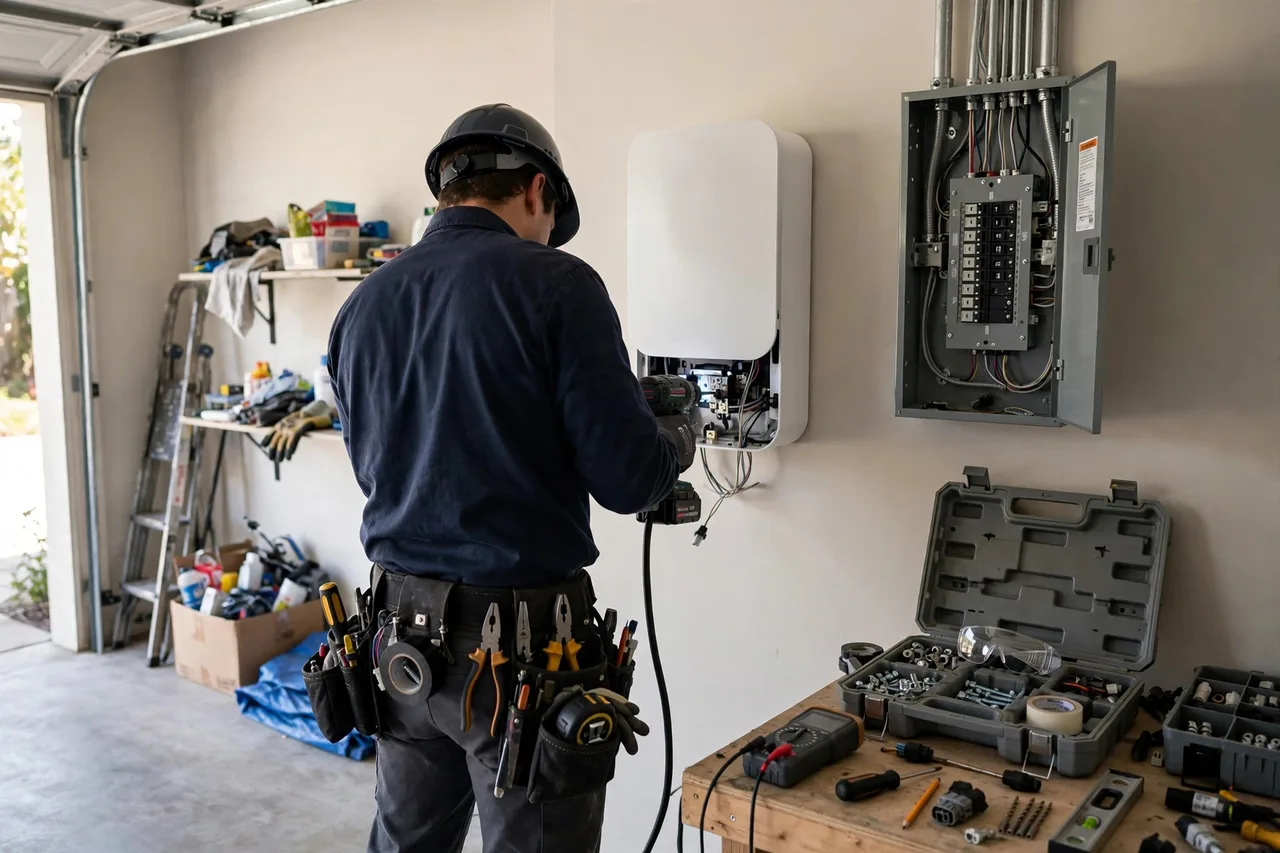
EV charging services in Fayetteville
An installer's work in Fayetteville usually starts with one of the three lead services below. The cards describe the job as it is actually scoped; the grid underneath carries the rest of the menu.
Home EV Charger Installation in Fayetteville
The core service, stated plainly: a dedicated 240-volt circuit run from your panel to your parking place, a station mounted and configured to that circuit, and the paperwork closed out with the permit office. Everything else in this section of the site exists to support or unblock this one job.
In Fayetteville: usually the first job a new EV household in Fayetteville books, scoped to the panel the house already has.
Dedicated Circuit & Electrical Panel Upgrade in Fayetteville
Capacity work wears three costumes — more amps, a fresh panel, or management electronics that make the existing amps behave like more. The load calculation is the fitting room: it shows which costume your house actually needs, and a trustworthy quote names the calculation before the costume.
In Fayetteville: the job that surfaces wherever housing is older — and Fayetteville's stock makes it a routine conversation, settled by a load calculation.
Level 2 Charger Installation in Fayetteville
Level 2 is where home charging becomes effortless: a dedicated 240-volt circuit returning a full battery overnight instead of a partial one by morning. The installer's work is the circuit itself — breaker, conductor, connection type — and the station's settings matched to it.
In Fayetteville: the 240-volt step that turns overnight charging in Fayetteville from a trickle into a full battery by morning.
Utility programs and electricity in Fayetteville
Electricity in Fayetteville comes from Duke Energy Progress. Parts of the wider metro are served by Virginia Electric & Power Co, Fayetteville Public Works Commission, Lumbee River Elec Member Corp. The utility matters twice over for a charger install: it sets the time-of-use rates that decide what overnight charging costs you, and it is the organisation that may — or may not — currently help pay for the equipment.
Rebate archaeology is a local sport: an old Duke Energy Progress program page, a neighbour's 2023 install story, a screenshot of terms nobody can date. The record for Fayetteville, as checked for this page, is simpler. The federal credit closed on September 30, 2025; North Carolina operates no home-charger program; and no active Duke Energy Progress residential charger rebate appears in current published sources. Funded rounds do reopen in this industry — on the utility's timetable, announced on the utility's site, and worth exactly what their published terms say on the day you read them.
Renters and condo owners should note the metering question early: whose meter the charger hangs off decides who pays for the energy, and Duke Energy Progress's options for submetering are part of the multifamily conversation below.
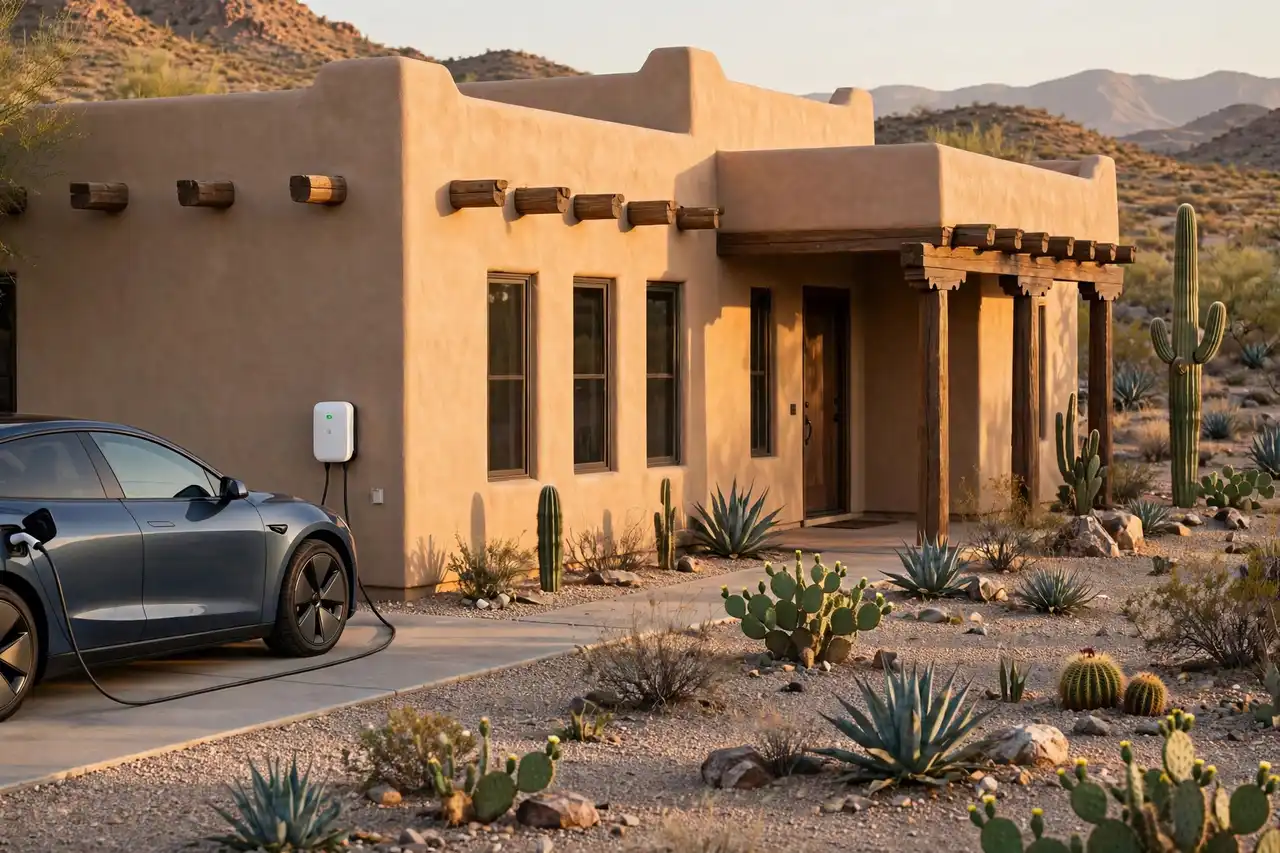
Condos, HOAs and the law in North Carolina
There is no North Carolina right-to-charge statute to lean on. Some national roundups list protection that does not exist in this state's code; the statute indexes checked for this page are clear. In Fayetteville, a condo or HOA charger is approved — or not — under the community's own documents, which makes the quality of your application the whole ballgame.
Timing helps too. Boards plan capital work annually; an application that arrives with the community's budget cycle, offering to coordinate with any planned electrical or repaving work, reads as a contribution rather than a demand.
Our condo and HOA guide covers both kinds of state; in Fayetteville the chapters on complete applications and cost allocation are the operative ones.
Climate, garages and charger placement
The marine layer writes the maintenance calendar: terminals inspected when the season turns, enclosures checked after the storm months, a cable whose jacket is rated for the ultraviolet that sea light carries even under cloud.
Storm preparation in coastal metros has a charging chapter: the car topped up ahead of a forecast landfall is the household's largest battery, and the station's breaker is labelled for the fast, safe isolation that post-storm inspection sometimes needs. Both habits cost nothing and are set at install time.

Permits and inspection in Fayetteville
If your install is part of a larger job — a panel upgrade, a garage build — the charger usually rides on the same permit set. Ask for the charger circuit to be listed explicitly so the inspection record shows it.

Neighbourhoods and ZIP codes served
The page covers 10 ZIP codes in and around Fayetteville — including 28301, 28302, 28303, 28304, 28305, 28306, 28309, 28311, 28312, 28314 — across Cumberland. If your ZIP is not in the first set shown, ask anyway: installer coverage follows the metro, not a postcode fence.
The same working area takes in the neighbouring localities of Pope Army Airfield, Fort Bragg, Cumberland, Hope Mills, Spring Lake, Wade, Stedman, Linden, Godwin, Falcon — the county ring an installer based in Fayetteville actually drives. Requests from those communities route exactly as city requests do: same services, same permit discipline, same local facts where they differ.
Cumberland County accounts for 21 of the ZIP codes and 11 named postal localities in the research file, the nearest of them Pope Army Airfield, Fort Bragg, Cumberland, Hope Mills, Spring Lake. The survey counts 338,545 residents in the county, with a median household income of $61,291 and a median home value of $199,200. Measured across its ZIP codes, the Fayetteville footprint runs about 12 miles north to south and 15 east to west, from ZIP 28301 to 28314 — the ground an installer based here actually covers in a working week.
Beyond the county seats, the working area takes in Pope Army Airfield, Fort Bragg, Cumberland, Hope Mills, Spring Lake, Wade, Stedman, Linden, Parkton, Godwin, Falcon, Autryville, Bunnlevel, Lumber Bridge, Lillington, Rex, Saint Pauls, Raeford, Shannon, Erwin, Roseboro, Dunn, Vass, Salemburg, White Oak, Tar Heel, Olivia, Mamers, Red Springs, Buies Creek, Broadway, Lakeview, Lemon Springs, Southern Pines, Sanford, Dublin, Cameron, Lumberton, Wagram, Newton Grove, Clinton, Aberdeen, Pembroke, Cumnock, Garland, Pinebluff, Carthage, Pinehurst, Maxton, Elizabethtown, Bladenboro, Hoffman, Turkey, West End, Laurinburg, Marston, Rowland, Laurel Hill, Clarkton, Faison, Proctorville, Calypso, Orrum, Mount Olive, Jackson Springs — the named localities for which Fayetteville is the nearest metro in the network (neighbouring metros' pages cover their own ground), each routing to the same installer-matching service.
The wider working area also reaches Coats, Kipling, Benson, Angier, Four Oaks, Willow Spring, Fuquay Varina, Holly Springs, Moncure, Gulf, New Hill, Smithfield, Goldston, Highfalls, Fairmont, Gibson, Harrells, Garner, Apex — ground shared with neighbouring metros, where installers cross the same county lines in both directions.
ZIP codes in that shared ground include 27252, 27256, 27259, 27501, 27502, 27504, 27521, 27523, 27524, 27526, 27529, 27539, 27540, 27543, 27559, 27562, 27577, 27592, 28340, 28343, 28444.
The largest communities in that working area after Fayetteville itself, by the GeoNames populated-place file: Fort Bragg (population 29,183), Sanford (population 29,144), Lumberton (population 21,667), Hope Mills (population 16,163), Pinehurst (population 15,752), Laurinburg (population 15,507), Southern Pines (population 13,539), Spring Lake (population 13,234). Charging demand follows those populations — the subdivisions and town centres where the next driveways, and the next panels, are.
Robeson County reaches into the working area with 116,902 residents, a median household income of $41,978 and a median home value of $94,500; its localities on this page include Parkton, Lumber Bridge, Rex, Saint Pauls, Shannon. Moore County reaches into the working area with 104,876 residents, a median household income of $86,080 and a median home value of $351,400; its localities on this page include Vass, Lakeview, Southern Pines, Cameron, Aberdeen. Sampson County reaches into the working area with 59,470 residents, a median household income of $52,432 and a median home value of $150,700; its localities on this page include Autryville, Roseboro, Salemburg, Newton Grove, Clinton.
| ZIP | Locality | County |
|---|---|---|
| 28301 | Fayetteville | Cumberland |
| 28308 | Pope Army Airfield | Cumberland |
| 28305 | Fayetteville | Cumberland |
| 28302 | Fayetteville | Cumberland |
| 28309 | Fayetteville | Cumberland |
| 28311 | Fayetteville | Cumberland |
| 28303 | Fayetteville | Cumberland |
| 28310 | Fort Bragg | Cumberland |
| 28306 | Fayetteville | Cumberland |
| 28304 | Fayetteville | Cumberland |
| 28331 | Cumberland | Cumberland |
| 28314 | Fayetteville | Cumberland |
| 28307 | Fort Bragg | Cumberland |
| 28348 | Hope Mills | Cumberland |
| 28390 | Spring Lake | Cumberland |
| 28395 | Wade | Cumberland |
| 28391 | Stedman | Cumberland |
| 28312 | Fayetteville | Cumberland |
| 28356 | Linden | Cumberland |
| 28371 | Parkton | Robeson |
| 28344 | Godwin | Cumberland |
| 28342 | Falcon | Cumberland |
| 28318 | Autryville | Sampson |
| 28323 | Bunnlevel | Harnett |
| 28357 | Lumber Bridge | Robeson |
| 27546 | Lillington | Harnett |
| 28378 | Rex | Robeson |
| 28384 | Saint Pauls | Robeson |
| 28376 | Raeford | Hoke |
| 28386 | Shannon | Robeson |
| 28339 | Erwin | Harnett |
| 28382 | Roseboro | Sampson |
| 28335 | Dunn | Harnett |
| 28334 | Dunn | Harnett |
| 28394 | Vass | Moore |
| 28385 | Salemburg | Sampson |
| 28399 | White Oak | Bladen |
| 28392 | Tar Heel | Bladen |
| 28368 | Olivia | Harnett |
| 27552 | Mamers | Harnett |
| 28377 | Red Springs | Robeson |
| 27506 | Buies Creek | Harnett |
| 27505 | Broadway | Lee |
| 28350 | Lakeview | Moore |
| 28355 | Lemon Springs | Lee |
| 28387 | Southern Pines | Moore |
| 27332 | Sanford | Lee |
| 28332 | Dublin | Bladen |
| 28326 | Cameron | Moore |
| 28360 | Lumberton | Robeson |
| 28396 | Wagram | Scotland |
| 28366 | Newton Grove | Sampson |
| 28328 | Clinton | Sampson |
| 28315 | Aberdeen | Moore |
| 28372 | Pembroke | Robeson |
| 27237 | Cumnock | Lee |
| 28329 | Clinton | Sampson |
| 28358 | Lumberton | Robeson |
| 27330 | Sanford | Lee |
| 28441 | Garland | Sampson |
| 28373 | Pinebluff | Moore |
| 27331 | Sanford | Lee |
| 28327 | Carthage | Moore |
| 28370 | Pinehurst | Moore |
| 28359 | Lumberton | Robeson |
| 28364 | Maxton | Robeson |
| 28388 | Southern Pines | Moore |
| 28374 | Pinehurst | Moore |
| 28337 | Elizabethtown | Bladen |
| 28320 | Bladenboro | Bladen |
| 28347 | Hoffman | Richmond |
| 28393 | Turkey | Sampson |
| 27376 | West End | Moore |
| 28353 | Laurinburg | Scotland |
| 28352 | Laurinburg | Scotland |
| 28363 | Marston | Richmond |
| 28383 | Rowland | Robeson |
| 28351 | Laurel Hill | Scotland |
| 28433 | Clarkton | Bladen |
| 28341 | Faison | Duplin |
| 28375 | Proctorville | Robeson |
| 28325 | Calypso | Duplin |
| 28369 | Orrum | Robeson |
| 28365 | Mount Olive | Wayne |
| 27281 | Jackson Springs | Moore |

Planning the install: from panel to parking
Two decisions shape every Fayetteville install, and both are made before any equipment is ordered. The first is electrical: the load calculation that decides between a straight circuit, a panel upgrade and load management. The second is physical: where the station lives — which wall, which side of the car the charge port sits on, and whether the cable reaches a second vehicle or a future one. Installers in Fayetteville see the same housing patterns repeat street by street, which is why a ten-minute site visit produces a firmer quote than any online form: the form starts the conversation, the visit settles it.
Finally, photograph the finished work — station, nameplate, panel directory with the new breaker labelled — and file it with the inspection record. When the car changes, the house sells or a second station joins the first, that folder is the difference between a five-minute answer and an archaeological dig.
Home charging know-how for Fayetteville households
Historic homes, modern loads
A house can be historically significant and electrically contemporary at once, but the marriage takes choreography: circuits routed through secondary spaces, equipment kept off protected fabric, the panel's growth planned where the preservation easement permits. The installers who do this work well treat the house's rules as a design brief rather than an obstacle, and the result — a period street front, a thoroughly modern garage — is the quiet norm in historic districts now.
Whose meter? The metering designs
Every shared-parking install eventually asks the same question: whose electricity is this? The designs that answer it cleanly are few and known — a circuit from the owner's own meter where the geometry allows, a submeter on a shared supply with readings the association can audit, a networked station billing each user directly, or a flat arrangement the community's documents permit. The right choice is the one the building's wiring and its paperwork both support. What never works is leaving the question open: energy without an owner is the objection that sinks applications, so the metering design travels with the application, not after it.
When protection trips, listen to it
Ground-fault protection and EV charging have a known friction: certain combinations of breaker protection and station electronics nuisance-trip each other, leaving a car uncharged by morning. The answers are design answers — a hardwired configuration, a breaker the station's manufacturer lists as compatible, protection delivered inside the equipment where the code allows — and they belong at install time, not after the third flat morning. A trip that begins months later is a different message: protection devices report faults, and a new trip pattern earns an electrician's visit, not a reset habit.
The new owner's first week
Week one with a home charger is about building the reflex: park, plug, forget. Set the schedule once, against your rate window; confirm the car wakes to the charge level your commute wants; learn where the station's indicator confirms a session at a glance from the door. By the second week the public-charging arithmetic of the old routine — detours, queues, weather — is already hard to remember. The households that struggle are the ones still treating the wall like a petrol station: sessions are not events, they are the background of parking.
The sounds a station makes
A charging station is mostly silent, but not entirely: a contactor's clunk when a session starts, a faint hum under load, occasionally a small fan in warm weather. These are the sounds of switching and cooling, and they are normal. The sounds that earn attention are changes — buzzing that was not there last month, clicking cycles, a hum that grows. Electricity should be boring to listen to; when it stops being boring, that is information, and the correct response is an electrician rather than a search engine.

Frequently asked questions
What happened to the federal home-charger credit in Fayetteville, NC?
You cannot — it no longer exists. The 30C credit closed to equipment placed in service after September 30, 2025, and no North Carolina program replaced it for home installs. Nor did the sources checked for this page show a live Duke Energy Progress residential rebate. Treat any 'credit' mentioned in a quote as a request for paperwork.
Can my HOA or condo board in Fayetteville, NC refuse my charger?
In Fayetteville, they can — there is no North Carolina statute stopping them. Right-to-charge protection simply has not been enacted here, so the board's own rules decide. Owners do still get approved regularly: the applications that succeed answer the board's concerns (metering, insurance, restoration, a licensed installer) before the meeting, in writing.
Will my Fayetteville, NC home need a panel upgrade for a Level 2 charger?
Start from the median, then verify: the median Fayetteville home was built in 1984, and 43% of the stock predates 1980, so 100-amp panels are a normal sight here — and a normal candidate for either an upgrade or a load-management device. The load calculation distinguishes the two in one visit, and any quote that skips it is guessing with your money.
How quickly will a Level 2 charger fill my car in Fayetteville, NC?
Level 2 is several-fold faster in the only unit that matters — miles back per hour parked: roughly 25–40 against Level 1's 3–5. The exact figure follows the circuit: a 40-amp circuit and a 60-amp circuit are both Level 2, and the car's onboard limit may sit below either. Your installer matches the three numbers at the site visit.
What happens next after I send a request?
Your request — service, Fayetteville ZIP, property type and timing — goes to licensed local installers who cover Fayetteville. They contact you directly to arrange a site visit and quote. PlugReady USA is the matching service, not the installer, and the sections above exist so you can judge any quote against the local facts.
Does Duke Energy Progress offer a time-of-use rate for EV charging in Fayetteville?
Many utilities do — a tariff where overnight energy carries a lower rate, designed for exactly this load. Whether your current plan includes such a window is a two-minute check on your tariff or the utility's rate pages. If it does, the charger's schedule is set once, at commissioning, and the saving runs itself from then on.
Nearby cities in North Carolina
- EV charger installation in Raleigh — about 50 miles from Fayetteville, metro population 1,500,000
- EV charger installation in Durham — about 64 miles from Fayetteville, metro population 600,000
- EV charger installation in Wilmington — about 78 miles from Fayetteville, metro population 470,000
- EV charger installation in Greensboro — about 84 miles from Fayetteville, metro population 800,000
- EV charger installation in Winston-Salem — about 102 miles from Fayetteville, metro population 700,000
- EV charger installation in Charlotte — about 107 miles from Fayetteville, metro population 2,900,000
- EV charger installation in Florence, SC — about 79 miles from Fayetteville, metro population 200,000
- EV charger installation in Myrtle Beach, SC — about 91 miles from Fayetteville, metro population 550,000
- EV charger installation in Sumter, SC — about 114 miles from Fayetteville, metro population 110,000
Ready to charge at home in Fayetteville?
Tell us the job — service, ZIP and property type — and licensed local installers will take it from there.