EV Charger Installation in Columbia, SC
Charging where you park, in Columbia: the utility programs, state law, permit process and housing facts behind a home charger install, gathered in one place.
There is a reason most charging happens at home: it is the most convenient fuelling an EV owner will ever use, and it happens while the car sits idle anyway. In Columbia, getting set up means answering a handful of local questions first. Columbia itself is home to about 144,281 people, inside a state that registered 35,700 battery-electric vehicles and 13,700 plug-in hybrids through 2025. Which utility serves your address, whether it currently funds part of a charger install, what your panel can carry, and what your HOA or condo board can and cannot say no to — this page covers each of them for Columbia specifically.
How PlugReady USA works, in one breath: you describe the job once, licensed local installers who cover Columbia receive it, and the conversations happen with them directly. The rest of this page exists so those conversations start from facts — yours about the house, ours about the metro — rather than from a sales script.
The registration ledger for the Columbia metro reads: SC capital; Dominion SC. Ledgers like this are what installer rounds are built from — they show where the cars already are, which is where the circuits get requested, permitted and inspected week after week.
The same survey puts median household income in Columbia at $55,233, with 42% of occupied homes owner-occupied and 46% of the housing stock single-unit detached. For charging, those are the operative facts: owners can approve their own electrical work, and detached homes put the car, the panel and the parking under one roof.

Put the survey together and Columbia's charging profile reads like this: an older housing fabric, where panel archaeology is a normal part of the first visit; a genuinely mixed city — houses, townhouses and larger buildings all carry weight; buildings of five or more units hold a substantial share of homes, which keeps the multifamily sections of this page in daily use; and renters form a large share of households, so the landlord conversation is a first-class topic here. That combination — more than any single number — is what the installers working here plan around, and it is the lens for everything on this page.
The counts behind the percentages, for the record: Columbia has 64,975 housing units on the survey's count, 56,847 of them occupied, and 24,107 owner-occupied households making their own electrical decisions. Detached houses number 29,573; homes built before 1980 number 30,677; units in buildings of five or more number 25,026. An installer's week in this city is a walk through exactly that distribution. The page's geography is equally concrete: 34 ZIP codes across Lexington, Richland, centred near 34.00 degrees north latitude. The city anchors the Columbia metropolitan area, home to roughly 850,000 people on the research file's metro estimate — the wider labour and housing market this page's installers work across.
The same survey release fills in the household economics around the housing stock: a median home value of $287,600, median gross rent of $1,249, per-capita income of $37,951, and a median resident age of 28. How the city moves completes the picture: 63% of Columbia workers drive to work alone — the commute pattern home charging is built around; 12% work from home, a population whose cars charge on daytime and overnight schedules alike; 2% commute by public transit; 48% of adults hold a bachelor's degree or higher. The survey's vehicle table is the one an EV page should quote first: 6,405 of Columbia's households have no vehicle at all, while 26,297 have two or more — the multi-car households for whom the second circuit is a when, not an if.
The cost-burden lines say who feels housing costs most in Columbia: 56% of renters spend 30% or more of income on rent, and 0% of owners with mortgages spend the same share on housing costs. Family households are 47% of all households — the two-car, school-run demographic whose charging patterns this page's planning sections keep circling back to.
Taken as one portrait, the numbers describe a specific charging market. A stock this old wires its history into the walls: cloth-wrapped conductors in the deepest streets, fuse boxes that outlived their century, panels added in layers by generations of electricians each solving their own decade's problem. The renter-and-condo share makes the law section of this page load-bearing: statutory rights, application windows and metering rules are not fine print here, they are the project's first phase.
Property managers are the metro's charging gatekeepers at this tenure mix, and the installers who thrive are the ones whose proposals arrive manager-shaped: standardised, insured, reversible on paper. Modest incomes make the overnight tariff the headline act: the difference between peak and off-peak charging, compounded nightly for years, is the largest single number in the ownership equation. Filed tariffs and public dockets give this territory a paper trail most markets lack: the diligent household can read the utility's own electrification plan and know which programmes are funded, piloted or merely proposed.
In the growth chapter, every institution is drafting: associations their rules, landlords their standard clauses, utilities their programme business cases — and complete applications help write all three drafts well. A mid-sized metro's market has a particular shape: a handful of established electrical firms, a few charging specialists, and word of mouth that travels fast enough to discipline all of them. Without a state charging statute, shared-property approvals in this metro are won on paper quality: metering clarity, licensed installers, insurance, reversibility — the complete package the guides set out.
The electrical reality in Columbia homes
Four numbers organise everything an installer expects in Columbia: median build year 1982; 47% of units built before 1980; 46% of the stock detached; 42% of occupied homes owner-occupied. Capacity, circuit routes and approval layers all correlate with those four. The paragraphs below are their commentary. A housing stock this age leans on smaller electrical services — 100-amp panels are common, and fuse-era equipment still turns up in the oldest streets. For many of those homes the honest answer is a panel upgrade or a load-management device before the charger circuit goes in, and a good installer will show you the load calculation rather than asking you to take it on faith. Porches, carports and parking pads carry a real share of this city's charging, because the stock predates the two-car garage as a standard feature — outdoor-rated equipment is a local staple, not an edge case.
One further survey line belongs in any Columbia install conversation: 72% of the city's homes heat with electricity — 38,287 households whose panels already carry a major winter load before a charger is contemplated. Electric heat and EV charging are the two largest discretionary loads a house can host, and where they coincide, the load calculation stops being a formality.
Renters are the other constituency in these numbers: about 32,740 of Columbia's occupied homes are rented rather than owned. Their charging route runs through a landlord conversation instead of a panel they control — a different project, covered by the rentals guide and the law section below, but a routine one in a city with this many renting households.
The city's stock is not all houses: 39% of units are in structures of five or more. Shared buildings mean shared panels, assigned parking and association process — the substance of the multifamily sections below.
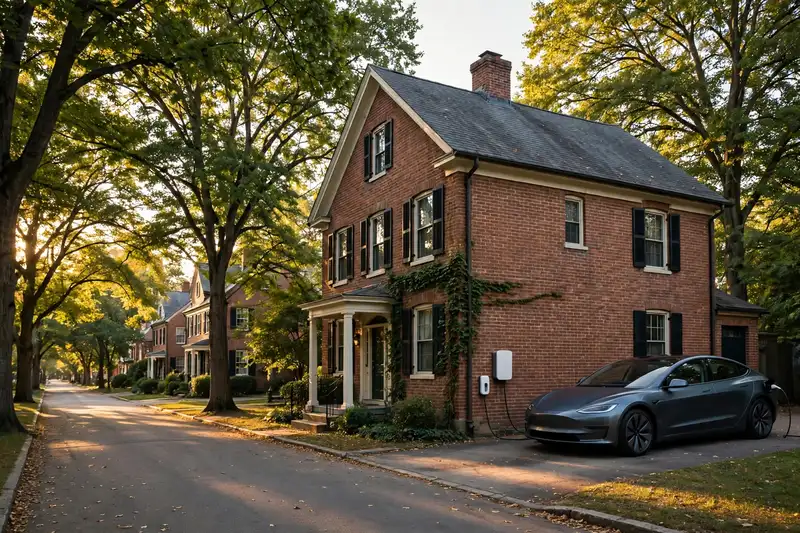
EV charging services in Columbia
Ten services cover the work installers do in Columbia. Three lead the list here because of what this city's housing and law actually look like — each links to its national service page, where scope and process are set out in full.
Home EV Charger Installation in Columbia
Think of it as plumbing for electrons, done once: capacity checked, circuit run, station mounted and configured, inspection passed. The households that report the smoothest projects describe the same shape — a visit that measured, a quote that itemised, and a car that simply charged from the first night.
In Columbia: the install Columbia's new EV households book first, and the one the rest of this page keeps returning to.
Dedicated Circuit & Electrical Panel Upgrade in Columbia
Panel work is the one part of a charger project that outlives the car, the station and possibly the household's tenure. Specified generously and documented properly, it is less an expense than a permanent alteration in what the house can do.
In Columbia: relevant in Columbia wherever a 100-amp panel already carries cooking, heating and hot water before a charger asks for room.
Level 2 Charger Installation in Columbia
The step from a household receptacle to a Level 2 circuit is the step from sipping to drinking: the car takes energy at the rate family life actually consumes it. The work is a breaker, a run of appropriately gauged conductor, and a connection made to torque — modest materials, permanent consequences.
In Columbia: the 240-volt step that turns overnight charging in Columbia from a trickle into a full battery by morning.
Utility programs and electricity in Columbia
Electricity in Columbia comes from Dominion Energy South Carolina, Inc. Parts of the wider metro are served by Mid-Carolina Electric Coop Inc, Aiken Electric Coop Inc, Fairfield Electric Coop, Inc. The utility matters twice over for a charger install: it sets the time-of-use rates that decide what overnight charging costs you, and it is the organisation that may — or may not — currently help pay for the equipment.
Frame the Columbia incentive question correctly and it answers itself. Three pots could in principle fund part of a home charger: a federal credit, a South Carolina program, a Dominion Energy South Carolina, Inc rebate. The first ended on September 30, 2025. The second does not exist for typical home installs. The third, in the sources checked for this page, is not currently offered for residential customers. Zero plus zero plus zero is the honest budget line — and any future change will arrive through the utility's own program page, with dates, which is where this page will take it from.
Net-metering households — rooftop solar is common across the metro — should tell the installer: charging schedules and load management are planned differently when the house generates as well as consumes.
Condos, HOAs and the law in South Carolina
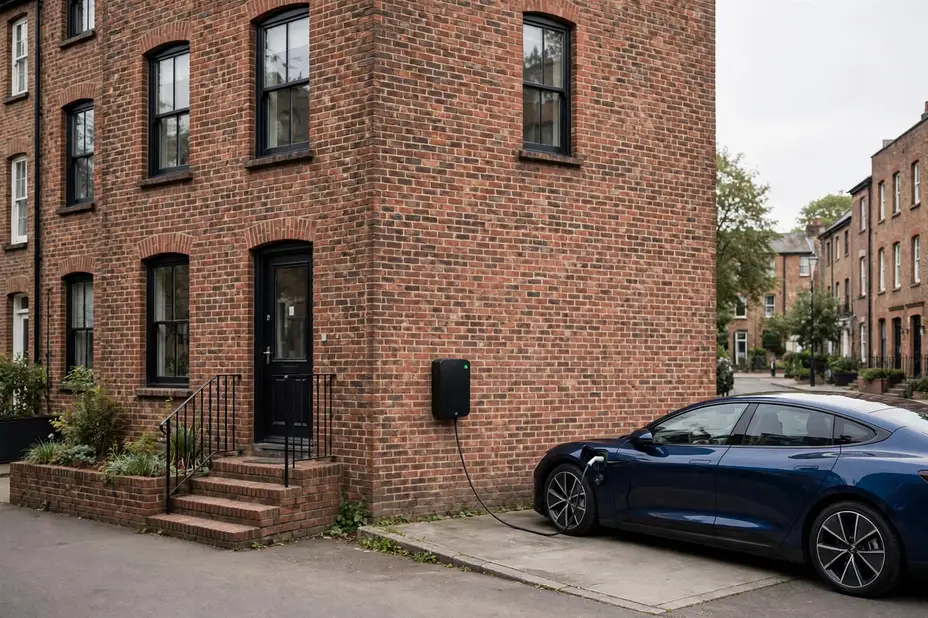
There is no South Carolina right-to-charge statute to lean on. Some national roundups list protection that does not exist in this state's code; the statute indexes checked for this page are clear. In Columbia, a condo or HOA charger is approved — or not — under the community's own documents, which makes the quality of your application the whole ballgame.
If the board says no, ask for the refusal in writing with the covenant cited. Rules change — several states added right-to-charge laws in 2025 alone — and a documented refusal is what a future rule change, or a future board, works from.
Our condo and HOA guide covers both kinds of state; in Columbia the chapters on complete applications and cost allocation are the operative ones.
Climate, garages and charger placement
Parking orientation is a thermal decision in this metro: a car that bakes in western sun all afternoon starts its session hot, and both the car and the station manage heat before they manage charging. The overnight schedule is partly a shade strategy executed by clock.
Afternoon is the design hour: a station, a cable and a car that all sit in the day's peak heat age on the local schedule, not the brochure's. West-facing walls are the last choice here; the shaded side of the garage, the eave's shadow and the overnight schedule are the three cheap protections every local installer reaches for.

Permits and inspection in Columbia
Timelines are set by the city's counter, not the installer: the electrical work itself is typically a day, while permit issuance and the inspection visit follow the department's queue. A quote that promises a date should tell you which parts of that date the installer actually controls.

Neighbourhoods and ZIP codes served
The page covers 34 ZIP codes in and around Columbia — including 29201, 29202, 29203, 29204, 29205, 29206, 29207, 29208, 29209, 29210, 29211, 29212, 29214, 29215, 29216, 29217, 29218, 29219, 29220, 29221, 29222, 29223, 29224, 29225, 29226, 29227, 29228, 29229, 29230, 29240, 29250, 29260, 29290, 29292 — across Lexington, Richland. If your ZIP is not in the first set shown, ask anyway: installer coverage follows the metro, not a postcode fence.
The same working area takes in the neighbouring localities of West Columbia, Cayce, State Park, Lexington, Hopkins, Irmo, Gaston, Blythewood, Ballentine, White Rock, Swansea, Chapin, Gadsden, Eastover — the county ring an installer based in Columbia actually drives. Requests from those communities route exactly as city requests do: same services, same permit discipline, same local facts where they differ.
Richland County accounts for 40 of the ZIP codes and 9 named postal localities in the research file, the nearest of them State Park, Hopkins, Irmo, Blythewood, Ballentine. The survey counts 422,117 residents in the county, with a median household income of $63,784 and a median home value of $242,800. Lexington County accounts for 17 of the ZIP codes and 11 named postal localities in the research file, the nearest of them West Columbia, Cayce, Lexington, Gaston, Swansea. The survey counts 304,887 residents in the county, with a median household income of $77,408 and a median home value of $234,500. Measured across its ZIP codes, the Columbia footprint runs about 15 miles north to south and 21 east to west, from ZIP 29201 to 29292 — the ground an installer based here actually covers in a working week.
Beyond the county seats, the working area takes in West Columbia, Cayce, State Park, Lexington, Hopkins, Irmo, Gaston, Blythewood, Ballentine, White Rock, Elgin, Swansea, Chapin, Gadsden, Pelion, Gilbert, Rion, Ridgeway, Saint Matthews, Jenkinsville, Peak, Lugoff, Little Mountain, Leesville, North, Winnsboro, Batesburg, Prosperity, Orangeburg, Pomaria, Wagener, Salley, Neeses, Liberty Hill, Springfield, Newberry, Norway, Blair, Westville, Great Falls, Blackstock, Cordova, Cope, Silverstreet, Rowesville — the named localities for which Columbia is the nearest metro in the network (neighbouring metros' pages cover their own ground), each routing to the same installer-matching service.
The wider working area also reaches Eastover, Horatio, Wedgefield, Rembert, Camden, Dalzell, Monetta, Pinewood, Cameron, Ridge Spring, Sumter, Cassatt, Shaw Afb, Ward, Aiken, Saluda, Elloree, Johnston, Bishopville — ground shared with neighbouring metros, where installers cross the same county lines in both directions.
ZIP codes in that shared ground include 29010, 29020, 29021, 29030, 29032, 29040, 29044, 29047, 29062, 29105, 29125, 29128, 29129, 29138, 29150, 29151, 29152, 29153, 29154, 29166, 29168, 29804, 29805, 29808, 29832.
The largest communities in that working area after Columbia itself, by the GeoNames populated-place file: Saint Andrews (population 21,151), Lexington (population 20,138), West Columbia (population 16,060), Seven Oaks (population 15,144), Dentsville (population 14,062), Cayce (population 13,619), Orangeburg (population 13,460), Irmo (population 12,056), Forest Acres (population 10,615), Newberry (population 10,331), Oak Grove (population 10,291), Red Bank (population 9,617), Woodfield (population 9,303), Oak Grove (population 8,183), Lugoff (population 7,434), Lake Murray of Richland (population 5,484), Batesburg-Leesville (population 5,441), Brookdale (population 4,873), Batesburg (population 4,380), Bamberg (population 3,383). Charging demand follows those populations — the subdivisions and town centres where the next driveways, and the next panels, are.
Orangeburg County reaches into the working area with 83,253 residents, a median household income of $45,675 and a median home value of $115,800; its localities on this page include North, Orangeburg, Neeses, Springfield. Newberry County reaches into the working area with 38,435 residents, a median household income of $61,780 and a median home value of $173,300; its localities on this page include Peak, Little Mountain, Prosperity, Pomaria, Newberry. Fairfield County reaches into the working area with 20,550 residents, a median household income of $47,885 and a median home value of $151,200; its localities on this page include Rion, Ridgeway, Jenkinsville, Winnsboro, Blair. Kershaw County reaches into the working area with 68,314 residents, a median household income of $68,231 and a median home value of $217,100; its localities on this page include Elgin, Lugoff, Liberty Hill, Westville. Aiken County reaches into the working area with 174,160 residents, a median household income of $70,609 and a median home value of $218,000; its localities on this page include Wagener, Salley.
| ZIP | Locality | County |
|---|---|---|
| 29201 | Columbia | Richland |
| 29202 | Columbia | Richland |
| 29208 | Columbia | Richland |
| 29211 | Columbia | Richland |
| 29214 | Columbia | Richland |
| 29216 | Columbia | Richland |
| 29217 | Columbia | Richland |
| 29218 | Columbia | Richland |
| 29220 | Columbia | Richland |
| 29225 | Columbia | Richland |
| 29205 | Columbia | Richland |
| 29204 | Columbia | Richland |
| 29169 | West Columbia | Lexington |
| 29033 | Cayce | Lexington |
| 29215 | Columbia | Richland |
| 29219 | Columbia | Richland |
| 29221 | Columbia | Richland |
| 29222 | Columbia | Richland |
| 29224 | Columbia | Richland |
| 29226 | Columbia | Richland |
| 29227 | Columbia | Richland |
| 29240 | Columbia | Richland |
| 29250 | Columbia | Richland |
| 29260 | Columbia | Richland |
| 29290 | Columbia | Richland |
| 29292 | Columbia | Richland |
| 29203 | Columbia | Richland |
| 29206 | Columbia | Richland |
| 29210 | Columbia | Richland |
| 29207 | Columbia | Richland |
| 29209 | Columbia | Richland |
| 29170 | West Columbia | Lexington |
| 29147 | State Park | Richland |
| 29230 | Columbia | Richland |
| 29172 | West Columbia | Lexington |
| 29223 | Columbia | Richland |
| 29212 | Columbia | Lexington |
| 29071 | Lexington | Lexington |
| 29072 | Lexington | Lexington |
| 29061 | Hopkins | Richland |
| 29063 | Irmo | Richland |
| 29053 | Gaston | Lexington |
| 29229 | Columbia | Richland |
| 29171 | West Columbia | Lexington |
| 29228 | Columbia | Lexington |
| 29016 | Blythewood | Richland |
| 29002 | Ballentine | Richland |
| 29073 | Lexington | Lexington |
| 29177 | White Rock | Richland |
| 29045 | Elgin | Kershaw |
| 29160 | Swansea | Lexington |
| 29036 | Chapin | Lexington |
| 29052 | Gadsden | Richland |
| 29123 | Pelion | Lexington |
| 29054 | Gilbert | Lexington |
| 29132 | Rion | Fairfield |
| 29130 | Ridgeway | Fairfield |
| 29135 | Saint Matthews | Calhoun |
| 29065 | Jenkinsville | Fairfield |
| 29122 | Peak | Newberry |
| 29078 | Lugoff | Kershaw |
| 29075 | Little Mountain | Newberry |
| 29070 | Leesville | Lexington |
| 29112 | North | Orangeburg |
| 29180 | Winnsboro | Fairfield |
| 29006 | Batesburg | Lexington |
| 29127 | Prosperity | Newberry |
| 29118 | Orangeburg | Orangeburg |
| 29126 | Pomaria | Newberry |
| 29164 | Wagener | Aiken |
| 29137 | Salley | Aiken |
| 29107 | Neeses | Orangeburg |
| 29074 | Liberty Hill | Kershaw |
| 29146 | Springfield | Orangeburg |
| 29115 | Orangeburg | Orangeburg |
| 29117 | Orangeburg | Orangeburg |
| 29116 | Orangeburg | Orangeburg |
| 29108 | Newberry | Newberry |
| 29113 | Norway | Orangeburg |
| 29015 | Blair | Fairfield |
| 29175 | Westville | Kershaw |
| 29055 | Great Falls | Chester |
| 29014 | Blackstock | Chester |
| 29039 | Cordova | Orangeburg |
| 29038 | Cope | Orangeburg |
| 29145 | Silverstreet | Newberry |
| 29133 | Rowesville | Orangeburg |

Planning the install: from panel to parking
Homeowners sometimes ask why a job that looks like 'one outlet' needs a site visit at all. The visit exists because the three variables that set the scope — spare capacity, the run's route, and the property's approval layer — are all invisible from a photograph. In Columbia an experienced installer reads them in minutes, in the panel's directory card, the garage's geometry and the community's documents. The quote that follows a visit is a different species from the quote that precedes one: it can be held to.
Finally, photograph the finished work — station, nameplate, panel directory with the new breaker labelled — and file it with the inspection record. When the car changes, the house sells or a second station joins the first, that folder is the difference between a five-minute answer and an archaeological dig.
Home charging know-how for Columbia households
Historic districts and exterior rules
In a designated historic district, the charger's exterior footprint can need a second audience: the preservation commission, whose concern is the streetscape rather than the circuit. The designs that pass keep faith with that concern — equipment inside the garage where possible, conduit routed away from the principal facade, nothing mounted on historic fabric. It adds a step, not a saga, and local installers know their commission's habits the way they know their permit counter's.
Breakers: the household's safety switches
A breaker is a switch that watches current and opens when the current stops being safe — heat in a conductor is the thing it exists to prevent. Two household rules follow. First, a tripping breaker is reporting, not malfunctioning by default: reset once, and if it repeats, the circuit gets an electrician, not another reset. Second, the forbidden fix: never answer a trip by fitting a larger breaker. The breaker protects the wire in the wall; upsizing the guard without upsizing the wire removes the protection and keeps the problem.
Three cars, one driveway
Households with more vehicles than bays run a small nightly logistics operation, and charging joins the rotation. The patterns that work: the station positioned to serve two parking spots in sequence, a household habit about whose night it is, and — where two of the fleet are electric — power sharing that removes the rotation entirely. The design conversation should start from the household's actual parking choreography, observed on a normal evening, because the charger serves the pattern that exists, not the one the driveway promised.
The landlord's side of the charger
For a landlord, a charger circuit is an amenity with unusual arithmetic: it is visible in listings, filterable in searches, and durable across tenancies in a way paint is not. The questions that decide it are practical rather than visionary — whose meter the circuit hangs from, how the cost is recovered, what the end-of-tenancy position is — and each has a standard answer the multifamily sections of this site describe. Landlords who run the numbers tenant by tenant usually conclude the circuit earns its wall space.
Three permit myths, retired
Myth one: it is just an outlet. A receptacle on a new 240-volt continuous-load circuit is permitted electrical work in effectively every jurisdiction — the outlet's familiarity does not change the circuit's nature. Myth two: nobody will know. The panel schedule, the insurer, the buyer's inspector and the next electrician all eventually know. Myth three: the permit is the expensive part. It is among the smallest lines in the project and the only one that produces an independent witness. Retire all three before the quotes arrive.

Frequently asked questions
Is the federal charger tax credit still available in Columbia, SC?
Checked and dated: in the sources reviewed for this page, Dominion Energy South Carolina, Inc runs no residential charger rebate, South Carolina runs no home-charger programme, and the federal credit that once filled the gap ended on September 30, 2025. If a salesperson's spreadsheet shows a rebate line for a Columbia install, the published programme page is the only acceptable evidence.
Can my association in Columbia, SC say no to a home charger?
They hold the stronger hand in South Carolina: with no right-to-charge statute on the books, a Columbia association's covenants are the law of the car park. The applications that succeed anyway share a shape — owner-funded, licensed installer, metered energy, insured, reversible — because they answer the board's risk questions in advance and in writing.
Does a Level 2 charger mean a panel upgrade for a Columbia, SC home?
It hinges on two numbers you cannot read off the panel door: the service's rating, and what the load calculation says it already carries. The vintage of Columbia's stock — median build year 1982, about 47% of homes from before 1980 — means both answers are common here. The charger enters the arithmetic at 125% of its draw; whatever room survives that entry decides between a circuit, a management device, and an upgrade.
How much faster is Level 2 charging at home in Columbia, SC?
Level 1 — the cord in the boot, on a normal outlet — returns about 3–5 miles of range an hour. Level 2 on its own 240-volt circuit returns roughly 25–40. A Columbia commuter who parks at seven and leaves at seven stops doing battery arithmetic entirely.
What happens next after I send a request?
Your request — service, Columbia ZIP, property type and timing — goes to licensed local installers who cover Columbia. They contact you directly to arrange a site visit and quote. PlugReady USA is the matching service, not the installer, and the sections above exist so you can judge any quote against the local facts.
My Columbia home has no garage — where does the charger go?
On the exterior wall beside the driveway, on a pedestal at the parking pad, or in a carport — outdoor-rated equipment is routine. The design adds weather sealing, a cable route the weather and the snow shovel both respect, and a position checked against where the car actually noses in. A large share of installs in attached and urban housing are exactly this shape.
Nearby cities in South Carolina
- EV charger installation in Sumter — about 38 miles from Columbia, metro population 110,000
- EV charger installation in Florence — about 71 miles from Columbia, metro population 200,000
- EV charger installation in Spartanburg — about 83 miles from Columbia, metro population 355,000
- EV charger installation in Greenville — about 96 miles from Columbia, metro population 975,000
- EV charger installation in Charleston — about 104 miles from Columbia, metro population 825,000
- EV charger installation in Hilton Head Island — about 124 miles from Columbia, metro population 225,000
- EV charger installation in Augusta, GA — about 64 miles from Columbia, metro population 625,000
- EV charger installation in Charlotte, NC — about 88 miles from Columbia, metro population 2,900,000
- EV charger installation in Hickory, NC — about 122 miles from Columbia, metro population 370,000
Ready to charge at home in Columbia?
Tell us the job — service, ZIP and property type — and licensed local installers will take it from there.