EV Charger Installation in Meridian, MS
Everything a Meridian homeowner needs before booking a charger install — the panel question, the utility's current programs, the HOA law and the permit — sourced, dated and local.
Nobody buys an electric car for the wiring, yet the wiring is what the ownership experience quietly runs on. Getting it right in Meridian means answering local questions with local facts. Meridian itself is home to about 34,137 people. Statewide the registered fleet reached 7,200 battery-electric vehicles plus 3,000 plug-in hybrids through 2025, and the installers working this metro have settled into the patterns this page describes: the panel conversation, the utility's current position, the association's rules, and the inspection that closes the job.
A word on how to use the page: each section answers one of the questions an installer will ask you anyway — panel, utility, property rules, permits — with Meridian's actual answers. Read the two that apply to your house and you will start the quoting conversation several steps ahead.
The demand picture for the Meridian metro, from the registration data this site is built on: MS coverage. Registration counts are the honest way to size a charging market — they count households, not headlines — and they are why Meridian sits where it does in our build order (rank 250 of 300 metros, Tier C).
Survey context for Meridian, in the three lines installers actually use: median household income $36,562; owner-occupation at 49%; single-unit detached homes at 61%. Income tracks adoption pace, tenure decides whose signature a job needs, and structure decides whether the answer is a garage circuit or a building negotiation.

Put the survey together and Meridian's charging profile reads like this: an older housing fabric, where panel archaeology is a normal part of the first visit; a detached-house majority with a real attached and multifamily minority; buildings of five or more units are a visible minority of the stock; and renters form a large share of households, so the landlord conversation is a first-class topic here. That combination — more than any single number — is what the installers working here plan around, and it is the lens for everything on this page.
In absolute terms, the survey counts 17,677 housing units in Meridian — 14,559 occupied, 7,083 of them by their owners. The stock resolves into 10,710 single-unit detached houses, 12,707 homes standing since before 1980, and 3,440 units in larger buildings. Those six counts are the city's charging map drawn without percentages, and every section of this page is a consequence of one of them. The page's geography is equally concrete: 7 ZIP codes across Lauderdale, centred near 32.36 degrees north latitude. The city anchors the Meridian metropolitan area, home to roughly 100,000 people on the research file's metro estimate — the wider labour and housing market this page's installers work across.
The same survey release fills in the household economics around the housing stock: a median home value of $107,900, median gross rent of $910, per-capita income of $25,094, and a median resident age of 39. How the city moves completes the picture: 79% of Meridian workers drive to work alone — the commute pattern home charging is built around; 5% work from home, a population whose cars charge on daytime and overnight schedules alike; 0% commute by public transit; 22% of adults hold a bachelor's degree or higher. And the fleet in the driveways: 5,326 households in Meridian have exactly one vehicle, 7,204 have two or more, and 2,029 have none.
The cost-burden lines say who feels housing costs most in Meridian: 48% of renters spend 30% or more of income on rent, and 0% of owners with mortgages spend the same share on housing costs. Family households are 55% of all households — the two-car, school-run demographic whose charging patterns this page's planning sections keep circling back to.
Taken as one portrait, the numbers describe a specific charging market. The oldest housing throws the longest shadows over an install: knob-and-tube remnants in the attic, ungrounded receptacles, services sized for iceboxes and radios that now feed induction ranges and heat pumps. The housing variety shows up in the permit data as variety: single-family circuits in volume, building projects in ones and twos, each teaching the local workforce a different half of the trade.
High renter share also means charging follows the lease cycle: applications cluster at move-in, installations at renewal leverage, and the whole market breathes on the rental calendar. At this income band the phantom-rebate problem bites hardest, which is why this page states the verified incentive position in plain terms and dates it. Tariff design is the quiet policy: the shape of the overnight window, the demand charges commercial customers face, the interconnection queue's pace — all set in dockets the diligent can read.
Early-market conditions have their own economics: fewer specialist installers, general electricians carrying the work, and a premium on the household arriving informed — which is the gap this page exists to close. A smaller metro runs on relationships: the electrical firms are few, known, and booked through reputations maintained across decades of local work. The association dimension here runs on persuasion rather than statute — no state charging law frames the application, so the complete, professional proposal carries the whole argument, as the law section above explains.
The electrical reality in Meridian homes
The Census Bureau counts Meridian's housing in ways that turn out to be an installer's briefing: the median home dates to 1969, 72% of units stood before 1980, 61% are detached single-unit houses, and 49% of occupied homes belong to their occupants. Panel sizes, wire routes and even permit histories track those proportions street by street. A housing stock this age leans on smaller electrical services — 100-amp panels are common, and fuse-era equipment still turns up in the oldest streets. For many of those homes the honest answer is a panel upgrade or a load-management device before the charger circuit goes in, and a good installer will show you the load calculation rather than asking you to take it on faith. Owner-occupiers can plan on their own timeline; renters and condo owners have an extra approval layer, which the law section below covers for this state.
One further survey line belongs in any Meridian install conversation: 60% of the city's homes heat with electricity — 8,713 households whose panels already carry a major winter load before a charger is contemplated. Electric heat and EV charging are the two largest discretionary loads a house can host, and where they coincide, the load calculation stops being a formality.
One further split matters for how this page is organised: about 7,476 of Meridian's occupied homes are renter-occupied. Everything above assumes you can approve your own electrical work; where you cannot, the approval layer — landlord or association — becomes part of the job, which is why the law section carries unusual weight here.
The city's stock is not all houses: 19% of units are in structures of five or more. Shared buildings mean shared panels, assigned parking and association process — the substance of the multifamily sections below.
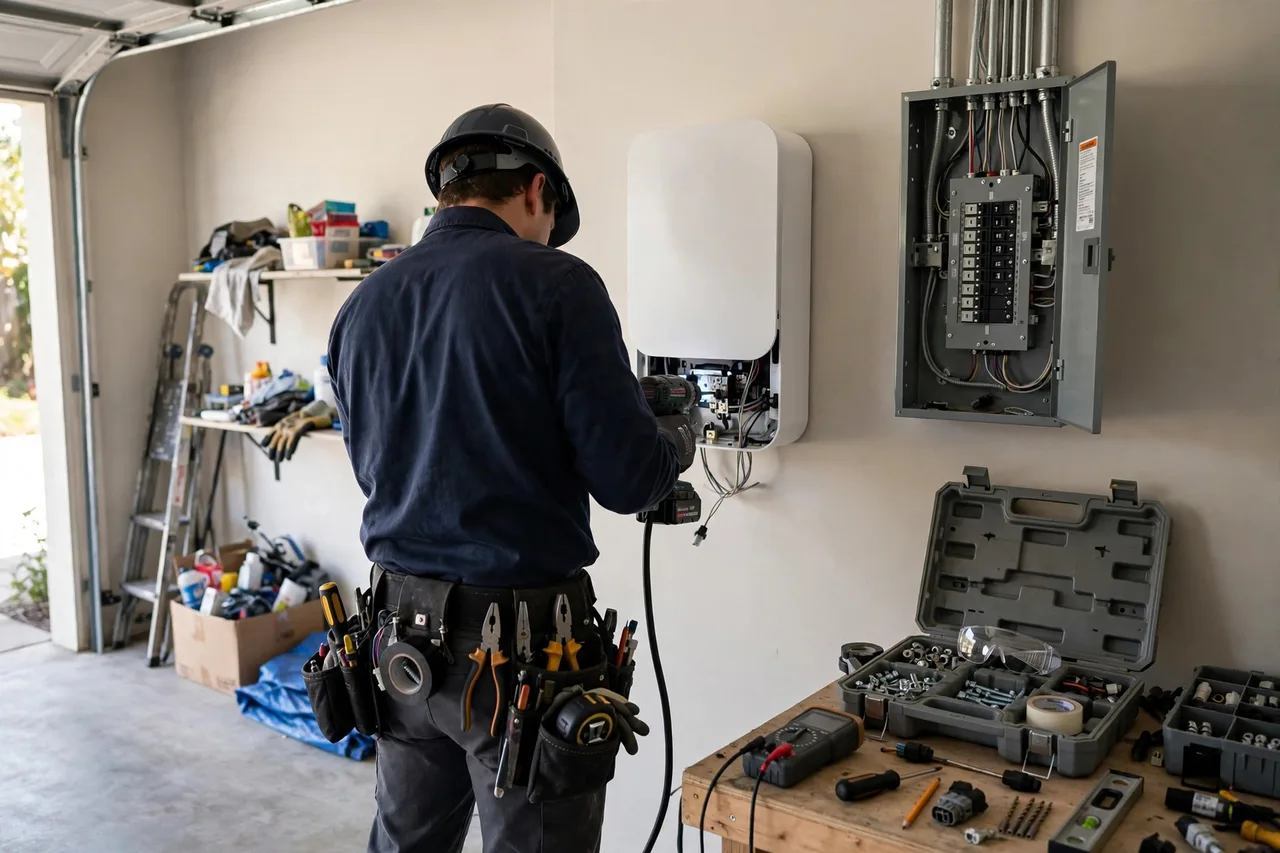
EV charging services in Meridian
The full menu runs to ten services; the three cards at the top are the ones Meridian's housing stock and state law push to the front. Everything links to its national service page for scope and process in full.
Home EV Charger Installation in Meridian
Start to finish, the domestic install is a half-day of electrical work wrapped in a week of scheduling: the survey, the circuit, the mounting, the configuration, the inspection. What the household experiences is simpler — a car that is full every morning and a cable that lives where the car does.
In Meridian: the core residential job in Meridian: circuit, mounting, configuration and inspection in one visit pattern.
Dedicated Circuit & Electrical Panel Upgrade in Meridian
Some homes meet the charger at the panel door: the service is already spoken for by cooking, heating and hot water. This service is the honest fix — capacity added properly, grounding brought current, and a panel schedule that finally matches the house it feeds.
In Meridian: the capacity answer when Meridian's older panels meet a continuous load.
Level 2 Charger Installation in Meridian
What is being bought is recovery rate. A Level 2 circuit returns in one overnight session what a household receptacle returns in a day and a half, and that margin is the difference between planning around the car and forgetting about it.
In Meridian: what most Meridian drivers mean when they say they want 'a real charger' — 240 volts, sized to the circuit.
Utility programs and electricity in Meridian
Electricity in Meridian comes from Mississippi Power Co. Parts of the wider metro are served by East Mississippi Elec Pwr Assn. The utility matters twice over for a charger install: it sets the time-of-use rates that decide what overnight charging costs you, and it is the organisation that may — or may not — currently help pay for the equipment.
The honest incentive position in Meridian is: nothing verified to claim. The federal charger credit (30C) ended on September 30, 2025; Mississippi runs no state replacement for typical home installs; and in the utility and state sources checked for this page, Mississippi Power Co had no active residential charger rebate to point to. Programs reopen — when one does, it will be on the utility's own site with terms and dates. Anything an installer describes without that paper trail should be treated as conversation, not money.
Solar households should read the export terms alongside the charging ones: the pair decides whether midday charging on home-working days beats the overnight window, and the answer is written in your tariff, not in general advice.
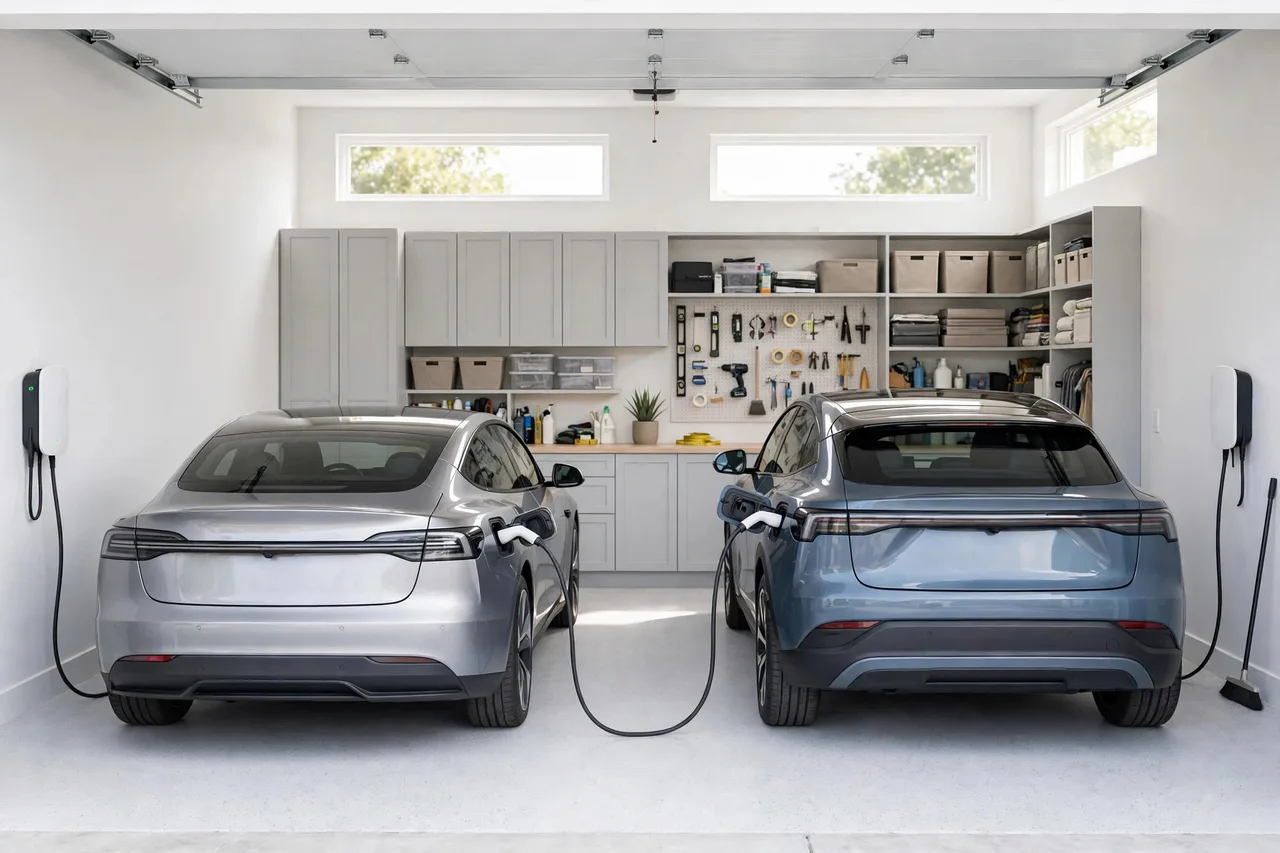
Condos, HOAs and the law in Mississippi
No statute promises a charger approval in Mississippi. Unlike the states that have enacted right-to-charge laws, Mississippi leaves the question entirely to each community's covenants and board discretion. For Meridian owners that is not the end of the road — it is a sign that the negotiation, the metering design and the written application carry the weight a statute would otherwise carry.
Owners of single-family homes in HOA communities should also check the covenants before assuming the driveway is uncomplicated: exterior-equipment and architectural-approval clauses can apply to a visible wall-mounted station even where the garage interior is entirely the owner's business.
Our condo and HOA guide covers both kinds of state; in Meridian the chapters on complete applications and cost allocation are the operative ones.
Climate, garages and charger placement
Heat also argues for headroom in the circuit decision. A car managing a hot battery after a hot commute draws on its own schedule; a generously sized circuit finishes the session inside the cool window instead of straddling the morning. It is a small thing, decided once, felt all summer.
Afternoon is the design hour: a station, a cable and a car that all sit in the day's peak heat age on the local schedule, not the brochure's. West-facing walls are the last choice here; the shaded side of the garage, the eave's shadow and the overnight schedule are the three cheap protections every local installer reaches for.

Permits and inspection in Meridian
Inspection day itself is undramatic by design: access to the panel and the station, the calculation on hand, the equipment's settings matching the circuit. Jobs fail inspection on paperwork mismatches far more often than on wiring — a fact that quietly grades installers.

Neighbourhoods and ZIP codes served
The page covers 7 ZIP codes in and around Meridian — including 39301, 39302, 39303, 39304, 39305, 39307, 39309 — across Lauderdale. If your ZIP is not in the first set shown, ask anyway: installer coverage follows the metro, not a postcode fence.
The same working area takes in the neighbouring localities of Marion, Bailey, Toomsuba, Lauderdale, Daleville, Collinsville — the county ring an installer based in Meridian actually drives. Requests from those communities route exactly as city requests do: same services, same permit discipline, same local facts where they differ.
Lauderdale County accounts for 13 of the ZIP codes and 7 named postal localities in the research file, the nearest of them Marion, Bailey, Toomsuba, Lauderdale, Daleville. The survey counts 71,504 residents in the county, with a median household income of $50,817 and a median home value of $133,300. Measured across its ZIP codes, the Meridian footprint runs about 13 miles north to south and 8 east to west, from ZIP 39301 to 39309 — the ground an installer based here actually covers in a working week.
Beyond the county seats, the working area takes in Marion, Bailey, Toomsuba, Lauderdale, Daleville, Stonewall, Chunky, Cuba, Enterprise, Collinsville, Hickory, Quitman, Lisman, Porterville, Little Rock, York, Rose Hill, De Kalb, Decatur, Pachuta, Shubuta, Ward, Jachin, Newton, Bellamy, Livingston, Needham, Butler, Melvin, Union, Paulding, Vossburg, Emelle, Lawrence, Scooba, Conehatta, Pennington, Louin, Epes, Philadelphia, Preston, Lake, Heidelberg, Gilbertown, Myrtlewood, Sebastopol, Nanafalia, Toxey, Jefferson, Panola, Bay Springs, Shuqualak, Sweet Water, Madden — the named localities for which Meridian is the nearest metro in the network (neighbouring metros' pages cover their own ground), each routing to the same installer-matching service.
The largest communities in that working area after Meridian itself, by the GeoNames populated-place file: Philadelphia (population 7,391), Demopolis (population 7,148), Louisville (population 6,314), Thomasville (population 4,051), Pearl River (population 3,601), Livingston (population 3,414), Newton (population 3,356), Macon (population 2,616), York (population 2,399), Quitman (population 2,209), Linden (population 2,025), Union (population 1,987), Collinsville (population 1,948), Butler (population 1,798), Decatur (population 1,797), Bay Springs (population 1,738), Coldwater (population 1,608), Marion (population 1,574), Grove Hill (population 1,494), Nellieburg (population 1,414). Charging demand follows those populations — the subdivisions and town centres where the next driveways, and the next panels, are.
Choctaw County reaches into the working area with 8,118 residents, a median household income of $50,919 and a median home value of $117,200; its localities on this page include Lisman, Ward, Jachin, Needham, Butler. Newton County reaches into the working area with 21,093 residents, a median household income of $50,540 and a median home value of $106,300; its localities on this page include Chunky, Hickory, Little Rock, Decatur, Newton. Jasper County reaches into the working area with 16,059 residents, a median household income of $48,660 and a median home value of $107,100; its localities on this page include Rose Hill, Paulding, Vossburg, Louin, Heidelberg. Clarke County reaches into the working area with 15,314 residents, a median household income of $46,108 and a median home value of $118,100; its localities on this page include Stonewall, Enterprise, Quitman, Pachuta, Shubuta. Kemper County reaches into the working area with 8,729 residents, a median household income of $46,431 and a median home value of $99,600; its localities on this page include Porterville, De Kalb, Scooba, Preston.
| ZIP | Locality | County |
|---|---|---|
| 39301 | Meridian | Lauderdale |
| 39302 | Meridian | Lauderdale |
| 39303 | Meridian | Lauderdale |
| 39304 | Meridian | Lauderdale |
| 39342 | Marion | Lauderdale |
| 39307 | Meridian | Lauderdale |
| 39305 | Meridian | Lauderdale |
| 39320 | Bailey | Lauderdale |
| 39364 | Toomsuba | Lauderdale |
| 39335 | Lauderdale | Lauderdale |
| 39326 | Daleville | Lauderdale |
| 39309 | Meridian | Lauderdale |
| 39363 | Stonewall | Clarke |
| 39323 | Chunky | Newton |
| 36907 | Cuba | Sumter |
| 39330 | Enterprise | Clarke |
| 39325 | Collinsville | Lauderdale |
| 39332 | Hickory | Newton |
| 39355 | Quitman | Clarke |
| 36912 | Lisman | Choctaw |
| 39352 | Porterville | Kemper |
| 39337 | Little Rock | Newton |
| 36925 | York | Sumter |
| 39356 | Rose Hill | Jasper |
| 39328 | De Kalb | Kemper |
| 39327 | Decatur | Newton |
| 39347 | Pachuta | Clarke |
| 39360 | Shubuta | Clarke |
| 36922 | Ward | Choctaw |
| 36910 | Jachin | Choctaw |
| 39345 | Newton | Newton |
| 36901 | Bellamy | Sumter |
| 35470 | Livingston | Sumter |
| 36915 | Needham | Choctaw |
| 36904 | Butler | Choctaw |
| 36913 | Melvin | Choctaw |
| 39365 | Union | Neshoba |
| 39348 | Paulding | Jasper |
| 39366 | Vossburg | Jasper |
| 35459 | Emelle | Sumter |
| 39336 | Lawrence | Newton |
| 39358 | Scooba | Kemper |
| 39057 | Conehatta | Newton |
| 36916 | Pennington | Choctaw |
| 39338 | Louin | Jasper |
| 35460 | Epes | Sumter |
| 39350 | Philadelphia | Neshoba |
| 39354 | Preston | Kemper |
| 39092 | Lake | Scott |
| 39439 | Heidelberg | Jasper |
| 36908 | Gilbertown | Choctaw |
| 36763 | Myrtlewood | Marengo |
| 39359 | Sebastopol | Scott |
| 36764 | Nanafalia | Marengo |
| 36921 | Toxey | Choctaw |
| 36745 | Jefferson | Marengo |
| 35477 | Panola | Sumter |
| 39422 | Bay Springs | Jasper |
| 39361 | Shuqualak | Noxubee |
| 36782 | Sweet Water | Marengo |
| 39109 | Madden | Leake |

Planning the install: from panel to parking
Consider the two households inside every Meridian install. The first owns the panel, the parking and the decision; the second — a partner, a teenager with the next car, a future buyer — inherits all three. Designing for the second household is the difference between an install and an asset: capacity reserved, conduit honest, paperwork filed. The first conversation with an installer should name both households explicitly.
Finally, photograph the finished work — station, nameplate, panel directory with the new breaker labelled — and file it with the inspection record. When the car changes, the house sells or a second station joins the first, that folder is the difference between a five-minute answer and an archaeological dig.
Home charging know-how for Meridian households
Charging while you travel
Cars left for weeks prefer a middle state of charge and a quiet life: plugged in, scheduled modestly, neither brimmed nor starved. The home station makes this effortless — the car sips as it wants, the household returns to a vehicle that is ready rather than recovered. Tell a housesitter nothing at all; there is nothing to do. It is one of home charging's under-sold virtues: the car manages its own storage, from your wall, while the house is empty.
Whose schedule? The car's or the station's
Two schedulers can govern a charging session — the vehicle's own charge timer and the station's app — and households inherit confusion when both are set at once. The discipline is simple: choose one governor. The car's timer travels with the car and knows its departure settings; the station's knows the tariff windows and the household's other loads. Either works; both together produce the 6 am mystery of the half-charged battery and a debugging session nobody enjoys.
Cable discipline: the daily five seconds
The connector and cable are the parts of the installation you touch twice a day, and they age by handling rather than by electricity. The habits that matter are small: the connector returns to its holster rather than the floor, the cable hangs in a loose loop rather than a kinked coil, the run never crosses the path of the other car's door swing or the bins' weekly journey. Drive-over is the cable's particular enemy — route so that tyres never cross it. Five seconds of discipline per park is the whole maintenance philosophy of the visible half of the system.
The insurance conversation
A permitted charger installation is a short conversation with your insurer, and it is worth having before rather than after. The documented install — permit, inspection, listed equipment, licensed electrician — is the version insurers process without friction, because every question they ask is answered by the file. Undocumented electrical work is where claims go to become arguments. Tell the insurer the circuit exists, keep the paperwork with the policy documents, and the charger's insurance chapter closes in one phone call.

Frequently asked questions
Can I still get the federal tax credit for a home charger in Meridian, MS?
The honest ledger for Meridian reads: federal credit, ended September 30, 2025; state program, none for typical home installs; Mississippi Power Co residential rebate, none verified in the sources checked. If a salesperson's quote leans on any of the three, the correct response is a request for the program's published page.
Can my HOA or condo board in Meridian, MS refuse my charger?
They hold the stronger hand, and it is better to plan with that admitted. Mississippi has enacted no right-to-charge law, so in Meridian the covenants and the board govern. Owners who treat the application as a design submission — circuit, metering, insurance, restoration — rather than a request for a favour are the ones charging by the following quarter.
Will my Meridian, MS home need a panel upgrade for a Level 2 charger?
Start from the median, then verify: the median Meridian home was built in 1969, and 72% of the stock predates 1980, so 100-amp panels are a normal sight here — and a normal candidate for either an upgrade or a load-management device. The load calculation distinguishes the two in one visit, and any quote that skips it is guessing with your money.
How much faster is Level 2 charging at home in Meridian, MS?
Level 1 — the cord in the boot, on a normal outlet — returns about 3–5 miles of range an hour. Level 2 on its own 240-volt circuit returns roughly 25–40. A Meridian commuter who parks at seven and leaves at seven stops doing battery arithmetic entirely.
What happens next after I send a request?
Your request is matched to licensed installers covering Meridian, Mississippi — service, ZIP, property type and timing travel with it. The installer who takes it arranges the site visit and quotes in writing; PlugReady USA's part is the research on this page and the introduction, and your contract is with the installer throughout.
Do installers cover the communities around Meridian, MS?
They do. Coverage follows the metro: Marion, Bailey, Toomsuba, Lauderdale, Daleville and their neighbouring communities are worked by the same installers who cover Meridian itself, and a request from those ZIP codes routes identically — service, property type and timing are all the form asks for.
Nearby cities in Mississippi
- EV charger installation in Hattiesburg — about 80 miles from Meridian, metro population 175,000
- EV charger installation in Jackson — about 85 miles from Meridian, metro population 600,000
- EV charger installation in Tupelo — about 131 miles from Meridian, metro population 140,000
- EV charger installation in Gulfport — about 138 miles from Meridian, metro population 420,000
- EV charger installation in Tuscaloosa, AL — about 84 miles from Meridian, metro population 250,000
- EV charger installation in Mobile, AL — about 120 miles from Meridian, metro population 425,000
- EV charger installation in Birmingham, AL — about 130 miles from Meridian, metro population 1,150,000
Ready to charge at home in Meridian?
Two minutes of form, and the request is in front of licensed installers who cover this city — quotes follow site visits, in writing.