EV Charger Installation in Peoria, IL
Charging where you park, in Peoria: the utility programs, state law, permit process and housing facts behind a home charger install, gathered in one place.
Start from the meter. Every home charger in Peoria is, underneath the hardware, an arrangement between a car, a panel and Illinois's electricity supply — and the households that arrange it well do so in that order. Peoria itself is home to about 115,996 people, in a state whose registered fleet reached 164,900 battery-electric vehicles and 51,600 plug-in hybrids by the end of 2025. This page works outward from the meter: the utility that serves your street and whether it currently funds charger installs, the association law that governs shared buildings, the permit counter's expectations, and the housing numbers that predict your panel's mood. Read it before the quotes, and the quotes get shorter.
The sections that follow are deliberately unglamorous: statutes, survey data, permit counters, tariff habits. That is what a good install is made of. The car is the exciting part; this page is about the wall it plugs into.
What the Experian and AFDC registration data say about Peoria: Central IL anchor. Translated out of market language: your neighbours are already charging at home, the permit office already knows the paperwork, and the installers already know the housing stock.
Three survey lines do most of the predictive work on this page. Income — a median of $65,078 per household — tracks the pace at which Peoria households adopt EVs at all. Tenure — 59% owner-occupied — decides whose signature the work needs. And structure — 65% single-unit detached — decides how often the answer is a simple garage circuit rather than a building negotiation.

The composite picture matters more than any single statistic. In Peoria: an older housing fabric, where panel archaeology is a normal part of the first visit; a detached-house majority with a real attached and multifamily minority; buildings of five or more units hold a substantial share of homes, which keeps the multifamily sections of this page in daily use; meanwhile, owners hold a working majority, with renters a significant minority. A page that ignored that profile would give the same advice everywhere; this one is ordered by it.
The counts behind the percentages, for the record: Peoria has 54,176 housing units on the survey's count, 50,011 of them occupied, and 29,731 owner-occupied households making their own electrical decisions. Detached houses number 35,461; homes built before 1980 number 36,401; units in buildings of five or more number 12,533. An installer's week in this city is a walk through exactly that distribution. The page's geography is equally concrete: 29 ZIP codes across Peoria, centred near 40.69 degrees north latitude. The city anchors the Peoria metropolitan area, home to roughly 400,000 people on the research file's metro estimate — the wider labour and housing market this page's installers work across.
The same survey release fills in the household economics around the housing stock: a median home value of $156,200, median gross rent of $1,005, per-capita income of $38,466, and a median resident age of 36. And the daily rhythms behind the housing numbers: 75% of Peoria workers drive to work alone — the commute pattern home charging is built around; 12% work from home, a population whose cars charge on daytime and overnight schedules alike; 2% commute by public transit; 38% of adults hold a bachelor's degree or higher. Vehicle ownership, from the same release: 23,847 households in Peoria run two or more vehicles, and 4,537 run none — the two ends of the market this page serves and does not serve.
Household structure, from the same release: 58% of Peoria households are family households. The burden shares behind the housing stock: 44% of renting households are cost-burdened at the 30%-of-income line, as are 0% of mortgaged owners — context for why the overnight rate window, once set, is treated here as a household fixture rather than a hobby.
Taken as one portrait, the numbers describe a specific charging market. A stock this old wires its history into the walls: cloth-wrapped conductors in the deepest streets, fuse boxes that outlived their century, panels added in layers by generations of electricians each solving their own decade's problem. Where form is mixed, advice must be conditional — the honest page, like the honest installer, keeps asking which housing the reader actually lives in before prescribing.
Neither renter-heavy nor owner-dominated, the market rewards installers who can work both sides of the tenure line: the domestic circuit and the negotiated one. Middle incomes discipline the specification toward the durable middle: not the minimum circuit that passes, not the maximal one that impresses — the one the load calculation actually indicates, documented. Tariff design is the quiet policy: the shape of the overnight window, the demand charges commercial customers face, the interconnection queue's pace — all set in dockets the diligent can read.
A large fleet normalises the paperwork: boards have seen the application before, landlords have a standard answer, permit counters process charger circuits as routine volume. The permit counter in a smaller city is a conversation, not a queue: applications are read by people who may know the street, and complete paperwork is remembered kindly. Where the state's statute speaks, the local conversation changes register: installers quote the framework, boards keep counsel's template, and approvals become administrative.
The electrical reality in Peoria homes
Read the stock the way a panel schedule reads it. Median build year 1967 means half of Peoria's homes were wired to codes of that era or earlier; 67% predate 1980 entirely. 65% of units are detached houses, and 59% of occupied homes are owned by their occupants — so most charger conversations here happen between a homeowner and an electrician, with no third party at the table. Age shows up electrically before it shows up anywhere else: services sized for a house with a third of today's appliances. Expect the first conversation to be about capacity — what the panel is, what it already feeds, and which of the three routes (circuit, management, upgrade) your numbers support. Housing age also tracks wire-run reality: older homes more often place the panel in a basement or interior wall far from the garage, and distance is copper, conduit and labour.
Heating fuel is the survey's quiet clue to panel life: in Peoria, 31% of homes heat electrically (15,185 households), against 68% heating with gas. A house already heating electrically has a service sized with that load in its history; a gas-heated house may have capacity to spare — either way the fuel mix is part of what the installer is reading.
One further split matters for how this page is organised: about 20,280 of Peoria's occupied homes are renter-occupied. Everything above assumes you can approve your own electrical work; where you cannot, the approval layer — landlord or association — becomes part of the job, which is why the law section carries unusual weight here.
One more structural fact shapes Peoria's charging map: 23% of the city's housing units sit in buildings of five or more units. Those households cannot simply book a circuit — their charger runs through a building, a board and a shared electrical service, which is why the multifamily service and the law section below carry unusual weight on this page.
EV charging services in Peoria
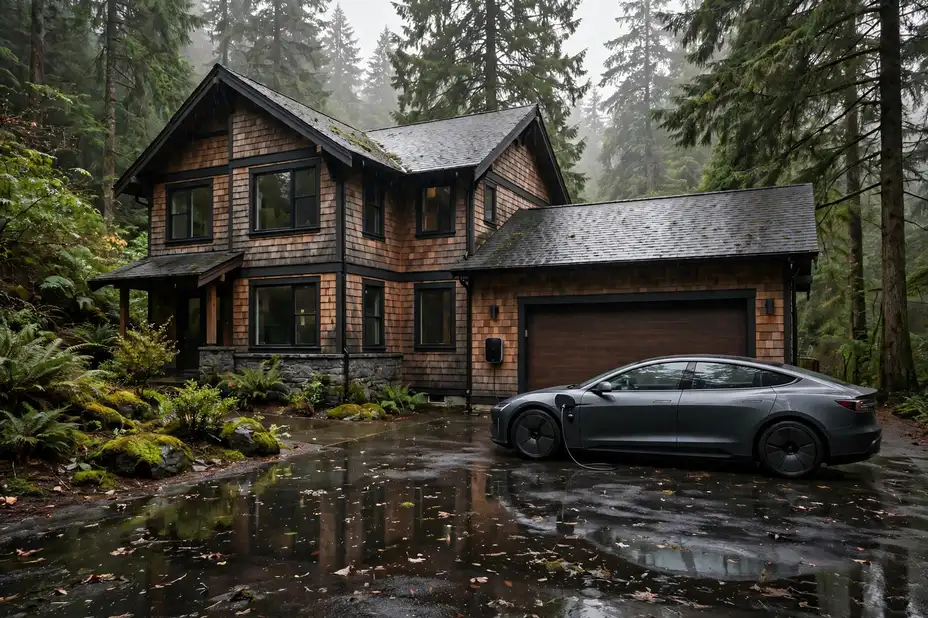
Three of the network's services lead this page because local conditions put them first; the remaining seven are one click away and equally available here. Each card states what the service involves — the matching itself is free of obligation until you accept an installer's quote.
Home EV Charger Installation in Peoria
Think of it as plumbing for electrons, done once: capacity checked, circuit run, station mounted and configured, inspection passed. The households that report the smoothest projects describe the same shape — a visit that measured, a quote that itemised, and a car that simply charged from the first night.
In Peoria: usually the first job a new EV household in Peoria books, scoped to the panel the house already has.
Dedicated Circuit & Electrical Panel Upgrade in Peoria
The upgrade is unglamorous and transformative: a modern panel with honest capacity, labelled circuits, and room for the decade's next three electrical ideas after the charger. Houses rarely regret capacity; they regret its absence annually.
In Peoria: the job that surfaces wherever housing is older — and Peoria's stock makes it a routine conversation, settled by a load calculation.
Multifamily & Condo EV Charging in Peoria
Buildings that solve charging solve it as infrastructure: a backbone capacity decision, a fair cost-allocation rule, and spaces that can be electrified in ones as residents arrive. The first installation is the constitution; the rest are amendments.
In Peoria: constitutions for shared charging in Peoria buildings: metering, load and approvals.
Utility programs and electricity in Peoria
Electricity in Peoria comes from Ameren Illinois Company. Parts of the wider metro are served by Spoon River Electric Coop, Inc. The utility matters twice over for a charger install: it sets the time-of-use rates that decide what overnight charging costs you, and it is the organisation that may — or may not — currently help pay for the equipment.
Do not budget for a rebate in Peoria right now. As of the sources checked for this page, Ameren Illinois Company publishes no residential charger rebate, Illinois offers no state program for typical home installs, and the federal 30C credit ended on September 30, 2025. If that changes, the utility's program page will say so with an as-of date — and this page will be updated to match. Until then, judge quotes on the work itself.
Solar households should read the export terms alongside the charging ones: the pair decides whether midday charging on home-working days beats the overnight window, and the answer is written in your tariff, not in general advice.
Condos, HOAs and the law in Illinois
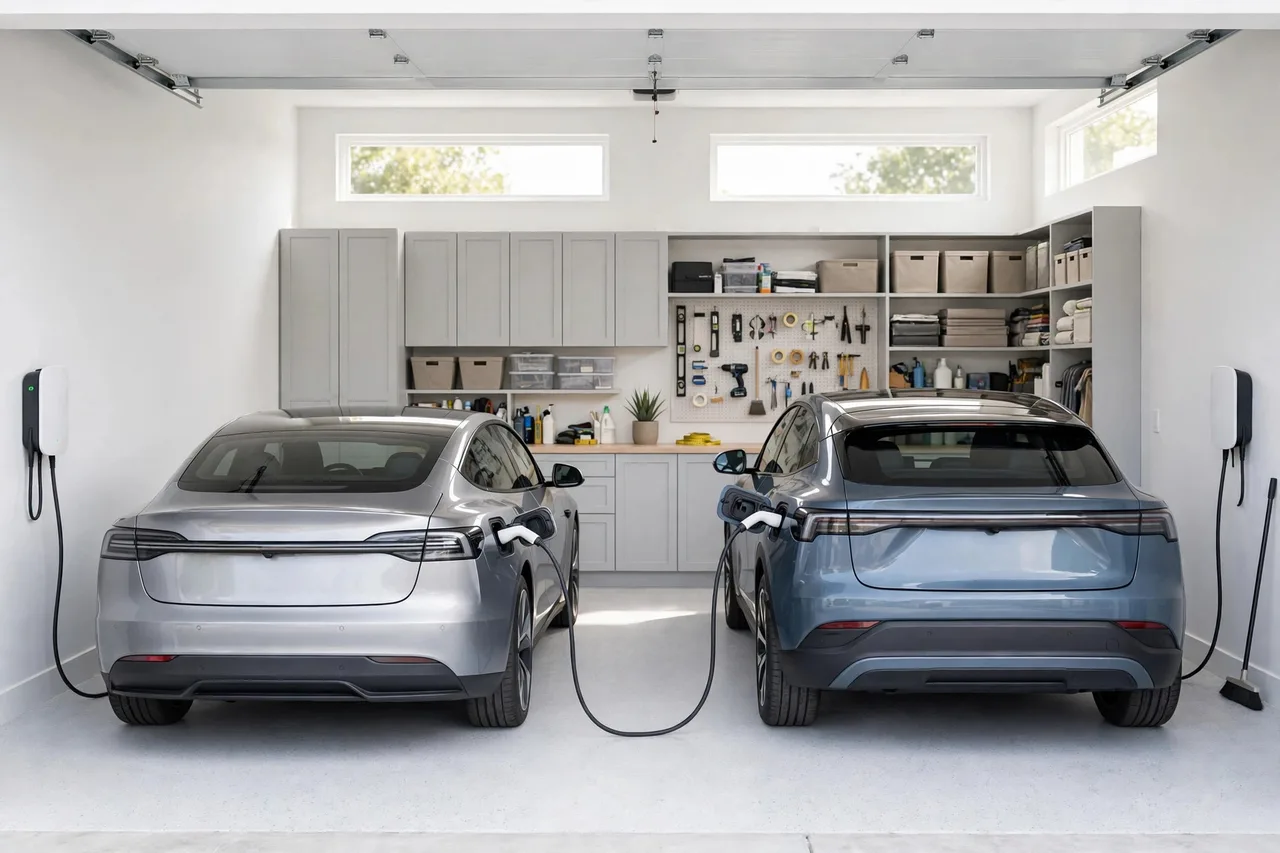
Charging is a protected right for association owners in Illinois. The state's right-to-charge statute (765 ILCS 160/1-45) stops a homeowners association or condominium from banning an owner's charging station outright. Conditions still exist — placement, appearance, insurance and restoration can all be regulated, and the owner pays — yet the starting position is yes-with-rules rather than no-unless-persuaded, and that difference decides most applications before they are written.
The statute is the floor, not the whole negotiation: associations in Illinois can still set reasonable conditions on placement, appearance and insurance. In Peoria, the installers who do multifamily work regularly are the ones who arrive with the application already drafted.
Read the full process in our guide to installing an EV charger in a condo or HOA community, and the multifamily and condo charging service page for how shared and assigned-space installs are designed.
Climate, garages and charger placement
Humidity is the slow variable: it works on exterior connections across seasons rather than in a single event, which is why coastal-grade habits — protected terminations, sealed entries, a yearly glance at the connector — pay off even well inland in a four-season climate.
Four-season metros ask the install to be two things: kind to a battery in January and indifferent to a thunderstorm in July. The equipment is rated for both out of the box; the local craft is in the details — cable jacket chosen for cold flexibility, mounting placed with drainage in mind, a schedule that follows the seasons' rate windows.

Permits and inspection in Peoria
The permit trail also protects the next transaction: a charger circuit on the inspection record is an asset a buyer's inspector reads in one line, while an undocumented circuit is a question that follows the sale. Installers who work this metro treat the filing as part of the deliverable, not an errand.

Neighbourhoods and ZIP codes served
The page covers 29 ZIP codes in and around Peoria — including 61601, 61602, 61603, 61604, 61605, 61606, 61607, 61612, 61613, 61614, 61615, 61625, 61629, 61630, 61633, 61634, 61636, 61637, 61638, 61639, 61641, 61643, 61650, 61651, 61652, 61653, 61654, 61655, 61656 — across Peoria. If your ZIP is not in the first set shown, ask anyway: installer coverage follows the metro, not a postcode fence.
The same working area takes in the neighbouring localities of Peoria Heights, Mossville, Mapleton, Edwards, Dunlap, Hanna City, Rome, Kingston Mines, Glasford, Chillicothe, Edelstein, Trivoli, Elmwood, Brimfield — the county ring an installer based in Peoria actually drives. Requests from those communities route exactly as city requests do: same services, same permit discipline, same local facts where they differ.
Peoria County accounts for 44 of the ZIP codes and 16 named postal localities in the research file, the nearest of them Peoria Heights, Mossville, Mapleton, Edwards, Dunlap. The survey counts 179,645 residents in the county, with a median household income of $65,108 and a median home value of $158,500. Measured across its ZIP codes, the Peoria footprint runs about 17 miles north to south and 11 east to west, from ZIP 61601 to 61656 — the ground an installer based here actually covers in a working week.
Beyond the county seats, the working area takes in East Peoria, Creve Coeur, Peoria Heights, Groveland, Mossville, Pekin, Morton, Mapleton, Washington, Edwards, Dunlap, Metamora, Hanna City, Rome, Kingston Mines, South Pekin, Tremont, Glasford, Deer Creek, Chillicothe, Mackinaw, Edelstein, Lowpoint, Eureka, Trivoli, Goodfield, Princeville, Green Valley, Elmwood, Brimfield, Hopedale, Speer, Manito, Roanoke, Delavan, Washburn, Sparland, Farmington, Norris, Lacon, Yates City, Laura, Canton, Forest City, Camp Grove, Wyoming, San Jose, La Rose, Dunfermline, Emden, Saint David, Williamsfield, Castleton, Varna, Liverpool, Henry, Topeka, Bryant, Toulon, Bradford, Fairview, Toluca, Fiatt, Maquon, Gilson, La Fayette, Cuba, Dahinda, Magnolia, Putnam, Victoria, London Mills, Havana, Lewistown, Mc Nabb, Ellisville, Wenona, Hennepin, Smithfield, Knoxville, Tiskilwa, Lostant, Neponset, Bureau, Buda, Saint Augustine, Mark, Granville, Depue — the named localities for which Peoria is the nearest metro in the network (neighbouring metros' pages cover their own ground), each routing to the same installer-matching service.
The wider working area also reaches Congerville, Minier, Danvers, Secor, Stanford, Carlock, Armington, Benson, El Paso, Minonk, Shirley, Hudson, Mc Lean, Normal, Atlanta, Easton, New Holland, Rutland, Lawndale, Gridley, Towanda, Waynesville, Middletown, Heyworth, Kewanee, Flanagan, East Galesburg, Kilbourne, Lexington, Beason, Merna, Wataga, Long Point, Downs, Oneida — ground shared with neighbouring metros, where installers cross the same county lines in both directions.
ZIP codes in that shared ground include 61333, 61358, 61414, 61430, 61434, 61443, 61467, 61488, 61516, 61701, 61702, 61709, 61721, 61723, 61725, 61729, 61736, 61738, 61740, 61745, 61748, 61751, 61753, 61754, 61758, 61759, 61760, 61761, 61772, 61774, 61776, 61778, 61790, 61791, 61799, 62633, 62642, 62643, 62655, 62666.
The largest communities in that working area after Peoria itself, by the GeoNames populated-place file: North Peoria (population 113,004), Pekin (population 33,223), East Peoria (population 23,080), Macomb (population 18,547), Washington (population 16,664), Morton (population 16,306), Canton (population 14,211), Peru (population 9,952), La Salle (population 9,609), Princeton (population 7,594), Bartonville (population 6,382), Chillicothe (population 6,226), Peoria Heights (population 5,979), Eureka (population 5,377), Spring Valley (population 5,314), Creve Coeur (population 5,272), West Peoria (population 4,418), Metamora (population 3,734), Oglesby (population 3,647), Germantown Hills (population 3,508). Charging demand follows those populations — the subdivisions and town centres where the next driveways, and the next panels, are.
Tazewell County reaches into the working area with 130,290 residents, a median household income of $77,982 and a median home value of $167,500; its localities on this page include East Peoria, Creve Coeur, Groveland, Pekin. Marshall County reaches into the working area with 11,647 residents, a median household income of $71,585 and a median home value of $142,800; its localities on this page include Washburn, Sparland, Lacon, Camp Grove, La Rose. Fulton County reaches into the working area with 33,020 residents, a median household income of $60,599 and a median home value of $107,200; its localities on this page include Farmington, Norris, Canton, Dunfermline, Saint David. Woodford County reaches into the working area with 38,312 residents, a median household income of $91,483 and a median home value of $197,600; its localities on this page include Metamora, Lowpoint, Eureka, Goodfield, Roanoke. Stark County reaches into the working area with 5,308 residents, a median household income of $62,878 and a median home value of $104,500; its localities on this page include Princeville, Speer, Wyoming, Castleton.
| ZIP | Locality | County |
|---|---|---|
| 61601 | Peoria | Peoria |
| 61602 | Peoria | Peoria |
| 61629 | Peoria | Peoria |
| 61634 | Peoria | Peoria |
| 61636 | Peoria | Peoria |
| 61637 | Peoria | Peoria |
| 61606 | Peoria | Peoria |
| 61625 | Peoria | Peoria |
| 61603 | Peoria | Peoria |
| 61639 | Peoria | Peoria |
| 61635 | East Peoria | Tazewell |
| 61605 | Peoria | Peoria |
| 61611 | East Peoria | Tazewell |
| 61604 | Peoria | Peoria |
| 61633 | Peoria | Peoria |
| 61610 | Creve Coeur | Tazewell |
| 61616 | Peoria Heights | Peoria |
| 61613 | Peoria | Peoria |
| 61641 | Peoria | Peoria |
| 61614 | Peoria | Peoria |
| 61615 | Peoria | Peoria |
| 61607 | Peoria | Peoria |
| 61638 | Peoria | Peoria |
| 61535 | Groveland | Tazewell |
| 61612 | Peoria | Peoria |
| 61630 | Peoria | Peoria |
| 61643 | Peoria | Peoria |
| 61650 | Peoria | Peoria |
| 61651 | Peoria | Peoria |
| 61653 | Peoria | Peoria |
| 61654 | Peoria | Peoria |
| 61655 | Peoria | Peoria |
| 61656 | Peoria | Peoria |
| 61552 | Mossville | Peoria |
| 61554 | Pekin | Tazewell |
| 61550 | Morton | Tazewell |
| 61547 | Mapleton | Peoria |
| 61558 | Pekin | Tazewell |
| 61571 | Washington | Tazewell |
| 61528 | Edwards | Peoria |
| 61555 | Pekin | Tazewell |
| 61525 | Dunlap | Peoria |
| 61548 | Metamora | Woodford |
| 61536 | Hanna City | Peoria |
| 61562 | Rome | Peoria |
| 61652 | Peoria | Peoria |
| 61539 | Kingston Mines | Peoria |
| 61564 | South Pekin | Tazewell |
| 61568 | Tremont | Tazewell |
| 61533 | Glasford | Peoria |
| 61733 | Deer Creek | Tazewell |
| 61523 | Chillicothe | Peoria |
| 61755 | Mackinaw | Tazewell |
| 61526 | Edelstein | Peoria |
| 61545 | Lowpoint | Woodford |
| 61530 | Eureka | Woodford |
| 61569 | Trivoli | Peoria |
| 61742 | Goodfield | Woodford |
| 61559 | Princeville | Stark |
| 61534 | Green Valley | Tazewell |
| 61529 | Elmwood | Peoria |
| 61517 | Brimfield | Peoria |
| 61747 | Hopedale | Tazewell |
| 61479 | Speer | Stark |
| 61546 | Manito | Mason |
| 61561 | Roanoke | Woodford |
| 61734 | Delavan | Tazewell |
| 61570 | Washburn | Marshall |
| 61565 | Sparland | Marshall |
| 61531 | Farmington | Fulton |
| 61553 | Norris | Fulton |
| 61540 | Lacon | Marshall |
| 61572 | Yates City | Knox |
| 61451 | Laura | Peoria |
| 61520 | Canton | Fulton |
| 61532 | Forest City | Mason |
| 61424 | Camp Grove | Marshall |
| 61491 | Wyoming | Stark |
| 62682 | San Jose | Mason |
| 61541 | La Rose | Marshall |
| 61524 | Dunfermline | Fulton |
| 62635 | Emden | Logan |
| 61563 | Saint David | Fulton |
| 61489 | Williamsfield | Knox |
| 61426 | Castleton | Stark |
| 61375 | Varna | Marshall |
| 61543 | Liverpool | Fulton |
| 61537 | Henry | Marshall |
| 61567 | Topeka | Mason |
| 61519 | Bryant | Fulton |

Planning the install: from panel to parking
Walk the route before anyone quotes the route. Between Peoria's panels and its parking spaces lie the job's real variables: a finished ceiling or an open one, a straight shot through a shared wall or a tour of the attic, forty feet of conductor or a hundred and forty. Installers who quote from photographs quote the average of all routes; installers who walk yours quote the one you actually have. The site visit is where the quote stops being a genre and becomes a document.
Future-proofing, in this trade, is mostly conduit and capacity: an oversized conduit run costs little during the first install and everything later; a panel position reserved is a breaker that never has to move. If a second EV, a workshop or an electrified water heater is anywhere in your five-year picture, say so at the site visit.
Home charging know-how for Peoria households
Two-storey houses and the vertical run
In a two-storey house the panel often lives in a utility room, a laundry or a ground-floor wall far from the garage, and the circuit's path becomes a vertical problem: chases, soffits and floor cavities are the route's vocabulary. Experienced installers read a house's structure the way a plumber does — where the stacked walls are, which cavities run uninterrupted — and the quote follows that reading. Expect the site visit to include a look upstairs; the ceiling above the garage is part of the job.
Assigned spaces and the waitlist problem
In established communities the first charger is the easy one; the design question is the tenth. Assigned-space installs should be planned as a system from the beginning — a shared capacity backbone, a metering pattern that repeats, conduit routes that serve a row rather than a single bay — so each new arrival plugs into a decision already made. Communities that improvise charger by charger eventually own a patchwork of circuits fighting over a service never designed for them. The board conversation that prevents it is short, and it happens once.
Breaker spaces are not capacity
Two different shortages hide inside the phrase 'my panel is full'. A panel can run out of breaker spaces while its service still has honest capacity — answered with a subpanel or, where the listing permits, tandem breakers. Or it can run out of capacity while spaces remain — answered with a service increase or a management system. The load calculation distinguishes the two in minutes, and the distinction is worth real scope: one answer is an afternoon's work, the other is a project. Any quote that treats them as the same problem has skipped the arithmetic.
Orientation: the garage's compass
A garage's orientation decides its microclimate: south- and west-facing doors take the day's heat load, north-facing ones hold the cold. The charger inherits the microclimate — electronics ageing in the hot wall's summer, cables stiffening in the cold one's January. Orientation is nobody's choice by install time, but it informs placement inside the room: the interior wall over the door wall, the shaded corner over the sun line, decided by someone who has read the room's compass.

Frequently asked questions
What happened to the federal home-charger credit in Peoria, IL?
Nothing is currently on offer that you should plan around. The federal 30C credit ended on September 30, 2025; Illinois operates no replacement for typical home installs; and the sources checked for this page showed no live residential rebate from Ameren Illinois Company. Programs do reopen — on the utility's own pages, with dates. Until one does, the install stands or falls on its own merits.
Can my HOA or condo board in Peoria, IL refuse my charger?
Not outright. Under 765 ILCS 160/1-45, Illinois associations cannot prohibit an owner's charger; they can condition it — reasonably — on placement, insurance and restoration, with the owner funding the work. The disputes that do arise are usually about conditions, and they settle fastest when the application answers them in advance.
Will my Peoria, IL home need a panel upgrade for a Level 2 charger?
Start from the median, then verify: the median Peoria home was built in 1967, and 67% of the stock predates 1980, so 100-amp panels are a normal sight here — and a normal candidate for either an upgrade or a load-management device. The load calculation distinguishes the two in one visit, and any quote that skips it is guessing with your money.
How quickly will a Level 2 charger fill my car in Peoria, IL?
Think of it in parked hours. Level 1 gives you back 3–5 miles for each of them; Level 2 gives back about 25–40, set by the circuit's amperage and what the car can accept. Overnight, that is the gap between 'enough for tomorrow' and 'full, every morning'.
How does the installer matching on this page work?
Send the request and it is matched against installers covering Peoria — your service, ZIP, property type and timing travel with it. An installer then arranges the site visit and quotes in writing. Our role ends at the introduction; your contract, permit and paperwork are with the installer.
Does Ameren Illinois Company offer a time-of-use rate for EV charging in Peoria?
Many Ameren Illinois Company customers can choose a time-of-use tariff; whether yours is one, and where its cheap window sits, decides how the charger should be scheduled from night one. Two minutes with your tariff sheet during the planning stage is the whole task — the installer sets the schedule to match while commissioning the station.
Nearby cities in Illinois
- EV charger installation in Bloomington — about 36 miles from Peoria, metro population 190,000
- EV charger installation in Springfield — about 62 miles from Peoria, metro population 210,000
- EV charger installation in Champaign — about 85 miles from Peoria, metro population 210,000
- EV charger installation in Rockford — about 113 miles from Peoria, metro population 340,000
- EV charger installation in Chicago — about 136 miles from Peoria, metro population 9,450,000
- EV charger installation in Davenport, IA — about 79 miles from Peoria, metro population 470,000
- EV charger installation in Iowa City, IA — about 124 miles from Peoria, metro population 175,000
- EV charger installation in Dubuque, IA — about 139 miles from Peoria, metro population 100,000
Ready to charge at home in Peoria?
Two minutes of form, and the request is in front of licensed installers who cover this city — quotes follow site visits, in writing.