EV Charger Installation in Gainesville, GA
Everything a Gainesville homeowner needs before booking a charger install — the panel question, the utility's current programs, the HOA law and the permit — sourced, dated and local.
Start from the meter. Every home charger in Gainesville is, underneath the hardware, an arrangement between a car, a panel and Georgia's electricity supply — and the households that arrange it well do so in that order. Gainesville itself is home to about 45,032 people, in a state whose registered fleet reached 161,200 battery-electric vehicles and 32,900 plug-in hybrids by the end of 2025. This page works outward from the meter: the utility that serves your street and whether it currently funds charger installs, the association law that governs shared buildings, the permit counter's expectations, and the housing numbers that predict your panel's mood. Read it before the quotes, and the quotes get shorter.
One honest note before the detail: PlugReady USA does not install chargers. We collect your requirements and pass them to licensed installers who cover Gainesville, and this page exists so that you can judge those conversations with the local facts already in hand.
What the Experian and AFDC registration data say about Gainesville: Atlanta exurb growth. Translated out of market language: your neighbours are already charging at home, the permit office already knows the paperwork, and the installers already know the housing stock.
The Census Bureau's portrait of Gainesville — median household income $66,974, 39% of occupied homes owner-occupied, 44% of units in single-unit detached houses — is, read correctly, a charging forecast. Owners approve their own work; detached houses host their own circuits; the remaining share is where the interesting projects live.

Put the survey together and Gainesville's charging profile reads like this: a housing stock of mixed vintages, where both electrical eras appear on the same street; a genuinely mixed city — houses, townhouses and larger buildings all carry weight; buildings of five or more units hold a substantial share of homes, which keeps the multifamily sections of this page in daily use; and renters form a large share of households, so the landlord conversation is a first-class topic here. That combination — more than any single number — is what the installers working here plan around, and it is the lens for everything on this page.
In absolute terms, the survey counts 18,001 housing units in Gainesville — 16,088 occupied, 6,301 of them by their owners. The stock resolves into 7,992 single-unit detached houses, 5,128 homes standing since before 1980, and 7,867 units in larger buildings. Those six counts are the city's charging map drawn without percentages, and every section of this page is a consequence of one of them. The page's geography is equally concrete: 5 ZIP codes across Hall, centred near 34.31 degrees north latitude. The city anchors the Gainesville metropolitan area, home to roughly 210,000 people on the research file's metro estimate — the wider labour and housing market this page's installers work across.
The same survey release fills in the household economics around the housing stock: a median home value of $382,200, median gross rent of $1,299, per-capita income of $34,505, and a median resident age of 33. How the city moves completes the picture: 68% of Gainesville workers drive to work alone — the commute pattern home charging is built around; 9% work from home, a population whose cars charge on daytime and overnight schedules alike; 3% commute by public transit; 27% of adults hold a bachelor's degree or higher. And the fleet in the driveways: 6,101 households in Gainesville have exactly one vehicle, 7,621 have two or more, and 2,366 have none.
Two burden statistics frame the economics: in Gainesville, 57% of renters and 0% of mortgage-holding owners are housing-cost burdened at the standard 30% threshold. And 63% of households are family households, the segment most likely to run the two-vehicle, two-schedule pattern the second-vehicle planning notes address.
The signature matters because installs follow it, street by street. Mixed-age stock means mixed answers: the same street can hold a 100-amp fuse-era service and a 200-amp panel with spare ways, so city-level generalisations dissolve at the level of the individual driveway. The renter-and-condo share makes the law section of this page load-bearing: statutory rights, application windows and metering rules are not fine print here, they are the project's first phase.
High renter share also means charging follows the lease cycle: applications cluster at move-in, installations at renewal leverage, and the whole market breathes on the rental calendar. Value engineering is the local dialect: load management weighed against panel work on merit, quotes compared line by line, the site visit treated as the moment the scope becomes honest. Filed tariffs and public dockets give this territory a paper trail most markets lack: the diligent household can read the utility's own electrification plan and know which programmes are funded, piloted or merely proposed.
A large fleet normalises the paperwork: boards have seen the application before, landlords have a standard answer, permit counters process charger circuits as routine volume. Smaller metros adopt on their own clock: the fleet follows the dealers and the demographics, and each install is a visible event a street notices. The association dimension here runs on persuasion rather than statute — no state charging law frames the application, so the complete, professional proposal carries the whole argument, as the law section above explains.
The electrical reality in Gainesville homes
Read the stock the way a panel schedule reads it. Median build year 1994 means half of Gainesville's homes were wired to codes of that era or earlier; 28% predate 1980 entirely. 44% of units are detached houses, and 39% of occupied homes are owned by their occupants — so most charger conversations here happen between a homeowner and an electrician, with no third party at the table. The metro's building booms left two electrical eras side by side. Post-1990s subdivisions were wired for modern loads and usually take a charger circuit directly; the established in-town stock asks harder questions of its panels. Knowing which era your street belongs to tells you most of what your site visit will conclude. Housing age also tracks wire-run reality: older homes more often place the panel in a basement or interior wall far from the garage, and distance is copper, conduit and labour.
The fuel table adds one more local fact: 11,379 Gainesville homes — 71% of the stock — heat with electricity. Those households already think in kilowatts through the winter, their panels carry the load to prove it, and a charger's overnight appetite joins a system that is, in the useful sense, already electrified.
One further split matters for how this page is organised: about 9,787 of Gainesville's occupied homes are renter-occupied. Everything above assumes you can approve your own electrical work; where you cannot, the approval layer — landlord or association — becomes part of the job, which is why the law section carries unusual weight here.
And 44% of Gainesville's homes are in buildings with five or more units — apartments and condominiums where charging is a building decision before it is an electrical one. If that is your situation, the law and multifamily sections of this page are the ones written for you.
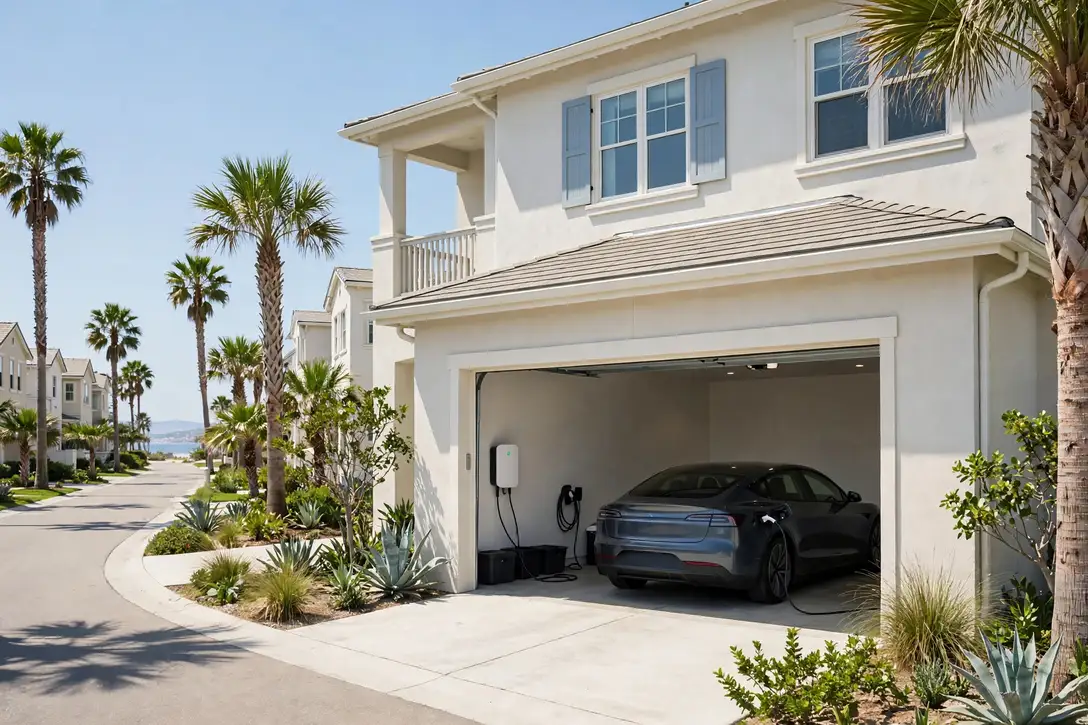
EV charging services in Gainesville
Installers in Gainesville book the same ten services as everywhere — but not in the same proportions. The three leading cards below are this city's pattern, set by its panels, its buildings and its statute book.
Home EV Charger Installation in Gainesville
One circuit, one station, one inspection: the residential install in its usual form. An installer sizes the circuit to the household's driving, mounts the station where the cable reaches the port without drama, sets its output to the circuit it landed on, and leaves the paperwork filed with the house.
In Gainesville: usually the first job a new EV household in Gainesville books, scoped to the panel the house already has.
Level 2 Charger Installation in Gainesville
Level 2 is where home charging becomes effortless: a dedicated 240-volt circuit returning a full battery overnight instead of a partial one by morning. The installer's work is the circuit itself — breaker, conductor, connection type — and the station's settings matched to it.
In Gainesville: what most Gainesville drivers mean when they say they want 'a real charger' — 240 volts, sized to the circuit.
Load Management & Smart Charging Setup in Gainesville
The device watches, the charger adapts, the house notices nothing. For homes whose arithmetic fails by a little — the common case — management converts an upgrade conversation into an equipment line, and the panel stays closed.
In Gainesville: pairs with time-of-use rates in Gainesville: charge when rates are lowest and capacity is spare.
Utility programs and electricity in Gainesville
Electricity in Gainesville comes from Georgia Power Co. Parts of the wider metro are served by Jackson Electric Member Corp, Sawnee Electric Membership Corporation, Habersham Electric Membership Corp. The utility matters twice over for a charger install: it sets the time-of-use rates that decide what overnight charging costs you, and it is the organisation that may — or may not — currently help pay for the equipment.
Current program (verified 2026-10-25): Georgia Power Co runs the Georgia Power EV Charger Rebate (residential) — Up to $150 toward a qualifying Level 2 home charger installation (installations Jan 1 - Dec 31, 2026). Program terms and funding status are published by the utility; check the current status before you plan around it, because funded programs close when their budgets run out. Source: Georgia Power's published program terms, cross-checked against a national incentive listing in October 2026.
For businesses and multifamily properties in the metro, the same utility has also published: $250/kW Level 2 and $150/kW DC fast charging for business/multifamily, up to $30,000 per project / $60,000 per year.
Solar households should read the export terms alongside the charging ones: the pair decides whether midday charging on home-working days beats the overnight window, and the answer is written in your tariff, not in general advice.
Condos, HOAs and the law in Georgia
No statute promises a charger approval in Georgia. Unlike the states that have enacted right-to-charge laws, Georgia leaves the question entirely to each community's covenants and board discretion. For Gainesville owners that is not the end of the road — it is a sign that the negotiation, the metering design and the written application carry the weight a statute would otherwise carry.
There is also a longer game available to Gainesville owners: associations revise their documents, boards turn over, and state legislatures have been adding right-to-charge laws year after year. A written application — and, if it comes to it, a written refusal — is the record that each of those futures works from.
For the full playbook — application contents, metering designs, the questions boards ask — see the condo and HOA charging guide. In Gainesville it should be read as a negotiation manual, because negotiation is what the absence of a statute leaves you.
Climate, garages and charger placement
In this climate the overnight window does double duty — rates are kinder and so are temperatures. Scheduling the charge for the small hours lets the car and the station work in the coolest air the day offers, which is easier on both. An installer who raises scheduling unprompted during the site visit is telling you they install in this heat regularly.
Heat also argues for headroom in the circuit decision. A car managing a hot battery after a hot commute draws on its own schedule; a generously sized circuit finishes the session inside the cool window instead of straddling the morning. It is a small thing, decided once, felt all summer.

Permits and inspection in Gainesville
What the inspector is checking, in plain terms: conductor size against breaker size, the continuous-load calculation, terminations torqued, protection where the code wants it, and a station whose settings match the circuit it landed on. It is a short visit that validates everything you cannot see.

Neighbourhoods and ZIP codes served
The page covers 5 ZIP codes in and around Gainesville — including 30501, 30503, 30504, 30506, 30507 — across Hall. If your ZIP is not in the first set shown, ask anyway: installer coverage follows the metro, not a postcode fence.
The same working area takes in the neighbouring localities of Oakwood, Chestnut Mountain, Gillsville, Murrayville, Flowery Branch, Lula, Clermont — the county ring an installer based in Gainesville actually drives. Requests from those communities route exactly as city requests do: same services, same permit discipline, same local facts where they differ.
Hall County accounts for 12 of the ZIP codes and 8 named postal localities in the research file, the nearest of them Oakwood, Chestnut Mountain, Gillsville, Murrayville, Flowery Branch. The survey counts 212,705 residents in the county, with a median household income of $80,901 and a median home value of $350,400. Measured across its ZIP codes, the Gainesville footprint runs about 7 miles north to south and 10 east to west, from ZIP 30501 to 30507 — the ground an installer based here actually covers in a working week.
Beyond the county seats, the working area takes in Oakwood, Chestnut Mountain, Gillsville, Murrayville, Flowery Branch, Talmo, Lula, Clermont, Braselton, Pendergrass, Maysville, Hoschton, Alto, Buford, Cumming, Dahlonega, Homer, Cleveland, Auburn, Dawsonville, Suwanee, Cornelia, Baldwin, Dacula, Demorest, Lawrenceville, Mount Airy, Helen, Marble Hill, Clarkesville, Sautee Nacoochee, Loganville, Ball Ground, Nelson, Tate, Suches, Toccoa Falls, Turnerville, Toccoa, Eastanollee, Tallulah Falls, Lakemont, Blairsville, Wiley, Tiger, Hiawassee, Long Creek — the named localities for which Gainesville is the nearest metro in the network (neighbouring metros' pages cover their own ground), each routing to the same installer-matching service.
The wider working area also reaches Jefferson, Winder, Nicholson, Norcross, Lilburn, Bethlehem, Statham, Ila, Danielsville, Stone Mountain, Atlanta, Snellville, Monroe, Hull, Jasper, Tucker, Colbert, Holly Springs, Canon, Woodstock, Waleska, Jersey, Marietta, Pine Lake, Comer, Redan, Decatur, Scottdale, Bowersville, Arnoldsville, Oxford, Avondale Estates, East Ellijay, Morganton, Bowman — ground shared with neighbouring metros, where installers cross the same county lines in both directions.
ZIP codes in that shared ground include 30012, 30017, 30029, 30048, 30054, 30067, 30078, 30086, 30087, 30088, 30093, 30095, 30096, 30097, 30098, 30115, 30143, 30328, 30333, 30340, 30341, 30515, 30529, 30539, 30549, 30553, 30599, 30602, 30604, 30608, 30609, 30612, 30623, 30628, 30633, 30638, 30645, 30666, 31145, 39901.
The largest communities in that working area after Gainesville itself, by the GeoNames populated-place file: Lawrenceville (population 30,493), Sugar Hill (population 21,747), Suwanee (population 18,694), Buford (population 13,748), Braselton (population 9,476), Toccoa (population 8,283), Auburn (population 7,524), Flowery Branch (population 6,683), Dahlonega (population 6,394), Cumming (population 5,718), Dacula (population 5,330), Cornelia (population 4,223), Oakwood (population 4,178), Cleveland (population 3,773), Jasper (population 3,762), Baldwin (population 3,286), Lula (population 2,879), Raoul (population 2,558), Dawsonville (population 2,525), Clayton (population 2,234). Charging demand follows those populations — the subdivisions and town centres where the next driveways, and the next panels, are.
Gwinnett County reaches into the working area with 979,864 residents, a median household income of $87,890 and a median home value of $380,900; its localities on this page include Buford, Suwanee, Dacula, Lawrenceville. Habersham County reaches into the working area with 47,793 residents, a median household income of $67,309 and a median home value of $238,300; its localities on this page include Alto, Cornelia, Demorest, Mount Airy, Clarkesville. Jackson County reaches into the working area with 84,757 residents, a median household income of $89,544 and a median home value of $345,000; its localities on this page include Talmo, Braselton, Pendergrass, Hoschton. Banks County reaches into the working area with 19,264 residents, a median household income of $77,063 and a median home value of $278,100; its localities on this page include Maysville, Homer, Baldwin. Forsyth County reaches into the working area with 267,287 residents, a median household income of $143,784 and a median home value of $550,400; its localities on this page include Cumming.
| ZIP | Locality | County |
|---|---|---|
| 30501 | Gainesville | Hall |
| 30504 | Gainesville | Hall |
| 30507 | Gainesville | Hall |
| 30506 | Gainesville | Hall |
| 30566 | Oakwood | Hall |
| 30502 | Chestnut Mountain | Hall |
| 30503 | Gainesville | Hall |
| 30543 | Gillsville | Hall |
| 30564 | Murrayville | Hall |
| 30542 | Flowery Branch | Hall |
| 30575 | Talmo | Jackson |
| 30554 | Lula | Hall |
| 30527 | Clermont | Hall |
| 30517 | Braselton | Jackson |
| 30567 | Pendergrass | Jackson |
| 30558 | Maysville | Banks |
| 30548 | Hoschton | Jackson |
| 30510 | Alto | Habersham |
| 30518 | Buford | Gwinnett |
| 30519 | Buford | Gwinnett |
| 30041 | Cumming | Forsyth |
| 30597 | Dahlonega | Lumpkin |
| 30533 | Dahlonega | Lumpkin |
| 30547 | Homer | Banks |
| 30040 | Cumming | Forsyth |
| 30528 | Cleveland | White |
| 30028 | Cumming | Forsyth |
| 30011 | Auburn | Barrow |
| 30534 | Dawsonville | Dawson |
| 30024 | Suwanee | Gwinnett |
| 30531 | Cornelia | Habersham |
| 30511 | Baldwin | Banks |
| 30019 | Dacula | Gwinnett |
| 30535 | Demorest | Habersham |
| 30043 | Lawrenceville | Gwinnett |
| 30049 | Lawrenceville | Gwinnett |
| 30046 | Lawrenceville | Gwinnett |
| 30563 | Mount Airy | Habersham |
| 30045 | Lawrenceville | Gwinnett |
| 30545 | Helen | White |
| 30148 | Marble Hill | Pickens |
| 30523 | Clarkesville | Habersham |
| 30571 | Sautee Nacoochee | White |
| 30052 | Loganville | Gwinnett |
| 30107 | Ball Ground | Cherokee |
| 30151 | Nelson | Cherokee |
| 30177 | Tate | Pickens |
| 30572 | Suches | Union |
| 30598 | Toccoa Falls | Stephens |
| 30580 | Turnerville | Habersham |
| 30577 | Toccoa | Stephens |
| 30538 | Eastanollee | Stephens |
| 30573 | Tallulah Falls | Rabun |
| 30552 | Lakemont | Rabun |
| 30514 | Blairsville | Union |
| 30512 | Blairsville | Union |
| 30581 | Wiley | Rabun |
| 30576 | Tiger | Rabun |
| 30546 | Hiawassee | Towns |
| 29658 | Long Creek | Oconee |

Planning the install: from panel to parking
Experienced Gainesville installers talk about 'the tell': the small observation that predicts the job. A panel directory in pencil with three generations of handwriting. A garage converted, then converted back. A charger-shaped hole in the household's plans — the second car already ordered. Mention your own tells at the visit; they are scope information, and scope named early is scope settled fairly.
Plan for the household you will be, not just the car you have. A second EV is the most common reason a charger circuit gets revisited, and the cheap moment to prepare for it — conduit sized up, panel capacity reserved, station placement that serves two bays — is during the first install, while the permit is open and the electrician is already in the panel.
Home charging know-how for Gainesville households
Historic districts and exterior rules
In a designated historic district, the charger's exterior footprint can need a second audience: the preservation commission, whose concern is the streetscape rather than the circuit. The designs that pass keep faith with that concern — equipment inside the garage where possible, conduit routed away from the principal facade, nothing mounted on historic fabric. It adds a step, not a saga, and local installers know their commission's habits the way they know their permit counter's.
When the garage is detached
A detached garage changes the install's centre of gravity: the circuit must travel. The route is usually a buried conduit run from the house panel, with depth, conduit type and the trench's path past roots, irrigation and paving all settled at the design stage — or, where the run is long and the loads justify it, a subpanel in the garage that also serves the workshop the building inevitably becomes. The charger at the end of that run behaves exactly like any other; it is the journey, measured in copper and digging, that defines the job.
Amps, volts and kilowatts without tears
Three numbers describe every charging session. Volts are the pressure — 240 of them on a Level 2 circuit. Amps are the flow — the circuit's rating, of which the car may continuously use eighty percent. Kilowatts are the product of the two and the speedometer of charging: volts times amps, divided by a thousand. A 40-amp circuit at 240 volts delivers 9.6 kilowatts; over a ten-hour night that is roughly 96 kilowatt-hours before losses — more than most batteries hold. Once the multiplication is familiar, every quote and specification sheet becomes readable.
Making the rate window automatic
Time-of-use tariffs reward households whose charging happens while the grid sleeps, and the reward compounds silently: every night, for the life of the car. The mechanism is trivial — a schedule set in the vehicle or the station — but the details decide whether it survives contact with real life: the window must fit the household's latest departure, the schedule must yield gracefully on the nights the car comes home empty, and the settings must live somewhere the household can find them again. Set it up at commissioning, with the installer, and the saving becomes infrastructure rather than intention.

Frequently asked questions
What charger rebates are currently running in Gainesville, GA?
Yes — Georgia Power Co's Georgia Power EV Charger Rebate (residential) currently offers Up to $150 toward a qualifying Level 2 home charger installation (installations Jan 1 - Dec 31, 2026) (program details verified 2026-10-25; funded programs can close, so confirm current status when you book). The old federal 30C charger credit ended on September 30, 2025, and is not part of any current offer.
Can my association in Gainesville, GA say no to a home charger?
Legally, yes — and it is better to know that before you buy the car. Georgia has enacted no right-to-charge law, so an association in Gainesville may refuse, condition or delay a charger under its covenants. The counterweight is a complete, documented application and, if refused, a written refusal citing the covenant — the record a future board or a future statute works from.
Does a Level 2 charger mean a panel upgrade for a Gainesville, GA home?
Start from the median, then verify: the median Gainesville home was built in 1994, and 28% of the stock predates 1980, so 100-amp panels are a normal sight here — and a normal candidate for either an upgrade or a load-management device. The load calculation distinguishes the two in one visit, and any quote that skips it is guessing with your money.
How quickly will a Level 2 charger fill my car in Gainesville, GA?
Level 2 is several-fold faster in the only unit that matters — miles back per hour parked: roughly 25–40 against Level 1's 3–5. The exact figure follows the circuit: a 40-amp circuit and a 60-amp circuit are both Level 2, and the car's onboard limit may sit below either. Your installer matches the three numbers at the site visit.
How does the installer matching on this page work?
Your request — service, Gainesville ZIP, property type and timing — goes to licensed local installers who cover Gainesville. They contact you directly to arrange a site visit and quote. PlugReady USA is the matching service, not the installer, and the sections above exist so you can judge any quote against the local facts.
Do installers cover the communities around Gainesville, GA?
Yes — an installer's working area is the county ring, not the city limit. From this page the same request flow covers Oakwood, Chestnut Mountain, Gillsville, Murrayville, Flowery Branch and the rest of Gainesville's surrounding localities, under the same permit discipline and the same local facts where they differ.
Nearby cities in Georgia
- EV charger installation in Athens — about 34 miles from Gainesville, metro population 215,000
- EV charger installation in Atlanta — about 48 miles from Gainesville, metro population 6,100,000
- EV charger installation in Dalton — about 71 miles from Gainesville, metro population 145,000
- EV charger installation in Rome — about 73 miles from Gainesville, metro population 100,000
- EV charger installation in Macon — about 104 miles from Gainesville, metro population 235,000
- EV charger installation in Augusta — about 118 miles from Gainesville, metro population 625,000
- EV charger installation in Greenville, SC — about 87 miles from Gainesville, metro population 975,000
- EV charger installation in Chattanooga, TN — about 96 miles from Gainesville, metro population 575,000
- EV charger installation in Spartanburg, SC — about 111 miles from Gainesville, metro population 355,000
Ready to charge at home in Gainesville?
Tell us the job — service, ZIP and property type — and licensed local installers will take it from there.