EV Charger Installation in Clarksville, TN
Everything a Clarksville homeowner needs before booking a charger install — the panel question, the utility's current programs, the HOA law and the permit — sourced, dated and local.
Start with the vehicle you already own and the driveway it already sleeps in: home charging succeeds when the electrical side is treated as a small building project rather than an accessory purchase. In Clarksville that project has local coordinates. Clarksville itself is home to about 185,680 people, inside a state counting 55,400 battery-electric vehicles and 16,100 plug-in hybrids through 2025. The utility serving your street, the vintage of your panel, the rules of your community and the habits of your permit office are the four coordinates — this page fixes each one for Clarksville.
Treat what follows as the site visit in written form. Each section is one of the stops a thorough installer makes — panel, tariff, property rules, permit — written out with Clarksville's facts in place, so that when the visit happens for real you can follow the reasoning and question it where it matters.
Measured demand, not enthusiasm, put Clarksville in Tier C of this network: Fort Campbell growth. For a homeowner the useful translation is simpler — installers here do this work weekly, know the local permit counter, and have seen your housing stock before.
Three percentages describe the working conditions for charging in Clarksville: 51% owner-occupied, 63% single-unit detached, and a median household income of $73,465 standing behind both. Everything in the sections below — panels, permissions, metering — is commentary on those proportions.

Every city charges differently, and Clarksville's difference is legible in the data: a comparatively young housing fabric, where modern services are the default; a detached-house majority with a real attached and multifamily minority; buildings of five or more units are a visible minority of the stock; owners hold a working majority, with renters a significant minority. Read the sections below through that profile and the local advice resolves into specifics — which questions are routine here, and which are rare.
In absolute terms, the survey counts 76,694 housing units in Clarksville — 72,910 occupied, 37,232 of them by their owners. The stock resolves into 48,161 single-unit detached houses, 18,796 homes standing since before 1980, and 11,298 units in larger buildings. Those six counts are the city's charging map drawn without percentages, and every section of this page is a consequence of one of them. The page's geography is equally concrete: 5 ZIP codes across Montgomery, centred near 36.52 degrees north latitude. The city anchors the Clarksville metropolitan area, home to roughly 320,000 people on the research file's metro estimate — the wider labour and housing market this page's installers work across.
The same survey release fills in the household economics around the housing stock: a median home value of $263,600, median gross rent of $1,307, per-capita income of $32,565, and a median resident age of 31. The movement data matters as much as the money data: 80% of Clarksville workers drive to work alone — the commute pattern home charging is built around; 8% work from home, a population whose cars charge on daytime and overnight schedules alike; 0% commute by public transit; 30% of adults hold a bachelor's degree or higher. Vehicle ownership, from the same release: 44,697 households in Clarksville run two or more vehicles, and 4,148 run none — the two ends of the market this page serves and does not serve.
The cost-burden lines say who feels housing costs most in Clarksville: 43% of renters spend 30% or more of income on rent, and 0% of owners with mortgages spend the same share on housing costs. Family households are 68% of all households — the two-car, school-run demographic whose charging patterns this page's planning sections keep circling back to.
This is the context an installer works against, whether it is written down or not. Recent construction also means recent everything else: AFCI and GFCI protection as built, grounding as designed, services sized for the loads of this century rather than the last one's. Variety is the installer's training programme here: no two days alike, the van stocked for houses and buildings alike, and a diary that reads like the housing survey performed live.
Renter weight gives this metro's charging story a negotiation at its centre: the circuit is easy, the permission is the project, and the paperwork patterns in the guides matter as much as any load calculation. Households at this band comparison-shop on scope rather than on slogans, which rewards the installer whose quote shows its working — the load study, the route, the permit, itemised. Scale brings a call centre, but it also brings published everything — interconnection standards, programme terms, complaint statistics — and the published page, not the phone call, is where this utility is most honest.
In the growth chapter, every institution is drafting: associations their rules, landlords their standard clauses, utilities their programme business cases — and complete applications help write all three drafts well. A smaller metro runs on relationships: the electrical firms are few, known, and booked through reputations maintained across decades of local work. Boards here decide without a statutory script, which makes precedent the currency: the first well-built application in a community quietly writes the policy for everyone after it.
The electrical reality in Clarksville homes
The survey's housing portrait for Clarksville opens with its median: a home built in 1999, in a stock where 25% of units predate 1980 and 63% stand detached on their own lots. 51% of occupied homes are owner-occupied. An installer reads those lines as a weather forecast: mostly settled conditions, with older wiring fronts moving through the pre-1980 districts. A comparatively young housing stock works in a charger's favour: most homes here were built with 200-amp service and modern panels, so the circuit itself is usually the whole job. The questions that remain are placement, wire-run length and whether the garage layout suits a wall-mounted station or a pedestal. Owner-occupiers can plan on their own timeline; renters and condo owners have an extra approval layer, which the law section below covers for this state.
One further survey line belongs in any Clarksville install conversation: 75% of the city's homes heat with electricity — 50,834 households whose panels already carry a major winter load before a charger is contemplated. Electric heat and EV charging are the two largest discretionary loads a house can host, and where they coincide, the load calculation stops being a formality.
One further split matters for how this page is organised: about 35,678 of Clarksville's occupied homes are renter-occupied. Everything above assumes you can approve your own electrical work; where you cannot, the approval layer — landlord or association — becomes part of the job, which is why the law section carries unusual weight here.
And 15% of Clarksville's homes are in buildings with five or more units — apartments and condominiums where charging is a building decision before it is an electrical one. If that is your situation, the law and multifamily sections of this page are the ones written for you.
EV charging services in Clarksville
Ten services cover the work installers do in Clarksville. Three lead the list here because of what this city's housing and law actually look like — each links to its national service page, where scope and process are set out in full.
Home EV Charger Installation in Clarksville
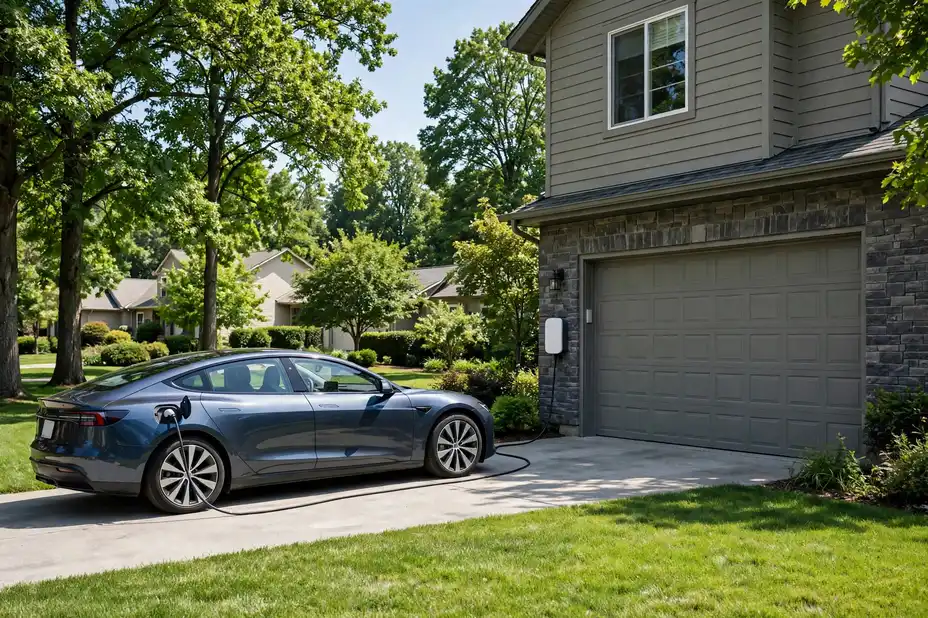
Start to finish, the domestic install is a half-day of electrical work wrapped in a week of scheduling: the survey, the circuit, the mounting, the configuration, the inspection. What the household experiences is simpler — a car that is full every morning and a cable that lives where the car does.
In Clarksville: where most Clarksville projects start and finish: one circuit, one station, one inspection.
Level 2 Charger Installation in Clarksville
The step from a household receptacle to a Level 2 circuit is the step from sipping to drinking: the car takes energy at the rate family life actually consumes it. The work is a breaker, a run of appropriately gauged conductor, and a connection made to torque — modest materials, permanent consequences.
In Clarksville: the circuit class behind nearly every home install in Clarksville, from first car to second.
Load Management & Smart Charging Setup in Clarksville
Load management is the code-recognised way to let a full panel tell the truth: the house's real load is spiky, not constant, and a managed charger lives in the valleys. The result reads like a bigger service on every ordinary night of the year.
In Clarksville: pairs with time-of-use rates in Clarksville: charge when rates are lowest and capacity is spare.
Utility programs and electricity in Clarksville
Electricity in Clarksville comes from Cumberland Elec Member Corp. Parts of the wider metro are served by City of Clarksville, City of Dickson. The utility matters twice over for a charger install: it sets the time-of-use rates that decide what overnight charging costs you, and it is the organisation that may — or may not — currently help pay for the equipment.
There is a strategic consequence to the empty incentive shelf in Clarksville: the install decision reduces to the work itself and the tariff it runs on. With no rebate distorting the comparison, quotes compete on scope, licensing and the load calculation's honesty — which is the competition homeowners should want. And the overnight rate window, where Cumberland Elec Member Corp offers one, quietly returns more over the car's life than most one-off rebates ever did.
While you are reading your tariff, check how your plan treats the evening peak. A charger scheduled to start after the peak window is the single easiest saving in home charging, and it is set once, in the car or the station, then forgotten.
Condos, HOAs and the law in Tennessee
No statute promises a charger approval in Tennessee. Unlike the states that have enacted right-to-charge laws, Tennessee leaves the question entirely to each community's covenants and board discretion. For Clarksville owners that is not the end of the road — it is a sign that the negotiation, the metering design and the written application carry the weight a statute would otherwise carry.
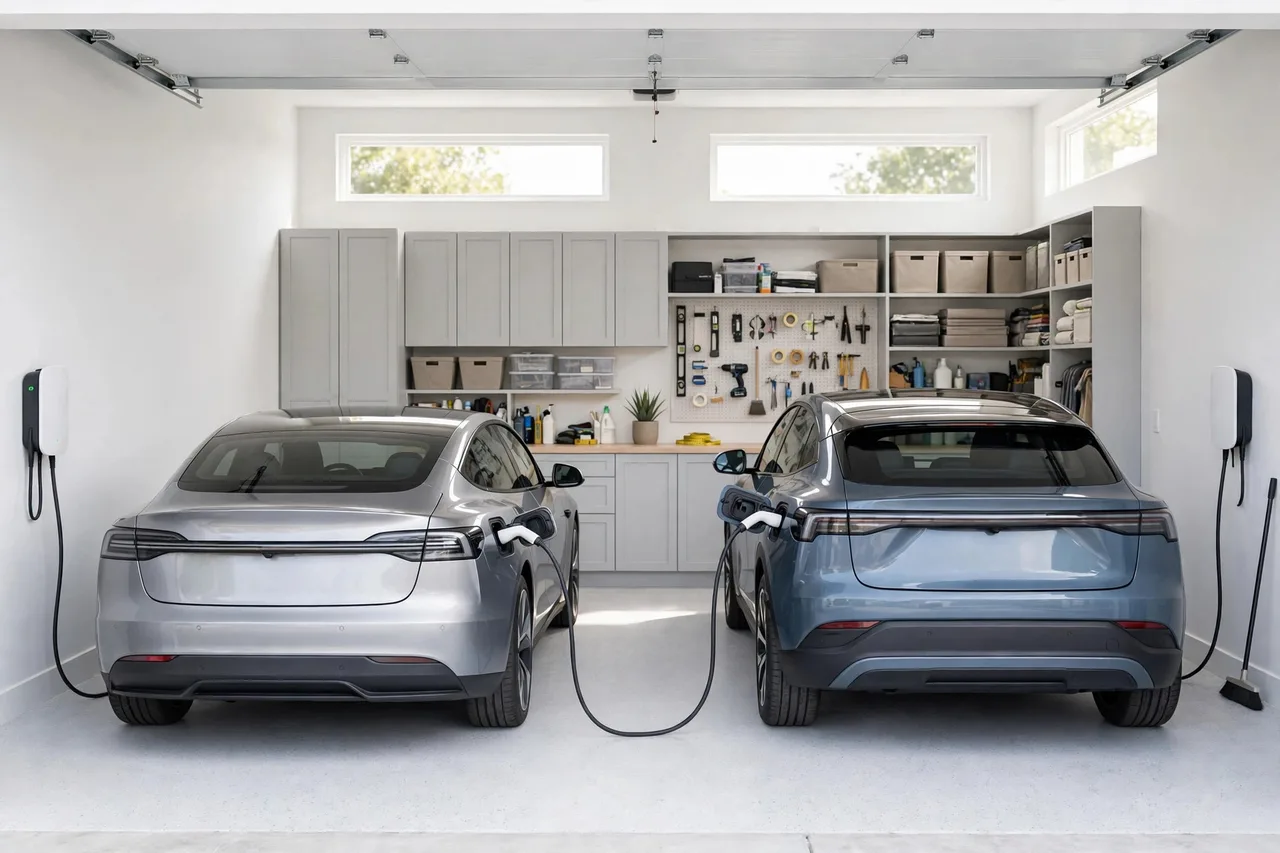
No law does not mean no path. Boards approve chargers every week when the proposal answers their real concerns in advance: a licensed installer, a dedicated circuit that touches nothing shared, metering that keeps the electricity cost on the owner, insurance, and a commitment to restore the space on removal. Bring that package, in writing, before the meeting — not during it.
For the full playbook — application contents, metering designs, the questions boards ask — see the condo and HOA charging guide. In Clarksville it should be read as a negotiation manual, because negotiation is what the absence of a statute leaves you.
Climate, garages and charger placement
Leaf-fall and pollen sound beneath an electrician's notice until they are inside a connector left lying open. The holster habit — connector docked, cap where the design provides one — is the entire countermeasure, and it is free.
A four-season spec sheet is a compromise written in equipment ratings: cable jackets flexible at the January low, electronics rated past the July high, an enclosure indifferent to both. The listed gear covers it; placement decides the rest.

Permits and inspection in Clarksville
Timelines are set by the city's counter, not the installer: the electrical work itself is typically a day, while permit issuance and the inspection visit follow the department's queue. A quote that promises a date should tell you which parts of that date the installer actually controls.

Neighbourhoods and ZIP codes served
The page covers 5 ZIP codes in and around Clarksville — including 37040, 37041, 37042, 37043, 37044 — across Montgomery. If your ZIP is not in the first set shown, ask anyway: installer coverage follows the metro, not a postcode fence.
The same working area takes in the neighbouring localities of Woodlawn, Palmyra, Cunningham, Southside — the county ring an installer based in Clarksville actually drives. Requests from those communities route exactly as city requests do: same services, same permit discipline, same local facts where they differ.
Montgomery County accounts for 9 of the ZIP codes and 5 named postal localities in the research file, the nearest of them Woodlawn, Palmyra, Cunningham, Southside. The survey counts 234,153 residents in the county, with a median household income of $75,613 and a median home value of $280,200. Measured across its ZIP codes, the Clarksville footprint runs about 7 miles north to south and 8 east to west, from ZIP 37040 to 37044 — the ground an installer based here actually covers in a working week.
Beyond the county seats, the working area takes in Woodlawn, Palmyra, Cunningham, Oak Grove, Fort Campbell, Southside, Adams, Trenton, Chapmansboro, Slayden, Guthrie, Cumberland Furnace, Pembroke, Indian Mound, Cumberland City, Herndon, La Fayette, Cedar Hill, Pleasant View, Charlotte, Allensville, Vanleer, Big Rock, Fairview, Erin, Hopkinsville, Dickson, Olmstead, Tennessee Ridge, Elkton, Gracey, Bumpus Mills, Dover, Adairville, Sharon Grove, Stewart, Mc Ewen, Cadiz, Russellville, Cerulean, Clifty, Crofton, Waverly, Lewisburg, New Concord, Auburn, Dunmor, Big Sandy, Eva, Buchanan — the named localities for which Clarksville is the nearest metro in the network (neighbouring metros' pages cover their own ground), each routing to the same installer-matching service.
The wider working area also reaches Ashland City, Springfield, Joelton, White Bluff, Nashville, Greenbrier, Kingston Springs, Burns, Ridgetop, Pegram, Whites Creek, Orlinda, Goodlettsville, Cross Plains, White House, Madison, Bon Aqua, Cottontown, Hendersonville, Franklin — ground shared with neighbouring metros, where installers cross the same county lines in both directions.
ZIP codes in that shared ground include 37015, 37025, 37029, 37048, 37049, 37062, 37069, 37072, 37073, 37077, 37082, 37115, 37116, 37187, 37201, 37202, 37204, 37205, 37207, 37208, 37209, 37210, 37212, 37213, 37216, 37219, 37220, 37224, 37227, 37228, 37229, 37230, 37232, 37234, 37235, 37236, 37240, 37241, 37243, 37246.
The largest communities in that working area after Clarksville itself, by the GeoNames populated-place file: Bowling Green (population 63,616), Hopkinsville (population 32,205), Paducah (population 24,864), Murray (population 18,954), Dickson (population 15,359), Fort Campbell North (population 13,685), Mayfield (population 10,080), Morehead (population 7,622), Oak Grove (population 7,444), Russellville (population 7,056), Princeton (population 6,174), Farley (population 4,701), Hendron (population 4,687), Massac (population 4,505), Reidland (population 4,491), Greenville (population 4,395), Benton (population 4,357), Pleasant View (population 4,295), Waverly (population 4,090), Dawson Springs (population 2,737). Charging demand follows those populations — the subdivisions and town centres where the next driveways, and the next panels, are.
Dickson County reaches into the working area with 55,983 residents, a median household income of $75,003 and a median home value of $306,400; its localities on this page include Slayden, Cumberland Furnace, Charlotte, Vanleer, Dickson. Stewart County reaches into the working area with 14,027 residents, a median household income of $63,114 and a median home value of $204,700; its localities on this page include Indian Mound, Cumberland City, Big Rock, Bumpus Mills, Dover. Houston County reaches into the working area with 8,353 residents, a median household income of $59,576 and a median home value of $172,700; its localities on this page include Erin, Tennessee Ridge, Stewart. Robertson County reaches into the working area with 75,539 residents, a median household income of $83,047 and a median home value of $335,000; its localities on this page include Adams, Cedar Hill. Cheatham County reaches into the working area with 41,829 residents, a median household income of $89,852 and a median home value of $338,700; its localities on this page include Chapmansboro, Pleasant View.
| ZIP | Locality | County |
|---|---|---|
| 37040 | Clarksville | Montgomery |
| 37044 | Clarksville | Montgomery |
| 37041 | Clarksville | Montgomery |
| 37043 | Clarksville | Montgomery |
| 37042 | Clarksville | Montgomery |
| 37191 | Woodlawn | Montgomery |
| 37142 | Palmyra | Montgomery |
| 37052 | Cunningham | Montgomery |
| 42262 | Oak Grove | Christian |
| 42223 | Fort Campbell | Christian |
| 37171 | Southside | Montgomery |
| 37010 | Adams | Robertson |
| 42286 | Trenton | Todd |
| 37035 | Chapmansboro | Cheatham |
| 37165 | Slayden | Dickson |
| 42234 | Guthrie | Todd |
| 37051 | Cumberland Furnace | Dickson |
| 42266 | Pembroke | Christian |
| 37079 | Indian Mound | Stewart |
| 37050 | Cumberland City | Stewart |
| 42236 | Herndon | Christian |
| 42254 | La Fayette | Christian |
| 37032 | Cedar Hill | Robertson |
| 37146 | Pleasant View | Cheatham |
| 37036 | Charlotte | Dickson |
| 42204 | Allensville | Todd |
| 37181 | Vanleer | Dickson |
| 37023 | Big Rock | Stewart |
| 42221 | Fairview | Christian |
| 37061 | Erin | Houston |
| 42240 | Hopkinsville | Christian |
| 42241 | Hopkinsville | Christian |
| 37056 | Dickson | Dickson |
| 42265 | Olmstead | Logan |
| 37178 | Tennessee Ridge | Houston |
| 42220 | Elkton | Todd |
| 42232 | Gracey | Christian |
| 37028 | Bumpus Mills | Stewart |
| 37058 | Dover | Stewart |
| 42202 | Adairville | Logan |
| 37055 | Dickson | Dickson |
| 42280 | Sharon Grove | Todd |
| 37175 | Stewart | Houston |
| 37101 | Mc Ewen | Humphreys |
| 42211 | Cadiz | Trigg |
| 42276 | Russellville | Logan |
| 42215 | Cerulean | Trigg |
| 42216 | Clifty | Todd |
| 42217 | Crofton | Christian |
| 37185 | Waverly | Humphreys |
| 42256 | Lewisburg | Logan |
| 42076 | New Concord | Calloway |
| 42206 | Auburn | Logan |
| 42339 | Dunmor | Muhlenberg |
| 38221 | Big Sandy | Benton |
| 38333 | Eva | Benton |
| 38222 | Buchanan | Henry |

Planning the install: from panel to parking
Walk the route before anyone quotes the route. Between Clarksville's panels and its parking spaces lie the job's real variables: a finished ceiling or an open one, a straight shot through a shared wall or a tour of the attic, forty feet of conductor or a hundred and forty. Installers who quote from photographs quote the average of all routes; installers who walk yours quote the one you actually have. The site visit is where the quote stops being a genre and becomes a document.
Plan for the household you will be, not just the car you have. A second EV is the most common reason a charger circuit gets revisited, and the cheap moment to prepare for it — conduit sized up, panel capacity reserved, station placement that serves two bays — is during the first install, while the permit is open and the electrician is already in the panel.
Home charging know-how for Clarksville households
Carports and the condensation line
A carport shelters the car from rain but not from air, and overnight condensation is its signature: cool surfaces, damp mornings, connectors beaded with moisture. Equipment listed for the exposure handles it as routine; the details are in drainage and holstering — a connector docked nose-down in its holder sheds water, one left coiled on the slab collects it. Small physics, daily consequences.
Household safety habits around the charger
A charging setup joins a household's ordinary safety landscape — the same category as the stove and the water heater: respected, listed, and left to do its job. The household habits are few. The cable lives off the floor where small feet and wheels travel; the connector is docked, not dangled; children learn the house rule that the charger is an appliance, not a toy, the way they learn the oven's. Nothing about a properly installed station asks for anxiety — just the standard respect electricity has always been owed.
Smart features, soberly assessed
Connectivity buys three real things in a charging station: scheduling against rate windows, session records the household can actually read, and power sharing between stations. It does not buy speed — the circuit decides that — and a station whose network features fail should still charge the car, which the good ones do. Households deep in a smart-home ecosystem may value the integrations; everyone else should choose on the electrical merits and treat the application as a bonus. Either way, the configuration that matters is set at commissioning: rate, schedule, and the circuit's limit, recorded on the paperwork.
Amps, volts and kilowatts without tears
Three numbers describe every charging session. Volts are the pressure — 240 of them on a Level 2 circuit. Amps are the flow — the circuit's rating, of which the car may continuously use eighty percent. Kilowatts are the product of the two and the speedometer of charging: volts times amps, divided by a thousand. A 40-amp circuit at 240 volts delivers 9.6 kilowatts; over a ten-hour night that is roughly 96 kilowatt-hours before losses — more than most batteries hold. Once the multiplication is familiar, every quote and specification sheet becomes readable.

Frequently asked questions
Can I still get the federal tax credit for a home charger in Clarksville, TN?
Checked and dated: in the sources reviewed for this page, Cumberland Elec Member Corp runs no residential charger rebate, Tennessee runs no home-charger programme, and the federal credit that once filled the gap ended on September 30, 2025. If a salesperson's spreadsheet shows a rebate line for a Clarksville install, the published programme page is the only acceptable evidence.
What can my HOA in Clarksville, TN do about a charger install?
They hold the stronger hand in Tennessee: with no right-to-charge statute on the books, a Clarksville association's covenants are the law of the car park. The applications that succeed anyway share a shape — owner-funded, licensed installer, metered energy, insured, reversible — because they answer the board's risk questions in advance and in writing.
Panel upgrade or not — how do Clarksville, TN homeowners find out?
It hinges on two numbers you cannot read off the panel door: the service's rating, and what the load calculation says it already carries. The vintage of Clarksville's stock — median build year 1999, about 25% of homes from before 1980 — means both answers are common here. The charger enters the arithmetic at 125% of its draw; whatever room survives that entry decides between a circuit, a management device, and an upgrade.
How much faster is Level 2 charging at home in Clarksville, TN?
Think of it in parked hours. Level 1 gives you back 3–5 miles for each of them; Level 2 gives back about 25–40, set by the circuit's amperage and what the car can accept. Overnight, that is the gap between 'enough for tomorrow' and 'full, every morning'.
How does the installer matching on this page work?
Your request is matched to licensed installers covering Clarksville, Tennessee — service, ZIP, property type and timing travel with it. The installer who takes it arranges the site visit and quotes in writing; PlugReady USA's part is the research on this page and the introduction, and your contract is with the installer throughout.
Do installers cover the communities around Clarksville, TN?
Yes — an installer's working area is the county ring, not the city limit. From this page the same request flow covers Woodlawn, Palmyra, Cunningham, Southside and the rest of Clarksville's surrounding localities, under the same permit discipline and the same local facts where they differ.
Nearby cities in Tennessee
- EV charger installation in Nashville — about 40 miles from Clarksville, metro population 2,050,000
- EV charger installation in Jackson — about 102 miles from Clarksville, metro population 175,000
- EV charger installation in Chattanooga — about 152 miles from Clarksville, metro population 575,000
- EV charger installation in Knoxville — about 194 miles from Clarksville, metro population 925,000
- EV charger installation in Kingsport — about 264 miles from Clarksville, metro population 305,000
- EV charger installation in Johnson City — about 277 miles from Clarksville, metro population 210,000
- EV charger installation in Evansville, IN — about 103 miles from Clarksville, metro population 360,000
- EV charger installation in Florence, AL — about 118 miles from Clarksville, metro population 150,000
- EV charger installation in Huntsville, AL — about 131 miles from Clarksville, metro population 525,000
Ready to charge at home in Clarksville?
Two minutes of form, and the request is in front of licensed installers who cover this city — quotes follow site visits, in writing.