EV Charger Installation in Buffalo, NY
Home Level 2 charging, panel upgrades and condo installs in Buffalo — matched to licensed local installers, with the local facts that shape the job set out below.
Every home charger installation is the same four decisions wearing local clothes: capacity in the panel, a route for the circuit, a position for the station, and paperwork that proves it was done properly. What changes from city to city is the content of those decisions — and in Buffalo the content is specific. Buffalo itself is home to about 276,618 people. New York's registered fleet stood at 209,300 battery-electric vehicles and 125,100 plug-in hybrids at the end of 2025, and this page works through the local version of each decision: your utility and its programs, your state's association law, your permit counter, and your housing stock's electrical habits.
How this page is organised matters less than what is in it: verified local facts, stated with their sources, so you can check them yourself. PlugReady USA matches homeowners in Buffalo with licensed local installers; the detail below is the homework we would want done before anyone quotes the job.
What the Experian and AFDC registration data say about Buffalo–Cheektowaga: Experian growth +18.7%. Translated out of market language: your neighbours are already charging at home, the permit office already knows the paperwork, and the installers already know the housing stock.
Context from the Census Bureau's survey of Buffalo: median household income $52,211; 47% of occupied homes are owner-occupied; 37% of housing units are single-unit detached houses. It is the profile of a city where the typical charger job is a homeowner job — scoped by the panel and the wire run, not by permissions.

The composite picture matters more than any single statistic. In Buffalo: an older housing fabric, where panel archaeology is a normal part of the first visit; a genuinely mixed city — houses, townhouses and larger buildings all carry weight; buildings of five or more units are a visible minority of the stock; meanwhile, renters form a large share of households, so the landlord conversation is a first-class topic here. A page that ignored that profile would give the same advice everywhere; this one is ordered by it.
The counts behind the percentages, for the record: Buffalo has 136,533 housing units on the survey's count, 119,620 of them occupied, and 55,745 owner-occupied households making their own electrical decisions. Detached houses number 49,990; homes built before 1980 number 123,133; units in buildings of five or more number 24,185. An installer's week in this city is a walk through exactly that distribution. The page's geography is equally concrete: 44 ZIP codes across Erie, centred near 42.90 degrees north latitude. The city anchors the Buffalo–Cheektowaga metropolitan area, home to roughly 1,125,000 people on the research file's metro estimate — the wider labour and housing market this page's installers work across.
The same survey release fills in the household economics around the housing stock: a median home value of $187,000, median gross rent of $1,142, per-capita income of $32,455, and a median resident age of 34. The movement data matters as much as the money data: 63% of Buffalo workers drive to work alone — the commute pattern home charging is built around; 11% work from home, a population whose cars charge on daytime and overnight schedules alike; 7% commute by public transit; 33% of adults hold a bachelor's degree or higher. The survey's vehicle table is the one an EV page should quote first: 23,813 of Buffalo's households have no vehicle at all, while 38,968 have two or more — the multi-car households for whom the second circuit is a when, not an if.
Two burden statistics frame the economics: in Buffalo, 48% of renters and 0% of mortgage-holding owners are housing-cost burdened at the standard 30% threshold. And 50% of households are family households, the segment most likely to run the two-vehicle, two-schedule pattern the second-vehicle planning notes address.
Taken as one portrait, the numbers describe a specific charging market. Pre-war and immediate post-war streets dominate the map, and their electrical fabric is stratified — original services beneath mid-century additions beneath modern subpanels, an archaeology the load calculation reads layer by layer. The built form refuses a single story: houses with garages on one side of the arterial, garden apartments and mid-rise condos on the other, each population charging by different rules.
Where renting dominates, the successful install is a document before it is a device — installer licence, insurance, metering clarity, end-of-tenancy position — assembled to make a landlord's yes the path of least resistance. Budget discipline shapes the specification — the circuit sized exactly, the management device considered wherever it defers a service upgrade, every scope line asked to justify itself. Filed tariffs and public dockets give this territory a paper trail most markets lack: the diligent household can read the utility's own electrification plan and know which programmes are funded, piloted or merely proposed.
The used-EV wave has arrived at this fleet scale, and it democratises the install question: households that bought electric second-hand, at family-car money, asking the same panel questions as the pioneers — with better local answers available. A mid-sized metro's market has a particular shape: a handful of established electrical firms, a few charging specialists, and word of mouth that travels fast enough to discipline all of them. The association dimension, at least, comes with a statutory frame in this state — the law section above sets out what boards may and may not do, and applications written inside that frame travel noticeably faster.
The electrical reality in Buffalo homes
The Census Bureau's latest American Community Survey puts the median Buffalo home's build year at 1938: about 90% of the city's housing units were built before 1980, 37% are single-unit detached houses, and 47% of occupied homes are owner-occupied. Those three numbers predict most of what an installer will find. A housing stock this age leans on smaller electrical services — 100-amp panels are common, and fuse-era equipment still turns up in the oldest streets. For many of those homes the honest answer is a panel upgrade or a load-management device before the charger circuit goes in, and a good installer will show you the load calculation rather than asking you to take it on faith. Garages here earn their keep across the year — workshop, storage and storm shelter by turns — so a station position that survives the household's real parking pattern matters more than the technically neatest wall.
The fuel table adds one more local fact: 11,507 Buffalo homes — 10% of the stock — heat with electricity. Those households already think in kilowatts through the winter, their panels carry the load to prove it, and a charger's overnight appetite joins a system that is, in the useful sense, already electrified.
Renters are the other constituency in these numbers: about 63,875 of Buffalo's occupied homes are rented rather than owned. Their charging route runs through a landlord conversation instead of a panel they control — a different project, covered by the rentals guide and the law section below, but a routine one in a city with this many renting households.
One more structural fact shapes Buffalo's charging map: 18% of the city's housing units sit in buildings of five or more units. Those households cannot simply book a circuit — their charger runs through a building, a board and a shared electrical service, which is why the multifamily service and the law section below carry unusual weight on this page.
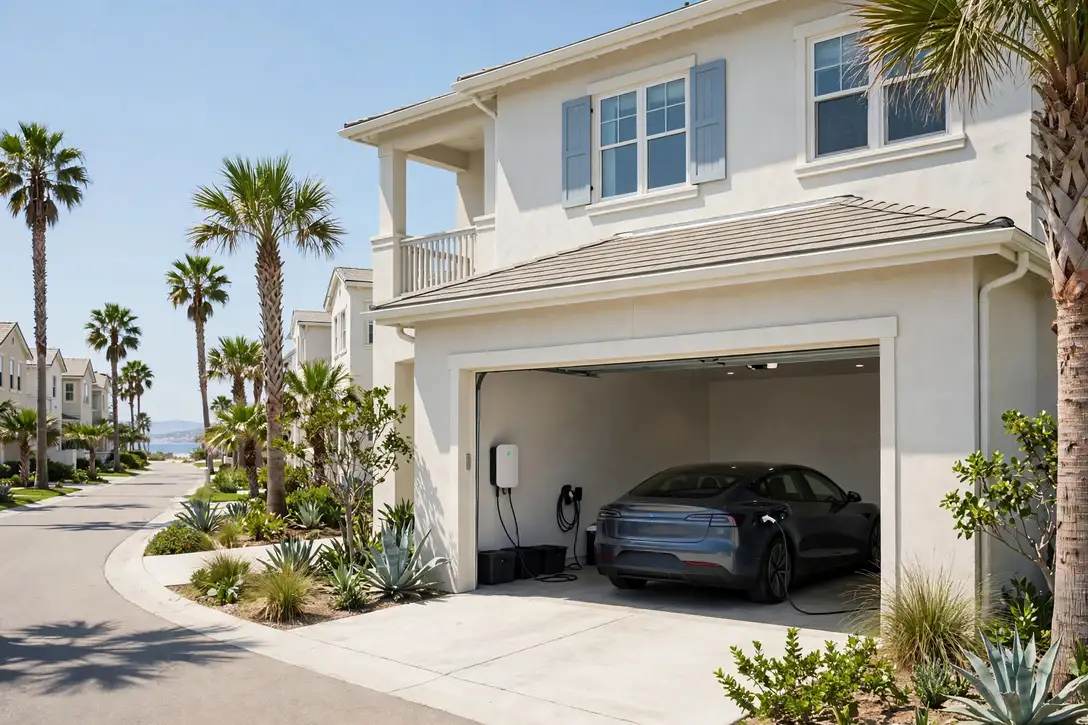
EV charging services in Buffalo
The services below are ordered by what Buffalo households most often need first, judged from the housing and fleet facts on this page. The full menu follows in the grid — every service is offered in this metro.
Home EV Charger Installation in Buffalo
The residential standard: a station where the car sleeps, on a circuit of its own, installed under permit. Variations are all local — the panel's spare room, the run's route through the house's fabric, and the parking pattern the cable has to serve.
In Buffalo: where most Buffalo projects start and finish: one circuit, one station, one inspection.
Dedicated Circuit & Electrical Panel Upgrade in Buffalo
Some homes meet the charger at the panel door: the service is already spoken for by cooking, heating and hot water. This service is the honest fix — capacity added properly, grounding brought current, and a panel schedule that finally matches the house it feeds.
In Buffalo: the job that surfaces wherever housing is older — and Buffalo's stock makes it a routine conversation, settled by a load calculation.
Multifamily & Condo EV Charging in Buffalo
The building version of the home job, with a governance layer on top. Boards approve complete applications; residents pay for their own energy through the metering design; the building's capacity is shared by management rather than by argument. That system is what this service installs.
In Buffalo: the approvals-plus-wiring job for Buffalo's condos and HOA communities, where the process matters as much as the circuit.
Utility programs and electricity in Buffalo
Electricity in Buffalo comes from Niagara Mohawk Power Corp.. Parts of the wider metro are served by New York State Elec & Gas Corp, Village of Arcade, Village of Springville. The utility matters twice over for a charger install: it sets the time-of-use rates that decide what overnight charging costs you, and it is the organisation that may — or may not — currently help pay for the equipment.
Rebate archaeology is a local sport: an old Niagara Mohawk Power Corp. program page, a neighbour's 2023 install story, a screenshot of terms nobody can date. The record for Buffalo, as checked for this page, is simpler. The federal credit closed on September 30, 2025; New York operates no home-charger program; and no active Niagara Mohawk Power Corp. residential charger rebate appears in current published sources. Funded rounds do reopen in this industry — on the utility's timetable, announced on the utility's site, and worth exactly what their published terms say on the day you read them.
While you are in the tariff pages, look at how the plan values the evening ramp — the hours when cooking, cooling and charging would otherwise stack. A charger that starts after the ramp is the simplest scheduling decision in home charging, and it is set once.
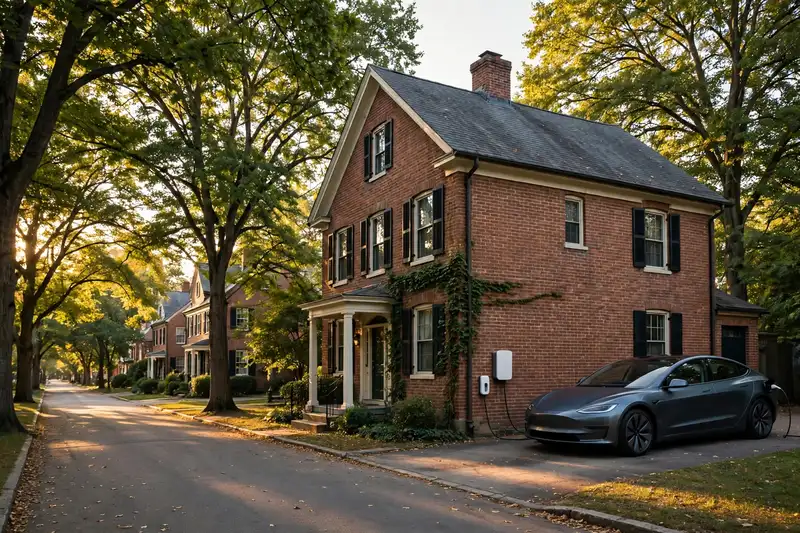
Condos, HOAs and the law in New York
An association in New York cannot simply say no. The right-to-charge law recorded for this state (RPL §339-kk / §339-LL (cited both ways — confirm at build)) entitles an owner to install charging equipment for their own vehicle in their own parking space, subject to reasonable association conditions on placement, insurance and eventual restoration. For a Buffalo owner, the practical consequence is that the application is a compliance exercise — equipment, circuit, paperwork — rather than a popularity contest at a board meeting.
If your board is stalling, the sequence that works in Buffalo is boring and effective: cite the statute, submit a complete application (equipment, circuit, installer licence, insurance), and keep everything in writing.
Read the full process in our guide to installing an EV charger in a condo or HOA community, and the multifamily and condo charging service page for how shared and assigned-space installs are designed.
Climate, garages and charger placement
A four-season spec sheet is a compromise written in equipment ratings: cable jackets flexible at the January low, electronics rated past the July high, an enclosure indifferent to both. The listed gear covers it; placement decides the rest.
Storm seasons punctuate the year here, and the installation's weather manners are set at mounting time: enclosures sealed as listed, exterior runs pitched so water travels away from entries, and a station position that the roof's drip line does not cross. Five minutes of the site visit, decades of consequence.

Permits and inspection in Buffalo
Inspection day itself is undramatic by design: access to the panel and the station, the calculation on hand, the equipment's settings matching the circuit. Jobs fail inspection on paperwork mismatches far more often than on wiring — a fact that quietly grades installers.

Neighbourhoods and ZIP codes served
The page covers 44 ZIP codes in and around Buffalo — including 14201, 14202, 14203, 14204, 14205, 14206, 14207, 14208, 14209, 14210, 14211, 14212, 14213, 14214, 14215, 14216, 14217, 14218, 14219, 14220, 14221, 14222, 14223, 14224, 14225, 14226, 14227, 14228, 14231, 14233, 14240, 14241, 14260, 14261, 14263, 14264, 14265, 14267, 14269, 14270, 14272, 14273, 14276, 14280 — across Erie. If your ZIP is not in the first set shown, ask anyway: installer coverage follows the metro, not a postcode fence.
The same working area takes in the neighbouring localities of Tonawanda, Athol Springs, Grand Island, Depew, Bowmansville, Getzville, Hamburg, Orchard Park, Lancaster, Lake View, Spring Brook, North Evans, East Amherst, Elma — the county ring an installer based in Buffalo actually drives. Requests from those communities route exactly as city requests do: same services, same permit discipline, same local facts where they differ.
Erie County accounts for 87 of the ZIP codes and 43 named postal localities in the research file, the nearest of them Tonawanda, Athol Springs, Grand Island, Depew, Bowmansville. The survey counts 950,622 residents in the county, with a median household income of $72,839 and a median home value of $233,800. Measured across its ZIP codes, the Buffalo footprint runs about 20 miles north to south and 8 east to west, from ZIP 14201 to 14280 — the ground an installer based here actually covers in a working week.
Beyond the county seats, the working area takes in Tonawanda, Athol Springs, Grand Island, Depew, North Tonawanda, Bowmansville, Getzville, Hamburg, Orchard Park, Lancaster, Lake View, Spring Brook, Niagara Falls, North Evans, East Amherst, Elma, Derby, North Boston, Clarence, Clarence Center, Sanborn, Eden, West Falls, East Aurora, Marilla, Niagara University, Colden, Alden, Boston, Angola, Lewiston, Model City, Lockport, North Collins, Wales Center, Akron, Stella Niagara, South Wales, Crittenden, Ransomville, Farnham, Brant, Irving, Glenwood, Lawtons, Cowlesville, Youngstown, Holland, Versailles, Collins, Darien Center, Strykersville, Gasport, Corfu, Newfane, Wilson, Collins Center, Springville, East Concord, Java Village, Silver Creek, Gowanda, Basom, Perrysburg, Burt, Middleport, Chaffee, Java Center, Appleton, Olcott, East Pembroke, Sardinia, Varysburg, Attica, North Java, Dayton, Yorkshire, Sheridan, Forestville, Alexander, Arcade, West Valley, Medina, East Otto, Delevan, Barker, South Dayton, Dunkirk, Otto, Cattaraugus, Dale, Machias, Sandusky, Fredonia, Freedom, Bliss, Leon, Warsaw, Cherry Creek, Van Buren Point, Ellicottville, Gainesville, Farmersville Station, Cassadaga, Conewango Valley, Little Valley, Lily Dale — the named localities for which Buffalo is the nearest metro in the network (neighbouring metros' pages cover their own ground), each routing to the same installer-matching service.
The wider working area also reaches Oakfield, Batavia, Knowlesville, Lyndonville, East Bethany, Elba, Stafford, Albion, Wyoming — ground shared with neighbouring metros, where installers cross the same county lines in both directions.
ZIP codes in that shared ground include 14020, 14021, 14054, 14058, 14098, 14125, 14143, 14411, 14479, 14591.
The largest communities in that working area after Buffalo itself, by the GeoNames populated-place file: Amherst (population 122,366), Cheektowaga (population 75,178), Niagara Falls (population 48,916), West Seneca (population 44,711), North Tonawanda (population 30,785), East Amherst (population 24,914), Grand Island (population 20,813), Lockport (population 20,624), Lackawanna (population 17,965), Kenmore (population 15,160), Depew (population 15,146), Eggertsville (population 15,019), Tonawanda (population 14,907), Olean (population 13,870), Dunkirk (population 12,081), Fredonia (population 10,705), Lancaster (population 10,258), Hamburg (population 9,576), Bradford (population 8,507), South Lockport (population 8,324). Charging demand follows those populations — the subdivisions and town centres where the next driveways, and the next panels, are.
| ZIP | Locality | County |
|---|---|---|
| 14201 | Buffalo | Erie |
| 14202 | Buffalo | Erie |
| 14205 | Buffalo | Erie |
| 14276 | Buffalo | Erie |
| 14280 | Buffalo | Erie |
| 14203 | Buffalo | Erie |
| 14264 | Buffalo | Erie |
| 14213 | Buffalo | Erie |
| 14222 | Buffalo | Erie |
| 14209 | Buffalo | Erie |
| 14204 | Buffalo | Erie |
| 14208 | Buffalo | Erie |
| 14212 | Buffalo | Erie |
| 14211 | Buffalo | Erie |
| 14207 | Buffalo | Erie |
| 14216 | Buffalo | Erie |
| 14214 | Buffalo | Erie |
| 14206 | Buffalo | Erie |
| 14210 | Buffalo | Erie |
| 14215 | Buffalo | Erie |
| 14220 | Buffalo | Erie |
| 14217 | Buffalo | Erie |
| 14223 | Buffalo | Erie |
| 14218 | Buffalo | Erie |
| 14226 | Buffalo | Erie |
| 14150 | Tonawanda | Erie |
| 14227 | Buffalo | Erie |
| 14225 | Buffalo | Erie |
| 14219 | Buffalo | Erie |
| 14241 | Buffalo | Erie |
| 14151 | Tonawanda | Erie |
| 14224 | Buffalo | Erie |
| 14010 | Athol Springs | Erie |
| 14231 | Buffalo | Erie |
| 14233 | Buffalo | Erie |
| 14240 | Buffalo | Erie |
| 14260 | Buffalo | Erie |
| 14261 | Buffalo | Erie |
| 14263 | Buffalo | Erie |
| 14265 | Buffalo | Erie |
| 14267 | Buffalo | Erie |
| 14269 | Buffalo | Erie |
| 14270 | Buffalo | Erie |
| 14272 | Buffalo | Erie |
| 14221 | Buffalo | Erie |
| 14072 | Grand Island | Erie |
| 14043 | Depew | Erie |
| 14120 | North Tonawanda | Niagara |
| 14273 | Buffalo | Erie |
| 14026 | Bowmansville | Erie |
| 14068 | Getzville | Erie |
| 14228 | Buffalo | Erie |
| 14075 | Hamburg | Erie |
| 14127 | Orchard Park | Erie |
| 14086 | Lancaster | Erie |
| 14085 | Lake View | Erie |
| 14140 | Spring Brook | Erie |
| 14304 | Niagara Falls | Niagara |
| 14112 | North Evans | Erie |
| 14051 | East Amherst | Erie |
| 14059 | Elma | Erie |
| 14047 | Derby | Erie |
| 14303 | Niagara Falls | Niagara |
| 14110 | North Boston | Erie |
| 14031 | Clarence | Erie |
| 14301 | Niagara Falls | Niagara |
| 14032 | Clarence Center | Erie |
| 14302 | Niagara Falls | Niagara |
| 14132 | Sanborn | Niagara |
| 14057 | Eden | Erie |
| 14305 | Niagara Falls | Niagara |
| 14170 | West Falls | Erie |
| 14052 | East Aurora | Erie |
| 14102 | Marilla | Erie |
| 14109 | Niagara University | Niagara |
| 14033 | Colden | Erie |
| 14004 | Alden | Erie |
| 14025 | Boston | Erie |
| 14006 | Angola | Erie |
| 14092 | Lewiston | Niagara |
| 14107 | Model City | Niagara |
| 14094 | Lockport | Niagara |
| 14111 | North Collins | Erie |
| 14169 | Wales Center | Erie |
| 14095 | Lockport | Niagara |
| 14001 | Akron | Erie |
| 14144 | Stella Niagara | Niagara |
| 14139 | South Wales | Erie |
| 14038 | Crittenden | Erie |
| 14131 | Ransomville | Niagara |

Planning the install: from panel to parking
Consider the two households inside every Buffalo install. The first owns the panel, the parking and the decision; the second — a partner, a teenager with the next car, a future buyer — inherits all three. Designing for the second household is the difference between an install and an asset: capacity reserved, conduit honest, paperwork filed. The first conversation with an installer should name both households explicitly.
Future-proofing, in this trade, is mostly conduit and capacity: an oversized conduit run costs little during the first install and everything later; a panel position reserved is a breaker that never has to move. If a second EV, a workshop or an electrified water heater is anywhere in your five-year picture, say so at the site visit.
Home charging know-how for Buffalo households
Charging through the winter
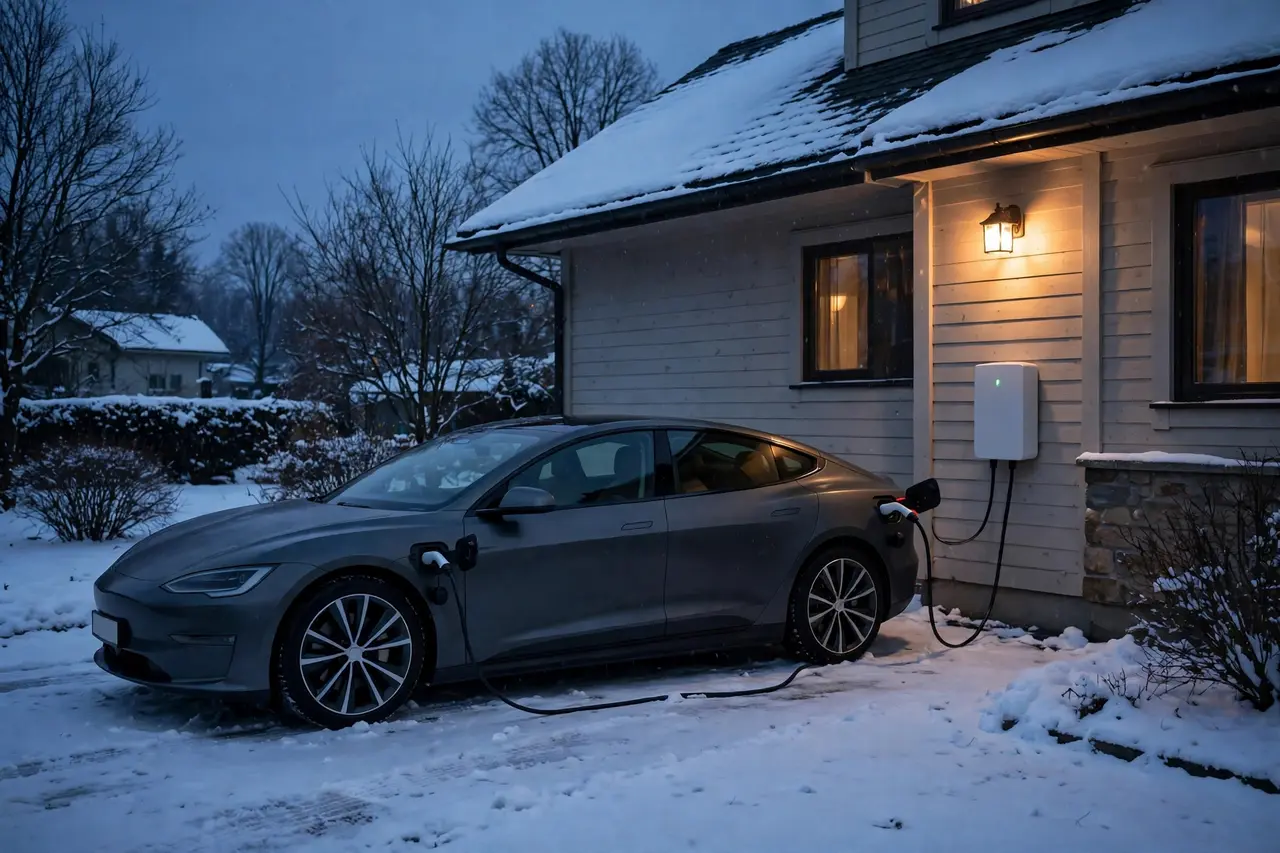
Winter changes the arithmetic of home charging without changing its logic. A cold battery accepts energy more slowly and spends some of it on staying warm, so the same commute consumes more of the overnight window in January than in June. The household answers are unglamorous: park plugged in every night rather than in long sessions twice a week, let the car precondition from the wall before departure, and keep the connector holstered out of the weather. A Level 2 circuit with headroom absorbs all of this invisibly — which is precisely why northern households tend to size the circuit generously at install time rather than return to the question later.
Smart features, soberly assessed
Connectivity buys three real things in a charging station: scheduling against rate windows, session records the household can actually read, and power sharing between stations. It does not buy speed — the circuit decides that — and a station whose network features fail should still charge the car, which the good ones do. Households deep in a smart-home ecosystem may value the integrations; everyone else should choose on the electrical merits and treat the application as a bonus. Either way, the configuration that matters is set at commissioning: rate, schedule, and the circuit's limit, recorded on the paperwork.
Reading the bill after the charger arrives
The first bills after an install reward a careful read. Charging appears as consumption, not as a line item — the household's kilowatt-hours rise by roughly the car's appetite, and the rate applied to the new hours depends on when they happened. Owners who check the schedule actually ran — that the car charged inside the intended window — catch the one configuration mistake that costs money monthly. After that, the bill becomes the household's quietest document: the car simply costs what the overnight rate says it should.
Conduit, finishes and the neatness question
Runs of conduit across a finished garage divide households: some want them invisible, some want them honest. The options are a spectrum — in-wall runs where framing allows, surface conduit painted to the wall, or a route through the ceiling line where neither shows. Each step toward invisible costs labour and sometimes access for future work. Decide at the design stage with the route in view, because the time to care about the charger's industrial look is before it is screwed to the wall, not in the first photograph afterwards.
Bidirectional charging, honestly framed
Vehicles that can return energy to a house or the grid exist, and the standards enabling them are settling — but for most households today it is a horizon technology, not a purchase category: it needs a compatible vehicle, bidirectional equipment, utility interconnection approval and a tariff that rewards it. None of that changes today's installation advice, except in one detail: conduit and panel capacity installed generously now are the same provisions a future bidirectional setup would want. Buy for the car you have; leave room for the one the industry is promising.
Frequently asked questions
Can I still get the federal tax credit for a home charger in Buffalo, NY?
The honest ledger for Buffalo reads: federal credit, ended September 30, 2025; state program, none for typical home installs; Niagara Mohawk Power Corp. residential rebate, none verified in the sources checked. If a salesperson's quote leans on any of the three, the correct response is a request for the program's published page.
What can my HOA in Buffalo, NY do about a charger install?
Not outright. Under RPL §339-kk / §339-LL (cited both ways — confirm at build), New York associations cannot prohibit an owner's charger; they can condition it — reasonably — on placement, insurance and restoration, with the owner funding the work. The disputes that do arise are usually about conditions, and they settle fastest when the application answers them in advance.
Does a Level 2 charger mean a panel upgrade for a Buffalo, NY home?
The answer lives in your panel's directory and its arithmetic, not in the car's requirements. With 90% of Buffalo's homes predating 1980 (median build 1938), local installers see both situations weekly: the 200-amp panel that takes the circuit directly, and the full 100-amp service that needs capacity work first. The site visit exists to sort your house into one of those two piles, on numbers.
Level 1 or Level 2 in Buffalo, NY — what is the real difference?
Think of it in parked hours. Level 1 gives you back 3–5 miles for each of them; Level 2 gives back about 25–40, set by the circuit's amperage and what the car can accept. Overnight, that is the gap between 'enough for tomorrow' and 'full, every morning'.
How does the installer matching on this page work?
Your request is matched to licensed installers covering Buffalo, New York — service, ZIP, property type and timing travel with it. The installer who takes it arranges the site visit and quotes in writing; PlugReady USA's part is the research on this page and the introduction, and your contract is with the installer throughout.
My Buffalo home has no garage — where does the charger go?
Outdoor mounting is a standard configuration, not a compromise: stations listed for exterior use mount on the house wall by the drive or on a post at the pad. Your installer will check enclosure rating, drainage, cable reach to the port, and clearance from vehicle swing — the four things that decide whether an outdoor install feels designed or improvised.
Nearby cities in New York
- EV charger installation in Rochester — about 71 miles from Buffalo, metro population 1,100,000
- EV charger installation in Ithaca — about 136 miles from Buffalo, metro population 105,000
- EV charger installation in Binghamton — about 173 miles from Buffalo, metro population 240,000
- EV charger installation in Watertown — about 180 miles from Buffalo, metro population 115,000
- EV charger installation in Utica — about 202 miles from Buffalo, metro population 295,000
- EV charger installation in Albany — about 284 miles from Buffalo, metro population 900,000
- EV charger installation in Erie, PA — about 85 miles from Buffalo, metro population 265,000
- EV charger installation in State College, PA — about 156 miles from Buffalo, metro population 160,000
- EV charger installation in Altoona, PA — about 166 miles from Buffalo, metro population 125,000
Ready to charge at home in Buffalo?
Send the essentials — what you need, where, and what kind of property — and a licensed local installer will pick it up from there.