EV Charger Installation in Albany, NY
Home Level 2 charging, panel upgrades and condo installs in Albany — matched to licensed local installers, with the local facts that shape the job set out below.
There is a reason most charging happens at home: it is the most convenient fuelling an EV owner will ever use, and it happens while the car sits idle anyway. In Albany, getting set up means answering a handful of local questions first. Albany itself is home to about 101,314 people, inside a state that registered 209,300 battery-electric vehicles and 125,100 plug-in hybrids through 2025. Which utility serves your address, whether it currently funds part of a charger install, what your panel can carry, and what your HOA or condo board can and cannot say no to — this page covers each of them for Albany specifically.
A word on how to use the page: each section answers one of the questions an installer will ask you anyway — panel, utility, property rules, permits — with Albany's actual answers. Read the two that apply to your house and you will start the quoting conversation several steps ahead.
Measured demand, not enthusiasm, put Albany in Tier B of this network: NY capital district. For a homeowner the useful translation is simpler — installers here do this work weekly, know the local permit counter, and have seen your housing stock before.
Context from the Census Bureau's survey of Albany: median household income $65,231; 38% of occupied homes are owner-occupied; 30% of housing units are single-unit detached houses. It is the profile of a city where the typical charger job is a homeowner job — scoped by the panel and the wire run, not by permissions.

The composite picture matters more than any single statistic. In Albany: an older housing fabric, where panel archaeology is a normal part of the first visit; a genuinely mixed city — houses, townhouses and larger buildings all carry weight; buildings of five or more units hold a substantial share of homes, which keeps the multifamily sections of this page in daily use; meanwhile, renters form a large share of households, so the landlord conversation is a first-class topic here. A page that ignored that profile would give the same advice everywhere; this one is ordered by it.
The counts behind the percentages, for the record: Albany has 52,788 housing units on the survey's count, 48,873 of them occupied, and 18,625 owner-occupied households making their own electrical decisions. Detached houses number 16,058; homes built before 1980 number 42,719; units in buildings of five or more number 18,876. An installer's week in this city is a walk through exactly that distribution. The page's geography is equally concrete: 50 ZIP codes across Albany, centred near 42.65 degrees north latitude. The city anchors the Albany–Schenectady–Troy metropolitan area, home to roughly 900,000 people on the research file's metro estimate — the wider labour and housing market this page's installers work across.
The same survey release fills in the household economics around the housing stock: a median home value of $234,700, median gross rent of $1,216, per-capita income of $37,843, and a median resident age of 32. The movement data matters as much as the money data: 55% of Albany workers drive to work alone — the commute pattern home charging is built around; 13% work from home, a population whose cars charge on daytime and overnight schedules alike; 10% commute by public transit; 45% of adults hold a bachelor's degree or higher. Vehicle ownership, from the same release: 13,945 households in Albany run two or more vehicles, and 10,563 run none — the two ends of the market this page serves and does not serve.
The cost-burden lines say who feels housing costs most in Albany: 53% of renters spend 30% or more of income on rent, and 0% of owners with mortgages spend the same share on housing costs. Family households are 35% of all households — the two-car, school-run demographic whose charging patterns this page's planning sections keep circling back to.
What follows is the city read as an electrical place rather than a dot on a map. Pre-war and immediate post-war streets dominate the map, and their electrical fabric is stratified — original services beneath mid-century additions beneath modern subpanels, an archaeology the load calculation reads layer by layer. With this much of the stock in shared buildings, the city's charging map is drawn in boardrooms as much as in electrical rooms: deeded spaces, common services, metering subplots in every application.
Property managers are the metro's charging gatekeepers at this tenure mix, and the installers who thrive are the ones whose proposals arrive manager-shaped: standardised, insured, reversible on paper. The specification pattern at this income band is disciplined: capacity for today's car and a conduit sized for tomorrow's, the upgrade deferred until the load calculation insists. Filed tariffs and public dockets give this territory a paper trail most markets lack: the diligent household can read the utility's own electrification plan and know which programmes are funded, piloted or merely proposed.
At this volume the binding constraints move upstream — panel capacity in older districts, transformer headroom on particular streets, the diary of the good installer rather than the existence of one. The diary economics differ from the biggest metros: good installers book in weeks, not months, and the household that calls in spring is rarely queueing behind a season of work. Shared-property households here work with a written legal position rather than a board's mood, which changes the application from a petition into a procedure.
The electrical reality in Albany homes
Albany's housing, in Census Bureau survey numbers: a median build year of 1945, 81% of units predating 1980, a stock that is 30% single-unit detached, and 38% of occupied homes owned by their occupants. Everything in this section is commentary on those four facts. Age shows up electrically before it shows up anywhere else: services sized for a house with a third of today's appliances. Expect the first conversation to be about capacity — what the panel is, what it already feeds, and which of the three routes (circuit, management, upgrade) your numbers support. Detached houses matter for a practical reason: a garage or driveway on your own lot means the charger, the car and the circuit are all under one roof and one owner's control, which is the simplest configuration there is.
Heating fuel is the survey's quiet clue to panel life: in Albany, 32% of homes heat electrically (15,461 households), against 64% heating with gas. A house already heating electrically has a service sized with that load in its history; a gas-heated house may have capacity to spare — either way the fuel mix is part of what the installer is reading.
One further split matters for how this page is organised: about 30,248 of Albany's occupied homes are renter-occupied. Everything above assumes you can approve your own electrical work; where you cannot, the approval layer — landlord or association — becomes part of the job, which is why the law section carries unusual weight here.
And 36% of Albany's homes are in buildings with five or more units — apartments and condominiums where charging is a building decision before it is an electrical one. If that is your situation, the law and multifamily sections of this page are the ones written for you.
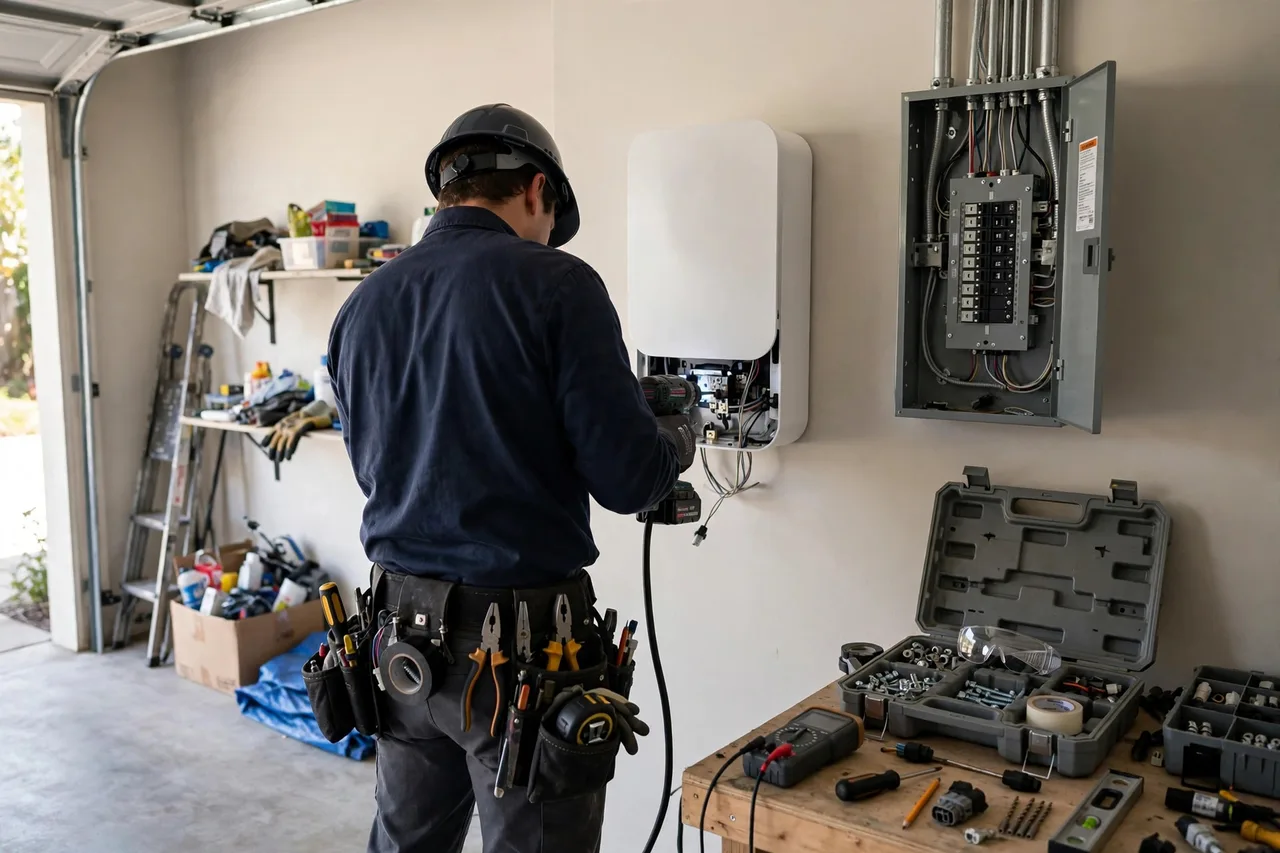
EV charging services in Albany
Installers in Albany book the same ten services as everywhere — but not in the same proportions. The three leading cards below are this city's pattern, set by its panels, its buildings and its statute book.
Home EV Charger Installation in Albany
Start to finish, the domestic install is a half-day of electrical work wrapped in a week of scheduling: the survey, the circuit, the mounting, the configuration, the inspection. What the household experiences is simpler — a car that is full every morning and a cable that lives where the car does.
In Albany: usually the first job a new EV household in Albany books, scoped to the panel the house already has.
Dedicated Circuit & Electrical Panel Upgrade in Albany
Some homes meet the charger at the panel door: the service is already spoken for by cooking, heating and hot water. This service is the honest fix — capacity added properly, grounding brought current, and a panel schedule that finally matches the house it feeds.
In Albany: the job that surfaces wherever housing is older — and Albany's stock makes it a routine conversation, settled by a load calculation.
Multifamily & Condo EV Charging in Albany
Buildings that solve charging solve it as infrastructure: a backbone capacity decision, a fair cost-allocation rule, and spaces that can be electrified in ones as residents arrive. The first installation is the constitution; the rest are amendments.
In Albany: the service behind the law section below — boards, applications and shared electrical capacity in Albany buildings.
Utility programs and electricity in Albany
Electricity in Albany comes from Niagara Mohawk Power Corp.. Parts of the wider metro are served by Central Hudson Gas & Elec Corp, Village of Green Island. The utility matters twice over for a charger install: it sets the time-of-use rates that decide what overnight charging costs you, and it is the organisation that may — or may not — currently help pay for the equipment.
Why does this page labour the absence of a rebate? Because in Albany the phantom rebate is the most common distortion in charger quotes: a figure justified by money that is not, at present, claimable. The verified position: federal 30C ended September 30, 2025; no New York replacement for typical home installs; no Niagara Mohawk Power Corp. residential charger rebate in the sources checked. If someone quotes you a rebate, the follow-up is one sentence — show me the program page — and its answer decides the quote's credibility.
While you are in the tariff pages, look at how the plan values the evening ramp — the hours when cooking, cooling and charging would otherwise stack. A charger that starts after the ramp is the simplest scheduling decision in home charging, and it is set once.
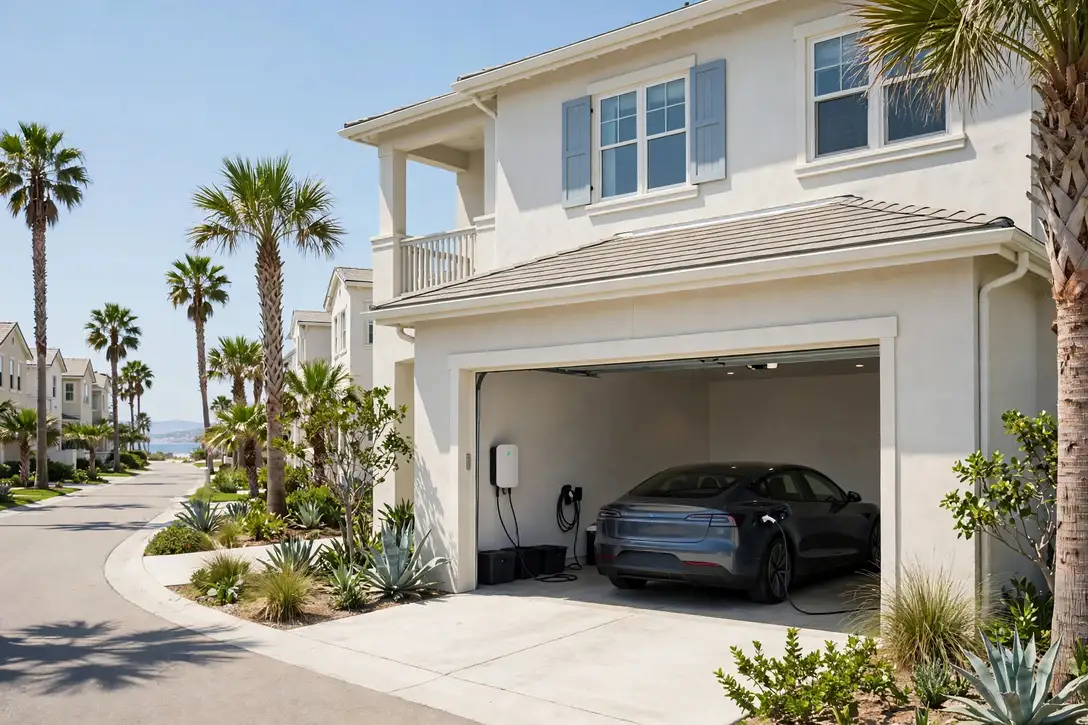
Condos, HOAs and the law in New York
New York law protects an owner's charger. RPL §339-kk / §339-LL (cited both ways — confirm at build) gives owners in association communities a statutory route to a charging station in their own space: the association may set reasonable conditions on how the installation looks, where exactly it sits, and how it is insured, but a flat prohibition is not one of its options. Owners fund the work, use licensed installers, and remain responsible for the equipment — the statute allocates the burdens; it does not remove them.
For renters, coverage in New York is recorded as: Owners (condo). If you rent in Albany, the practical route is still a written proposal to the landlord — dedicated circuit, licensed installer, your name on the permit — because a charger-ready space is an asset most landlords keep when you leave.
Both the process and the paperwork are covered in the condo and HOA guide; Albany readers can skip the chapters about persuading reluctant boards and go straight to the compliance checklist.
Climate, garages and charger placement
Storm seasons punctuate the year here, and the installation's weather manners are set at mounting time: enclosures sealed as listed, exterior runs pitched so water travels away from entries, and a station position that the roof's drip line does not cross. Five minutes of the site visit, decades of consequence.
A four-season spec sheet is a compromise written in equipment ratings: cable jackets flexible at the January low, electronics rated past the July high, an enclosure indifferent to both. The listed gear covers it; placement decides the rest.

Permits and inspection in Albany
The normal sequence is the same across the metro: the installer files the electrical permit, installs to the current National Electrical Code (a charger is a continuous load, so the circuit is sized at 125% of the draw), and the city inspects before the job is signed off. Keep the passed inspection record — insurers, future buyers and warranty claims all ask for it.

Neighbourhoods and ZIP codes served
The page covers 50 ZIP codes in and around Albany — including 12201, 12202, 12203, 12204, 12205, 12206, 12207, 12208, 12209, 12210, 12211, 12212, 12214, 12220, 12222, 12223, 12224, 12225, 12226, 12227, 12228, 12229, 12230, 12231, 12232, 12233, 12234, 12235, 12236, 12237, 12238, 12239, 12240, 12241, 12242, 12243, 12244, 12245, 12246, 12247, 12248, 12249, 12250, 12252, 12255, 12256, 12257, 12260, 12261, 12288 — across Albany. If your ZIP is not in the first set shown, ask anyway: installer coverage follows the metro, not a postcode fence.
The same working area takes in the neighbouring localities of Glenmont, Newtonville, Delmar, Watervliet, Slingerlands, Latham, Troy, Selkirk, Guilderland, Cohoes, South Bethlehem, Voorheesville, Feura Bush, Guilderland Center — the county ring an installer based in Albany actually drives. Requests from those communities route exactly as city requests do: same services, same permit discipline, same local facts where they differ.
Albany County accounts for 78 of the ZIP codes and 29 named postal localities in the research file, the nearest of them Glenmont, Newtonville, Delmar, Watervliet, Slingerlands. The survey counts 317,018 residents in the county, with a median household income of $85,333 and a median home value of $294,600. Measured across its ZIP codes, the Albany footprint runs about 5 miles north to south and 6 east to west, from ZIP 12201 to 12288 — the ground an installer based here actually covers in a working week.
Beyond the county seats, the working area takes in Rensselaer, Glenmont, Newtonville, Delmar, East Greenbush, Watervliet, Slingerlands, Latham, Wynantskill, Troy, Selkirk, West Sand Lake, Castleton On Hudson, Guilderland, Cohoes, East Schodack, South Bethlehem, Voorheesville, Poestenkill, Waterford, Averill Park, Feura Bush, Nassau, Schodack Landing, Guilderland Center, Dormansville, Schenectady, Coeymans, Clarksville, Ravena, Clifton Park, Sand Lake, North Chatham, New Baltimore, Coeymans Hollow, Altamont, Rexford, Melrose, Niverville, Hannacroix, Malden Bridge, Valatie, Alplaus, East Nassau, Alcove, East Berne, Brainard, Cropseyville, West Coxsackie, Westerlo, Mechanicville, Old Chatham, Round Lake, Grafton, Kinderhook, Ballston Lake, Stephentown, Schaghticoke, West Lebanon, Duanesburg, Valley Falls, Knox, Stuyvesant, Climax, Burnt Hills, Johnsonville, East Chatham, Coxsackie, Cherry Plain, Stuyvesant Falls, Berlin, Surprise, Berne, Rotterdam Junction, Greenville, Earlton, Chatham, Columbiaville, Rensselaerville, Petersburg, New Lebanon, Quaker Street, Pattersonville, Delanson, Ghent, Medusa, Canaan, Freehold, Stottville, Leeds, Gallupville, Athens, East Durham, Cairo, Oak Hill, Mellenville, Hoosick Falls, Spencertown, Hudson, Austerlitz, Hoosick, Philmont, South Cairo, Acra, Richmond, Durham, North Hoosick, Claverack, North Pownal, Preston Hollow, Cornwallville, West Stockbridge, Schoharie, Purling, Catskill, Esperance, Lanesborough, Williamstown, Amsterdam, Hagaman, Hollowville, Round Top, Pownal, Pittsfield, Middleburgh, Berkshire, Central Bridge, Maplecrest, Craryville, Lenox, Cheshire, Howes Cave, Housatonic, Stockbridge, Hillsdale, North Bennington, Sloansville, Glendale, Dalton, Bennington, East Jewett, Fort Johnson, Lenox Dale, Adams, Fort Hunter, Hensonville, North Egremont, Tribes Hill, Windham, Auriesville, South Lee, North Adams, Fultonville, Lee, Fultonham, Great Barrington, Stamford, North Blenheim, Jewett, Gilboa, Hunter, Carlisle, West Fulton, Ashland, Cobleskill, Sprakers, Fonda, Warnerville, Johnstown, Drury, Prattsville, Monroe Bridge, Lexington, Summit, Readsboro, Richmondville — the named localities for which Albany is the nearest metro in the network (neighbouring metros' pages cover their own ground), each routing to the same installer-matching service.
The wider working area also reaches Stillwater, Ballston Spa, Buskirk, Saratoga Springs, Victory Mills, Eagle Bridge, Middle Falls, Cambridge, Livingston, Palenville, Gansevoort, Porter Corners, Broadalbin, Germantown, Tannersville, Copake Falls, Elizaville, Copake, Elka Park, Malden On Hudson, Shushan, Ancram, Becket, Hinsdale, Corinth, South Egremont, Saugerties, Tyringham, Mayfield, Glasco, Ancramdale, Arlington, Mount Marion, Lanesville, Annandale On Hudson — ground shared with neighbouring metros, where installers cross the same county lines in both directions.
ZIP codes in that shared ground include 01223, 01235, 01245, 01256, 01257, 01264, 01270, 05262, 12020, 12025, 12028, 12074, 12117, 12170, 12432, 12450, 12453, 12456, 12485, 12502, 12503, 12504, 12517, 12523, 12526, 12541, 12571, 12583, 12803, 12822, 12828, 12831, 12834, 12850, 12859, 12865, 12866, 12871, 12873, 12884.
The largest communities in that working area after Albany itself, by the GeoNames populated-place file: West Albany (population 93,794), Schenectady (population 65,305), Troy (population 49,906), Pittsfield (population 43,303), Clifton Park (population 36,705), Glenville (population 29,326), Latham (population 20,736), Rotterdam (population 20,652). Charging demand follows those populations — the subdivisions and town centres where the next driveways, and the next panels, are.
Rensselaer County reaches into the working area with 160,332 residents, a median household income of $87,915 and a median home value of $258,400; its localities on this page include Rensselaer, East Greenbush, Wynantskill, Troy. Schenectady County reaches into the working area with 160,369 residents, a median household income of $79,623 and a median home value of $235,700; its localities on this page include Schenectady. Saratoga County reaches into the working area with 238,284 residents, a median household income of $100,787 and a median home value of $348,600; its localities on this page include Waterford, Clifton Park.
| ZIP | Locality | County |
|---|---|---|
| 12201 | Albany | Albany |
| 12207 | Albany | Albany |
| 12214 | Albany | Albany |
| 12220 | Albany | Albany |
| 12223 | Albany | Albany |
| 12224 | Albany | Albany |
| 12225 | Albany | Albany |
| 12226 | Albany | Albany |
| 12227 | Albany | Albany |
| 12228 | Albany | Albany |
| 12229 | Albany | Albany |
| 12230 | Albany | Albany |
| 12231 | Albany | Albany |
| 12232 | Albany | Albany |
| 12233 | Albany | Albany |
| 12234 | Albany | Albany |
| 12235 | Albany | Albany |
| 12236 | Albany | Albany |
| 12237 | Albany | Albany |
| 12238 | Albany | Albany |
| 12239 | Albany | Albany |
| 12240 | Albany | Albany |
| 12241 | Albany | Albany |
| 12242 | Albany | Albany |
| 12243 | Albany | Albany |
| 12244 | Albany | Albany |
| 12245 | Albany | Albany |
| 12247 | Albany | Albany |
| 12248 | Albany | Albany |
| 12249 | Albany | Albany |
| 12250 | Albany | Albany |
| 12252 | Albany | Albany |
| 12255 | Albany | Albany |
| 12256 | Albany | Albany |
| 12257 | Albany | Albany |
| 12260 | Albany | Albany |
| 12261 | Albany | Albany |
| 12288 | Albany | Albany |
| 12210 | Albany | Albany |
| 12246 | Albany | Albany |
| 12202 | Albany | Albany |
| 12206 | Albany | Albany |
| 12209 | Albany | Albany |
| 12144 | Rensselaer | Rensselaer |
| 12208 | Albany | Albany |
| 12204 | Albany | Albany |
| 12211 | Albany | Albany |
| 12077 | Glenmont | Albany |
| 12222 | Albany | Albany |
| 12128 | Newtonville | Albany |
| 12054 | Delmar | Albany |
| 12212 | Albany | Albany |
| 12061 | East Greenbush | Rensselaer |
| 12205 | Albany | Albany |
| 12189 | Watervliet | Albany |
| 12159 | Slingerlands | Albany |
| 12110 | Latham | Albany |
| 12203 | Albany | Albany |
| 12198 | Wynantskill | Rensselaer |
| 12180 | Troy | Rensselaer |
| 12183 | Troy | Albany |
| 12181 | Troy | Rensselaer |
| 12158 | Selkirk | Albany |
| 12196 | West Sand Lake | Rensselaer |
| 12033 | Castleton On Hudson | Rensselaer |
| 12084 | Guilderland | Albany |
| 12047 | Cohoes | Albany |
| 12063 | East Schodack | Rensselaer |
| 12161 | South Bethlehem | Albany |
| 12182 | Troy | Rensselaer |
| 12186 | Voorheesville | Albany |
| 12140 | Poestenkill | Rensselaer |
| 12188 | Waterford | Saratoga |
| 12018 | Averill Park | Rensselaer |
| 12067 | Feura Bush | Albany |
| 12123 | Nassau | Rensselaer |
| 12156 | Schodack Landing | Rensselaer |
| 12085 | Guilderland Center | Albany |
| 12055 | Dormansville | Albany |
| 12304 | Schenectady | Schenectady |
| 12045 | Coeymans | Albany |
| 12309 | Schenectady | Schenectady |
| 12041 | Clarksville | Albany |
| 12143 | Ravena | Albany |
| 12065 | Clifton Park | Saratoga |
| 12303 | Schenectady | Schenectady |
| 12153 | Sand Lake | Rensselaer |
| 12132 | North Chatham | Columbia |
| 12307 | Schenectady | Schenectady |
| 12124 | New Baltimore | Greene |

Planning the install: from panel to parking
Experienced Albany installers talk about 'the tell': the small observation that predicts the job. A panel directory in pencil with three generations of handwriting. A garage converted, then converted back. A charger-shaped hole in the household's plans — the second car already ordered. Mention your own tells at the visit; they are scope information, and scope named early is scope settled fairly.
Plan for the household you will be, not just the car you have. A second EV is the most common reason a charger circuit gets revisited, and the cheap moment to prepare for it — conduit sized up, panel capacity reserved, station placement that serves two bays — is during the first install, while the permit is open and the electrician is already in the panel.
Home charging know-how for Albany households
The autumn checklist
Households in seasonal country develop a small autumn ritual around the charger: the connector and holster checked before the weather turns, the cable's route confirmed clear of the snow-storage corner and the plough's line, the schedule revisited against winter tariffs and winter range. Ten minutes, once a year, timed with the rest of the house's changeover. It belongs to the same family as the inspection file — the unglamorous habits that make an installation feel, five winters later, like it was designed by someone who had met the climate before.
Charging alongside rooftop solar
A house that generates as well as consumes plans its charging differently. The naive pattern — charge at night, export by day — is often fine; the refined pattern shifts some charging into the solar hours on home-working days, stores the commute in the car when the panels are producing, and leans on the overnight window only for the balance. None of this changes the circuit; it changes the schedule, and occasionally the case for a station whose output can follow the house's generation. Tell the installer the array exists — it belongs in the first conversation.
Household safety habits around the charger
A charging setup joins a household's ordinary safety landscape — the same category as the stove and the water heater: respected, listed, and left to do its job. The household habits are few. The cable lives off the floor where small feet and wheels travel; the connector is docked, not dangled; children learn the house rule that the charger is an appliance, not a toy, the way they learn the oven's. Nothing about a properly installed station asks for anxiety — just the standard respect electricity has always been owed.
A word about the word 'charger'
Strictly speaking, the charger lives in the car: the onboard unit that converts alternating current from the wall into the direct current the battery stores. The box on your wall is supply equipment — it negotiates, switches and protects, but the conversion happens in the vehicle. The distinction explains two practical things: why the car's acceptance rate caps every circuit conversation, and why the same wall equipment serves different cars at different speeds. Installers use 'charger' for the wall box anyway, as does this page — but the mental model is worth owning.
Etiquette for shared stations
Shared stations run on norms before they run on rules. The norms that work: move the car when the session ends, coil the cable for the next driver, report a fault rather than stepping over it, and never unplug a stranger's session except under the building's posted arrangement. Buildings formalise this gradually — a group message thread, a simple rota in high season — and the households that start with courtesy rarely need the formal version. The equipment is shared; so is the goodwill it runs on.

Frequently asked questions
Can I still get the federal tax credit for a home charger in Albany, NY?
Treat the answer as a standing no with a watching brief. The 30C credit is finished, New York has not replaced it for homeowners, and no verified Niagara Mohawk Power Corp. rebate was running in the sources checked for this page. Should that change, the utility's program page will say so first — and this page will be updated to match.
Can my HOA or condo board in Albany, NY refuse my charger?
Not outright. Under RPL §339-kk / §339-LL (cited both ways — confirm at build), New York associations cannot prohibit an owner's charger; they can condition it — reasonably — on placement, insurance and restoration, with the owner funding the work. The disputes that do arise are usually about conditions, and they settle fastest when the application answers them in advance.
Panel upgrade or not — how do Albany, NY homeowners find out?
The question has a correct instrument: the load calculation. It totals what your service already carries — with the code's demand factors, not nameplate panic — and sets the charger's continuous load against the remainder. In Albany, where the median home dates to 1945 and about 81% of units predate 1980, the answer splits by street: post-war and newer 200-amp homes usually proceed; older 100-amp homes choose between capacity work and load management. Anyone answering without the calculation is guessing in a uniform.
Level 1 or Level 2 in Albany, NY — what is the real difference?
Level 2 is several-fold faster in the only unit that matters — miles back per hour parked: roughly 25–40 against Level 1's 3–5. The exact figure follows the circuit: a 40-amp circuit and a 60-amp circuit are both Level 2, and the car's onboard limit may sit below either. Your installer matches the three numbers at the site visit.
What happens next after I send a request?
Three things happen, in order. Your request is routed to licensed installers who work in Albany; one of them contacts you to book a site visit; and the visit produces a written quote based on your actual panel and parking. PlugReady USA runs the matching, not the tools — the contractor on the job is the installer who visits.
Do installers cover the communities around Albany, NY?
They do. Coverage follows the metro: Glenmont, Newtonville, Delmar, Watervliet, Slingerlands and their neighbouring communities are worked by the same installers who cover Albany itself, and a request from those ZIP codes routes identically — service, property type and timing are all the form asks for.
Nearby cities in New York
- EV charger installation in Glens Falls — about 46 miles from Albany, metro population 125,000
- EV charger installation in Poughkeepsie — about 66 miles from Albany, metro population 700,000
- EV charger installation in Utica — about 87 miles from Albany, metro population 295,000
- EV charger installation in Binghamton — about 123 miles from Albany, metro population 240,000
- EV charger installation in New York — about 132 miles from Albany, metro population 19,900,000
- EV charger installation in Watertown — about 150 miles from Albany, metro population 115,000
- EV charger installation in Springfield, MA — about 75 miles from Albany, metro population 700,000
- EV charger installation in Hartford, CT — about 85 miles from Albany, metro population 1,200,000
- EV charger installation in Lebanon, NH — about 108 miles from Albany, metro population 220,000
Ready to charge at home in Albany?
Send the essentials — what you need, where, and what kind of property — and a licensed local installer will pick it up from there.