EV Charger Installation in Fayetteville, AR
Everything a Fayetteville homeowner needs before booking a charger install — the panel question, the utility's current programs, the HOA law and the permit — sourced, dated and local.
Every home charger installation is the same four decisions wearing local clothes: capacity in the panel, a route for the circuit, a position for the station, and paperwork that proves it was done properly. What changes from city to city is the content of those decisions — and in Fayetteville the content is specific. Fayetteville itself is home to about 103,124 people. Arkansas's registered fleet stood at 12,300 battery-electric vehicles and 4,900 plug-in hybrids at the end of 2025, and this page works through the local version of each decision: your utility and its programs, your state's association law, your permit counter, and your housing stock's electrical habits.
How to read this page in four minutes: the data band tells you what kind of housing city Fayetteville is; the utility section tells you whether money is on the table; the law section tells you whether permission is a process or a negotiation; and the permit section tells you what proof the finished job leaves behind. The rest is elaboration.
Measured demand, not enthusiasm, put Fayetteville in Tier B of this network: Walmart HQ corridor growth; SWEPCO rebate area. For a homeowner the useful translation is simpler — installers here do this work weekly, know the local permit counter, and have seen your housing stock before.
Three percentages describe the working conditions for charging in Fayetteville: 38% owner-occupied, 47% single-unit detached, and a median household income of $66,237 standing behind both. Everything in the sections below — panels, permissions, metering — is commentary on those proportions.

Put the survey together and Fayetteville's charging profile reads like this: a comparatively young housing fabric, where modern services are the default; a genuinely mixed city — houses, townhouses and larger buildings all carry weight; buildings of five or more units hold a substantial share of homes, which keeps the multifamily sections of this page in daily use; and renters form a large share of households, so the landlord conversation is a first-class topic here. That combination — more than any single number — is what the installers working here plan around, and it is the lens for everything on this page.
The counts behind the percentages, for the record: Fayetteville has 47,942 housing units on the survey's count, 42,089 of them occupied, and 16,195 owner-occupied households making their own electrical decisions. Detached houses number 22,540; homes built before 1980 number 11,014; units in buildings of five or more number 19,691. An installer's week in this city is a walk through exactly that distribution. The page's geography is equally concrete: 4 ZIP codes across Washington, centred near 36.05 degrees north latitude. The city anchors the Fayetteville–Springdale–Rogers metropolitan area, home to roughly 600,000 people on the research file's metro estimate — the wider labour and housing market this page's installers work across.
The same survey release fills in the household economics around the housing stock: a median home value of $349,600, median gross rent of $1,065, per-capita income of $39,241, and a median resident age of 29. And the daily rhythms behind the housing numbers: 72% of Fayetteville workers drive to work alone — the commute pattern home charging is built around; 15% work from home, a population whose cars charge on daytime and overnight schedules alike; 1% commute by public transit; 49% of adults hold a bachelor's degree or higher. The survey's vehicle table is the one an EV page should quote first: 2,130 of Fayetteville's households have no vehicle at all, while 23,404 have two or more — the multi-car households for whom the second circuit is a when, not an if.
Household structure, from the same release: 50% of Fayetteville households are family households. The burden shares behind the housing stock: 40% of renting households are cost-burdened at the 30%-of-income line, as are 0% of mortgaged owners — context for why the overnight rate window, once set, is treated here as a household fixture rather than a hobby.
Taken as one portrait, the numbers describe a specific charging market. A young stock standardises the install conversation — the variables narrow to run length, station position and the household's second-car horizon, because the capacity question was answered by the builder years ago. With this much of the stock in shared buildings, the city's charging map is drawn in boardrooms as much as in electrical rooms: deeded spaces, common services, metering subplots in every application.
Renter weight gives this metro's charging story a negotiation at its centre: the circuit is easy, the permission is the project, and the paperwork patterns in the guides matter as much as any load calculation. Households at this band comparison-shop on scope rather than on slogans, which rewards the installer whose quote shows its working — the load study, the route, the permit, itemised. The commission's calendar quietly schedules the market: when a new time-of-use design is approved, installer phones ring in a pattern the docket predicted months earlier.
In an early market every install is disproportionately instructive: the permit counter learns, the association learns, the street learns, and the second install on any street is always easier than the first. At this scale the city's charging infrastructure is legible — a household can learn the whole local system, its programmes, precedents and people, in an evening's reading. This page is most of that evening. The association dimension here runs on persuasion rather than statute — no state charging law frames the application, so the complete, professional proposal carries the whole argument, as the law section above explains.
The electrical reality in Fayetteville homes
Start with the survey's three operative figures for Fayetteville: median build year 1998; 23% of housing units standing since before 1980; 47% of the stock in single-unit detached houses, with 38% of occupied homes owner-occupied. Between them, they sketch the electrical city an installer works in. Newer stock, newer services: 200-amp panels are the norm in the recent subdivisions, and the charger conversation moves quickly from 'can we' to 'where exactly'. The variables left are the run's length and the station's position relative to the car's port. Detached houses matter for a practical reason: a garage or driveway on your own lot means the charger, the car and the circuit are all under one roof and one owner's control, which is the simplest configuration there is.
One further survey line belongs in any Fayetteville install conversation: 53% of the city's homes heat with electricity — 21,579 households whose panels already carry a major winter load before a charger is contemplated. Electric heat and EV charging are the two largest discretionary loads a house can host, and where they coincide, the load calculation stops being a formality.
Renters are the other constituency in these numbers: about 25,894 of Fayetteville's occupied homes are rented rather than owned. Their charging route runs through a landlord conversation instead of a panel they control — a different project, covered by the rentals guide and the law section below, but a routine one in a city with this many renting households.
And 41% of Fayetteville's homes are in buildings with five or more units — apartments and condominiums where charging is a building decision before it is an electrical one. If that is your situation, the law and multifamily sections of this page are the ones written for you.
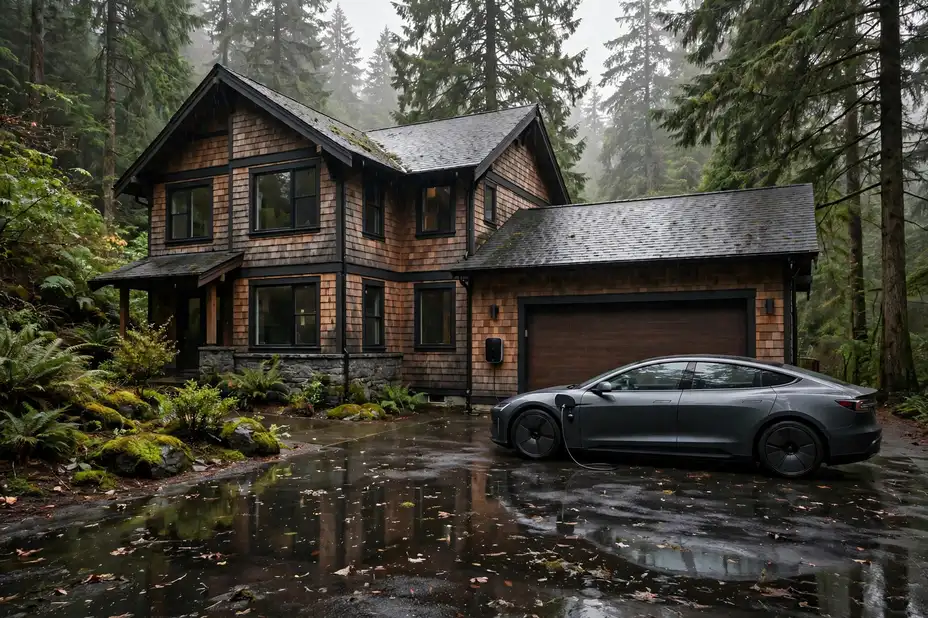
EV charging services in Fayetteville
Installers in Fayetteville book the same ten services as everywhere — but not in the same proportions. The three leading cards below are this city's pattern, set by its panels, its buildings and its statute book.
Home EV Charger Installation in Fayetteville
One circuit, one station, one inspection: the residential install in its usual form. An installer sizes the circuit to the household's driving, mounts the station where the cable reaches the port without drama, sets its output to the circuit it landed on, and leaves the paperwork filed with the house.
In Fayetteville: where most Fayetteville projects start and finish: one circuit, one station, one inspection.
Level 2 Charger Installation in Fayetteville
A Level 2 circuit turns charging from a ration into a routine. The job is electrical rather than electronic — breaker and conductor sized at the continuous-load factor, the run routed to the parking position, and the station dialled to the circuit rather than to its own headline maximum.
In Fayetteville: the upgrade from a wall outlet to a dedicated 240-volt circuit, and the end of range arithmetic at bedtime.
Load Management & Smart Charging Setup in Fayetteville
Smart scheduling pairs with smart limiting here — charge inside the cheap rate window, at whatever rate the house can spare at that moment. For many homes it converts an upgrade-sized problem into a device-sized one, with the same full battery by morning.
In Fayetteville: pairs with time-of-use rates in Fayetteville: charge when rates are lowest and capacity is spare.
Utility programs and electricity in Fayetteville
Electricity in Fayetteville comes from Southwestern Electric Power Co. Parts of the wider metro are served by Carroll Electric Coop Corp, Ozarks Electric Coop Corp, Oklahoma Gas & Electric Co. The utility matters twice over for a charger install: it sets the time-of-use rates that decide what overnight charging costs you, and it is the organisation that may — or may not — currently help pay for the equipment.
There is a strategic consequence to the empty incentive shelf in Fayetteville: the install decision reduces to the work itself and the tariff it runs on. With no rebate distorting the comparison, quotes compete on scope, licensing and the load calculation's honesty — which is the competition homeowners should want. And the overnight rate window, where Southwestern Electric Power Co offers one, quietly returns more over the car's life than most one-off rebates ever did.
While you are reading your tariff, check how your plan treats the evening peak. A charger scheduled to start after the peak window is the single easiest saving in home charging, and it is set once, in the car or the station, then forgotten.
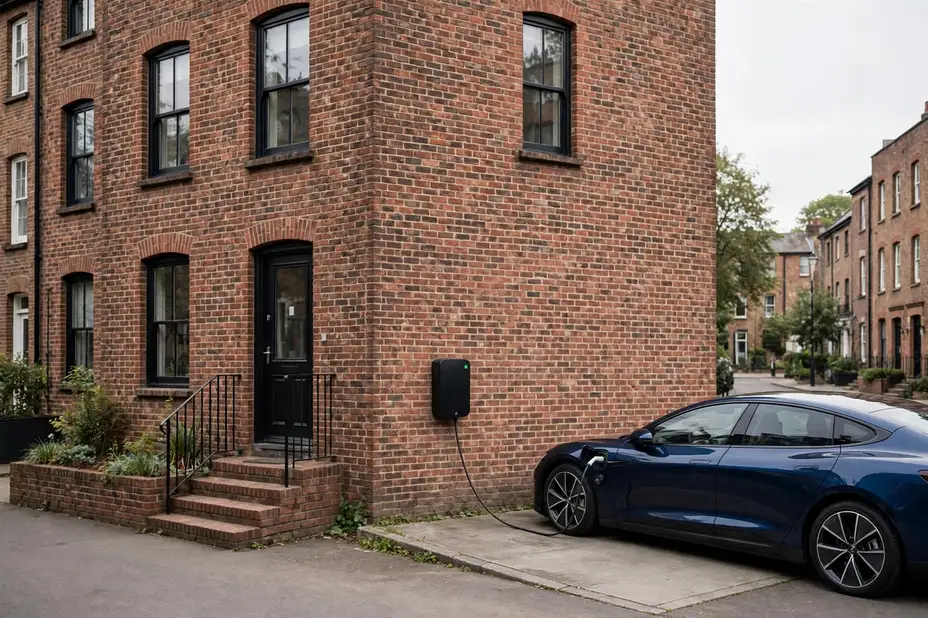
Condos, HOAs and the law in Arkansas
Arkansas has no statewide right-to-charge law. That needs saying plainly, because roundups on the internet sometimes claim otherwise: in the authoritative statute indexes checked for this page, no Arkansas law prevents a homeowners association or condominium from refusing a charger in a common or assigned space. Your community's own covenants and board govern the question in Fayetteville.
Strategy, then, is the local substitute for statute. In Fayetteville the applications that succeed tend to share a shape: they arrive before the meeting rather than at it, they answer metering and insurance in the first paragraph, and they offer the board a design it can approve once and reuse for the next owner who asks.
The negotiation playbook — application contents, metering options, the wording that answers boards' standard objections — is set out in our condo and HOA guide, read here as a persuasion manual rather than a rights manual.
Climate, garages and charger placement
Shade is a specification here, not a nicety. Outdoor stations belong under eaves or on the wall that escapes the afternoon sun; connectors left baking in a holder weather faster, and cables stiffen and crack on a shorter clock. The site walk should include a look at where the sun actually lands at four in the afternoon — that is the hour the equipment has to survive.
Shade structures — carports, pergolas, the live-oak side of the lot — are charging infrastructure in a hot climate whether they were built as such or not. A car that starts the session twenty degrees cooler spends its first charging hour on energy rather than on cooling itself.

Permits and inspection in Fayetteville
If your install is part of a larger job — a panel upgrade, a garage build — the charger usually rides on the same permit set. Ask for the charger circuit to be listed explicitly so the inspection record shows it.

Neighbourhoods and ZIP codes served
The page covers 4 ZIP codes in and around Fayetteville — including 72701, 72702, 72703, 72704 — across Washington. If your ZIP is not in the first set shown, ask anyway: installer coverage follows the metro, not a postcode fence.
The same working area takes in the neighbouring localities of Greenland, Farmington, Johnson, Springdale, Tontitown, Elkins, Prairie Grove, Goshen, West Fork, Elm Springs, Winslow, Lincoln, Summers, Morrow — the county ring an installer based in Fayetteville actually drives. Requests from those communities route exactly as city requests do: same services, same permit discipline, same local facts where they differ.
Washington County accounts for 23 of the ZIP codes and 17 named postal localities in the research file, the nearest of them Greenland, Farmington, Johnson, Springdale, Tontitown. The survey counts 256,765 residents in the county, with a median household income of $70,639 and a median home value of $298,400. Measured across its ZIP codes, the Fayetteville footprint runs about 3 miles north to south and 9 east to west, from ZIP 72701 to 72704 — the ground an installer based here actually covers in a working week.
Beyond the county seats, the working area takes in Greenland, Farmington, Johnson, Springdale, Tontitown, Elkins, Prairie Grove, Goshen, West Fork, Elm Springs, Lowell, Winslow, Cave Springs, Lincoln, Wesley, Hindsville, Rogers, Summers, Morrow, Bentonville, Canehill, Siloam Springs, Combs, Gentry, Centerton, Huntsville, Westville, Avoca, Chester, Evansville, Decatur, Watts, Saint Paul, Pea Ridge, Garfield, Hiwasse, Bella Vista, Colcord, Witter, Gravette, Stilwell, Gateway, Maysville, Pettigrew, Proctor, Sulphur Springs, Eureka Springs, Seligman, Kingston, Beaver, Washburn, Kansas, Berryville, Oaks, Twin Oaks, Oark, Welling, Eagle Rock, Jay, Ponca, Moodys — the named localities for which Fayetteville is the nearest metro in the network (neighbouring metros' pages cover their own ground), each routing to the same installer-matching service.
The wider working area also reaches Mountainburg, Natural Dam, Cedarville, Rudy, Uniontown, Mulberry, Pineville, Alma, Noel, Dyer, Powell, Ozark, South West City, Lanagan, Bunch, Van Buren, Cecil, Anderson, Exeter — ground shared with neighbouring metros, where installers cross the same county lines in both directions.
ZIP codes in that shared ground include 64831, 64847, 64854, 64856, 64863, 65647, 65730, 72921, 72930, 72932, 72935, 72946, 72947, 72948, 72949, 72952, 72955, 72956, 72957, 74931.
The largest communities in that working area after Fayetteville itself, by the GeoNames populated-place file: Springdale (population 77,859), Rogers (population 63,159), Bentonville (population 44,499), Bella Vista (population 27,999), Tahlequah (population 16,598), Siloam Springs (population 16,081), Harrison (population 13,138), Centerton (population 12,023), Lowell (population 8,549), Farmington (population 6,701), Berryville (population 5,371), Pea Ridge (population 5,242), Prairie Grove (population 5,186), Stilwell (population 4,016), Johnson (population 3,634), Gentry (population 3,397), Gravette (population 3,232), Cave Springs (population 3,076), Elkins (population 2,946), Tontitown (population 2,811). Charging demand follows those populations — the subdivisions and town centres where the next driveways, and the next panels, are.
Benton County reaches into the working area with 303,632 residents, a median household income of $93,506 and a median home value of $323,500; its localities on this page include Lowell, Cave Springs, Rogers. Madison County reaches into the working area with 17,329 residents, a median household income of $56,798 and a median home value of $178,100; its localities on this page include Wesley, Hindsville, Combs, Huntsville, Saint Paul. Carroll County reaches into the working area with 28,626 residents, a median household income of $54,230 and a median home value of $210,400; its localities on this page include Eureka Springs, Beaver, Berryville. Crawford County reaches into the working area with 61,139 residents, a median household income of $64,132 and a median home value of $182,800; its localities on this page include Chester. Johnson County reaches into the working area with 26,003 residents, a median household income of $45,995 and a median home value of $135,300; its localities on this page include Oark.
| ZIP | Locality | County |
|---|---|---|
| 72701 | Fayetteville | Washington |
| 72702 | Fayetteville | Washington |
| 72703 | Fayetteville | Washington |
| 72737 | Greenland | Washington |
| 72730 | Farmington | Washington |
| 72741 | Johnson | Washington |
| 72765 | Springdale | Washington |
| 72770 | Tontitown | Washington |
| 72727 | Elkins | Washington |
| 72704 | Fayetteville | Washington |
| 72762 | Springdale | Washington |
| 72766 | Springdale | Washington |
| 72753 | Prairie Grove | Washington |
| 72764 | Springdale | Washington |
| 72735 | Goshen | Washington |
| 72774 | West Fork | Washington |
| 72728 | Elm Springs | Washington |
| 72745 | Lowell | Benton |
| 72959 | Winslow | Washington |
| 72718 | Cave Springs | Benton |
| 72744 | Lincoln | Washington |
| 72773 | Wesley | Madison |
| 72738 | Hindsville | Madison |
| 72758 | Rogers | Benton |
| 72769 | Summers | Washington |
| 72757 | Rogers | Benton |
| 72756 | Rogers | Benton |
| 72749 | Morrow | Washington |
| 72713 | Bentonville | Benton |
| 72717 | Canehill | Washington |
| 72712 | Bentonville | Benton |
| 72716 | Bentonville | Benton |
| 72761 | Siloam Springs | Benton |
| 72721 | Combs | Madison |
| 72734 | Gentry | Benton |
| 72719 | Centerton | Benton |
| 72740 | Huntsville | Madison |
| 74965 | Westville | Adair |
| 72711 | Avoca | Benton |
| 72934 | Chester | Crawford |
| 72729 | Evansville | Washington |
| 72722 | Decatur | Benton |
| 74964 | Watts | Adair |
| 72760 | Saint Paul | Madison |
| 72751 | Pea Ridge | Benton |
| 72732 | Garfield | Benton |
| 72739 | Hiwasse | Benton |
| 72714 | Bella Vista | Benton |
| 72715 | Bella Vista | Benton |
| 74338 | Colcord | Delaware |
| 72776 | Witter | Madison |
| 72736 | Gravette | Benton |
| 74960 | Stilwell | Adair |
| 72733 | Gateway | Benton |
| 72747 | Maysville | Benton |
| 72752 | Pettigrew | Madison |
| 74457 | Proctor | Adair |
| 72768 | Sulphur Springs | Benton |
| 72631 | Eureka Springs | Carroll |
| 72632 | Eureka Springs | Carroll |
| 65745 | Seligman | Barry |
| 72742 | Kingston | Madison |
| 72613 | Beaver | Carroll |
| 65772 | Washburn | Barry |
| 74347 | Kansas | Delaware |
| 72616 | Berryville | Carroll |
| 74359 | Oaks | Delaware |
| 74368 | Twin Oaks | Delaware |
| 72852 | Oark | Johnson |
| 74471 | Welling | Cherokee |
| 65641 | Eagle Rock | Barry |
| 74346 | Jay | Delaware |
| 72670 | Ponca | Newton |
| 74444 | Moodys | Cherokee |

Planning the install: from panel to parking
Think of the project as a chain with four links: capacity, route, placement, paperwork. Capacity is the load calculation. Route is the path copper takes from panel to parking — through a shared wall if you are lucky, across a ceiling or a trench if you are not. Placement is the unglamorous decision that governs daily life with the car for a decade: reach, cable slack, and which side the port is on. Paperwork is the permit and the passed inspection, the proof that outlives the installer's visit.
Plan for the household you will be, not just the car you have. A second EV is the most common reason a charger circuit gets revisited, and the cheap moment to prepare for it — conduit sized up, panel capacity reserved, station placement that serves two bays — is during the first install, while the permit is open and the electrician is already in the panel.
Home charging know-how for Fayetteville households
The labelled breaker
Panel directories are autobiographies written in pencil, and a charger install adds a chapter. The new breaker gets labelled — circuit, station, date — in the directory and, in thorough households, on the panel schedule taped inside the door. It reads as pedantry until the night something trips at 11 pm and the labelled directory turns a flashlight search into a ten-second answer. It also serves the future: the next electrician, the inspector, the buyer, each reads the panel's story faster when the latest chapter is legible.
Single-phase, three-phase, and your house
Home charging runs on the same single-phase service as the rest of the house — the 240 volts between the two legs of a standard residential service — and everything in the domestic sections of this site assumes exactly that. Three-phase power belongs to commercial and industrial buildings, where it changes the design of larger installations and the arithmetic of their load management. The distinction matters only when a quote crosses the two worlds: a household needs no three-phase anything, and a depot cannot plan without it. Knowing which world your property lives in keeps the conversation honest in both directions.
The paperwork is part of the installation
A finished install leaves two legacies: a working charger and a file. The file — permit, passed inspection, the station's configuration recorded, the panel schedule updated, a photograph of the finished work — is what the future runs on. It answers the insurer's question, the buyer's question, the second installer's load calculation, and the warranty conversation, each in one page. Households that treat the paperwork as part of the deliverable never have to reconstruct it; households that do not, eventually do. Ask for the file at handover and keep it with the house documents.
Dust, grime and the working garage
Garages are workshops, and workshops make dust. A charging connector living in one needs its holster the way a tool needs its hook — off the bench, out of the sawdust's fall line, capped by its dock rather than dangling. Metal filings and charger contacts are particular enemies; grinding and charging do not share a corner happily. None of this asks for a cleanroom — just the ordinary discipline of a space that works for a living, extended to the one appliance that is also a fuel line.
Charging for guests
A home charger quietly becomes hospitality infrastructure: the visiting family's EV, the friend's road-trip top-up, the neighbour mid-renovation. Households handle it with varying ceremony — a standing offer, a holster left accessible, a note in the guest room. The electrical system does not care; the point is social. The charger joins the spare bed and the good coffee in the category of things a house offers the people it likes.

Frequently asked questions
Can I still get the federal tax credit for a home charger in Fayetteville, AR?
No. The federal Alternative Fuel Refueling Property Credit (30C) ended for equipment placed in service after September 30, 2025. In the sources checked for this page, Southwestern Electric Power Co had no verified residential charger rebate running either — if an installer names a current program, ask for its published terms.
What can my HOA in Fayetteville, AR do about a charger install?
They hold the stronger hand, and it is better to plan with that admitted. Arkansas has enacted no right-to-charge law, so in Fayetteville the covenants and the board govern. Owners who treat the application as a design submission — circuit, metering, insurance, restoration — rather than a request for a favour are the ones charging by the following quarter.
Panel upgrade or not — how do Fayetteville, AR homeowners find out?
Nobody can answer that from a photograph of your panel's door, and you should be suspicious of anyone who tries. In a city where the median home dates to 1998 and about 23% of units predate 1980, the honest answer is a load calculation: what your service is, what it already carries, and what a continuous charger load does to the total. Then the options — circuit, load management, or upgrade — compare on paper.
Level 1 or Level 2 in Fayetteville, AR — what is the real difference?
Level 1 — the cord in the boot, on a normal outlet — returns about 3–5 miles of range an hour. Level 2 on its own 240-volt circuit returns roughly 25–40. A Fayetteville commuter who parks at seven and leaves at seven stops doing battery arithmetic entirely.
What happens after I request an installer through this page?
Your request — service, Fayetteville ZIP, property type and timing — goes to licensed local installers who cover Fayetteville. They contact you directly to arrange a site visit and quote. PlugReady USA is the matching service, not the installer, and the sections above exist so you can judge any quote against the local facts.
I live in a Fayetteville apartment or condo building — can I charge at home?
With about 41% of Fayetteville's housing in buildings of five or more units, building charging is a mainstream question here. It is an approvals project before it is an electrical one — board or landlord, metering, load design — and the sections above walk through both the legal position in Arkansas and the application package that works.
Nearby cities in Arkansas
- EV charger installation in Fort Smith — about 49 miles from Fayetteville, metro population 280,000
- EV charger installation in Hot Springs — about 124 miles from Fayetteville, metro population 100,000
- EV charger installation in Jonesboro — about 191 miles from Fayetteville, metro population 140,000
- EV charger installation in Joplin, MO — about 75 miles from Fayetteville, metro population 185,000
- EV charger installation in Springfield, MO — about 94 miles from Fayetteville, metro population 490,000
- EV charger installation in Tulsa, OK — about 95 miles from Fayetteville, metro population 1,050,000
Ready to charge at home in Fayetteville?
Send the essentials — what you need, where, and what kind of property — and a licensed local installer will pick it up from there.