EV Charger Installation in Trenton, NJ
Charging where you park, in Trenton: the utility programs, state law, permit process and housing facts behind a home charger install, gathered in one place.
Charging at home is the version of EV ownership that actually works day to day, and in Trenton it starts with a straightforward question: where will the car sleep, and what can the electrical panel behind that wall honestly support? Trenton itself is home to about 91,204 people, and 210,000 battery-electric vehicles plus 61,900 plug-in hybrids were registered across New Jersey by the end of 2025 — every one of them a household that charges somewhere. This page gathers what a homeowner in Trenton needs to know before booking an installer: the local utility and its current charger programs, the state law that applies in condos and HOA communities, the permit process, and the housing realities that decide how simple or involved an installation will be.
Nothing on this page is decorative. The statutes are quoted because boards respect them, the survey numbers are shown because quotes should follow them, and the program status is stated plainly — including when the plain statement is that no verified program currently exists for Trenton. Informed homeowners get better installs; this page is the informing.
The demand picture for the Trenton–Princeton metro, from the registration data this site is built on: NJ 210K BEVs; right-to-charge. Registration counts are the honest way to size a charging market — they count households, not headlines — and they are why Trenton sits where it does in our build order (rank 127 of 300 metros, Tier C).
Survey context for Trenton, in the three lines installers actually use: median household income $55,393; owner-occupation at 37%; single-unit detached homes at 16%. Income tracks adoption pace, tenure decides whose signature a job needs, and structure decides whether the answer is a garage circuit or a building negotiation.

Every city charges differently, and Trenton's difference is legible in the data: an older housing fabric, where panel archaeology is a normal part of the first visit; a genuinely mixed city — houses, townhouses and larger buildings all carry weight; buildings of five or more units hold a substantial share of homes, which keeps the multifamily sections of this page in daily use; renters form a large share of households, so the landlord conversation is a first-class topic here. Read the sections below through that profile and the local advice resolves into specifics — which questions are routine here, and which are rare.
In absolute terms, the survey counts 31,821 housing units in Trenton — 30,208 occupied, 11,209 of them by their owners. The stock resolves into 5,189 single-unit detached houses, 23,446 homes standing since before 1980, and 8,314 units in larger buildings. Those six counts are the city's charging map drawn without percentages, and every section of this page is a consequence of one of them. The page's geography is equally concrete: 27 ZIP codes across Mercer, centred near 40.28 degrees north latitude. The city anchors the Trenton–Princeton metropolitan area, home to roughly 390,000 people on the research file's metro estimate — the wider labour and housing market this page's installers work across.
The same survey release fills in the household economics around the housing stock: a median home value of $232,100, median gross rent of $1,390, per-capita income of $23,843, and a median resident age of 31. How the city moves completes the picture: 54% of Trenton workers drive to work alone — the commute pattern home charging is built around; 8% work from home, a population whose cars charge on daytime and overnight schedules alike; 5% commute by public transit; 15% of adults hold a bachelor's degree or higher. The survey's vehicle table is the one an EV page should quote first: 6,893 of Trenton's households have no vehicle at all, while 10,061 have two or more — the multi-car households for whom the second circuit is a when, not an if.
Household structure, from the same release: 62% of Trenton households are family households. The burden shares behind the housing stock: 53% of renting households are cost-burdened at the 30%-of-income line, as are 0% of mortgaged owners — context for why the overnight rate window, once set, is treated here as a household fixture rather than a hobby.
The signature matters because installs follow it, street by street. The oldest housing throws the longest shadows over an install: knob-and-tube remnants in the attic, ungrounded receptacles, services sized for iceboxes and radios that now feed induction ranges and heat pumps. The renter-and-condo share makes the law section of this page load-bearing: statutory rights, application windows and metering rules are not fine print here, they are the project's first phase.
High renter share also means charging follows the lease cycle: applications cluster at move-in, installations at renewal leverage, and the whole market breathes on the rental calendar. At this income band the phantom-rebate problem bites hardest, which is why this page states the verified incentive position in plain terms and dates it. The commission's calendar quietly schedules the market: when a new time-of-use design is approved, installer phones ring in a pattern the docket predicted months earlier.
Households here are rarely the first on their street; the local knowledge pool — which installer, which tariff, which board precedent — is deep and shared freely. The permit counter in a smaller city is a conversation, not a queue: applications are read by people who may know the street, and complete paperwork is remembered kindly. Shared-property households here work with a written legal position rather than a board's mood, which changes the application from a petition into a procedure.
The electrical reality in Trenton homes
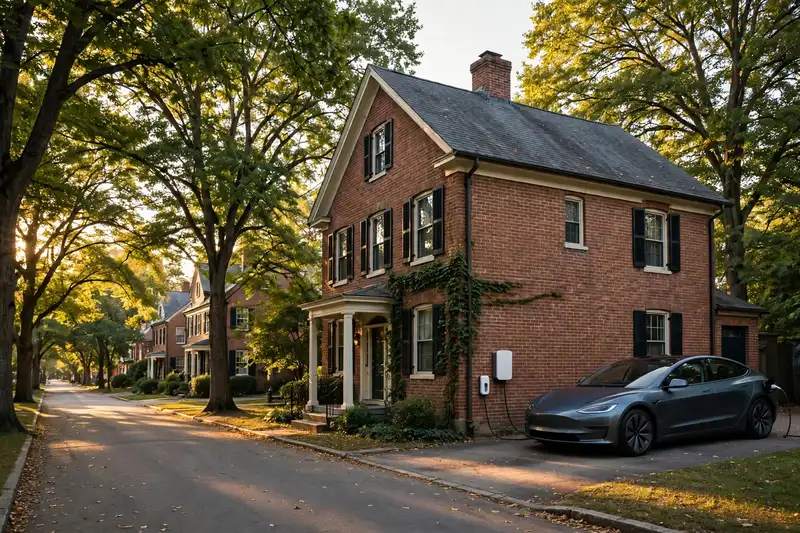
Tenure first, because tenure allocates the decisions: 37% of Trenton's occupied homes are owner-occupied, free to commission electrical work outright. The stock they occupy has a median build year of 1959; 74% predates 1980; 16% is detached single-unit. For the owner-occupied majority, the charger question is purely electrical, and these are the electrical facts. Age shows up electrically before it shows up anywhere else: services sized for a house with a third of today's appliances. Expect the first conversation to be about capacity — what the panel is, what it already feeds, and which of the three routes (circuit, management, upgrade) your numbers support. Porches, carports and parking pads carry a real share of this city's charging, because the stock predates the two-car garage as a standard feature — outdoor-rated equipment is a local staple, not an edge case.
Heating fuel is the survey's quiet clue to panel life: in Trenton, 26% of homes heat electrically (8,423 households), against 66% heating with gas. A house already heating electrically has a service sized with that load in its history; a gas-heated house may have capacity to spare — either way the fuel mix is part of what the installer is reading.
The tenure split cuts the other way too: roughly 18,999 occupied homes in Trenton are rented. For those households the charger question is a negotiation with a property owner — written proposal, licensed installer, metering clarity — and it succeeds often enough that installers here keep the pattern ready.
And 26% of Trenton's homes are in buildings with five or more units — apartments and condominiums where charging is a building decision before it is an electrical one. If that is your situation, the law and multifamily sections of this page are the ones written for you.
EV charging services in Trenton
Ten services cover the work installers do in Trenton. Three lead the list here because of what this city's housing and law actually look like — each links to its national service page, where scope and process are set out in full.
Home EV Charger Installation in Trenton
The standard first install: a dedicated circuit from the panel to the parking space, a station mounted and configured to that circuit, and a passed inspection to close it out. What changes from house to house is never the recipe — it is the panel's spare capacity, the length of the run, and how the car actually parks.
In Trenton: where most Trenton projects start and finish: one circuit, one station, one inspection.
Dedicated Circuit & Electrical Panel Upgrade in Trenton
The capacity project behind the charger project. A load calculation decides whether the answer is a service increase, a panel replacement, a subpanel or load management — and the work is sequenced with the utility and the inspector so the house is live again the same day in most cases.
In Trenton: the capacity fix that lets the charger circuit go in without the rest of the house living at its limit.
Multifamily & Condo EV Charging in Trenton
Buildings that solve charging solve it as infrastructure: a backbone capacity decision, a fair cost-allocation rule, and spaces that can be electrified in ones as residents arrive. The first installation is the constitution; the rest are amendments.
In Trenton: constitutions for shared charging in Trenton buildings: metering, load and approvals.
Utility programs and electricity in Trenton
Electricity in Trenton comes from Public Service Elec & Gas Co. Parts of the wider metro are served by Jersey Central Power & Lt Co. The utility matters twice over for a charger install: it sets the time-of-use rates that decide what overnight charging costs you, and it is the organisation that may — or may not — currently help pay for the equipment.
The honest incentive position in Trenton is: nothing verified to claim. The federal charger credit (30C) ended on September 30, 2025; New Jersey runs no state replacement for typical home installs; and in the utility and state sources checked for this page, Public Service Elec & Gas Co had no active residential charger rebate to point to. Programs reopen — when one does, it will be on the utility's own site with terms and dates. Anything an installer describes without that paper trail should be treated as conversation, not money.
While you are in the tariff pages, look at how the plan values the evening ramp — the hours when cooking, cooling and charging would otherwise stack. A charger that starts after the ramp is the simplest scheduling decision in home charging, and it is set once.
Condos, HOAs and the law in New Jersey
Charging is a protected right for association owners in New Jersey. The state's right-to-charge statute (N.J.S.A. 45:22A-48.2 / -48.4 (confirm section at build)) stops a homeowners association or condominium from banning an owner's charging station outright. Conditions still exist — placement, appearance, insurance and restoration can all be regulated, and the owner pays — yet the starting position is yes-with-rules rather than no-unless-persuaded, and that difference decides most applications before they are written.
For renters, coverage in New Jersey is recorded as: Owners. If you rent in Trenton, the practical route is still a written proposal to the landlord — dedicated circuit, licensed installer, your name on the permit — because a charger-ready space is an asset most landlords keep when you leave.
For the design side — shared versus assigned spaces, load management across a building, billing per owner — see the multifamily and condo charging service page.
Climate, garages and charger placement
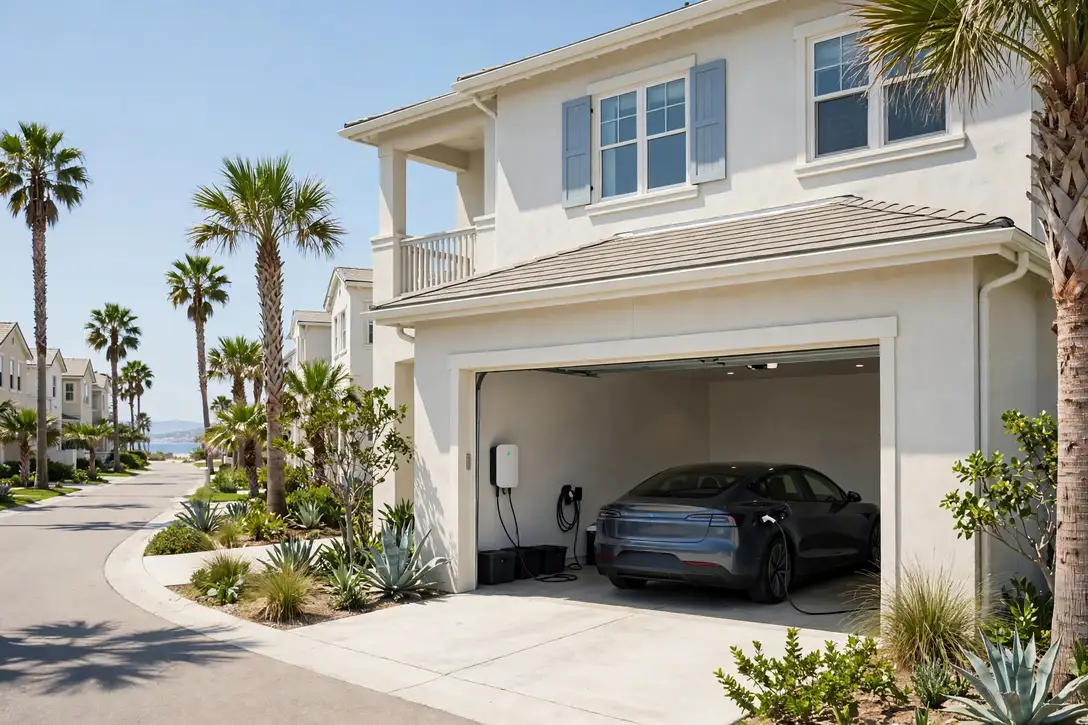
Humidity works on connections slowly and then all at once, which is why coastal installs are inspected with the terminations in mind: torqued at the visit, protected in the enclosure, and on the list for the occasional check. None of it adds drama to the job — it is simply the local version of doing it once and doing it right.
The coastal garage is often the house's dampest room — part storage, part boathouse, part workshop. Equipment listed for damp locations, mounted above the historical water line of the floor, and cabled without low points where moisture gathers: the specification writes itself once the room is described honestly.

Permits and inspection in Trenton
If your install is part of a larger job — a panel upgrade, a garage build — the charger usually rides on the same permit set. Ask for the charger circuit to be listed explicitly so the inspection record shows it.

Neighbourhoods and ZIP codes served
The page covers 27 ZIP codes in and around Trenton — including 08601, 08602, 08603, 08604, 08605, 08606, 08607, 08608, 08609, 08610, 08611, 08618, 08619, 08620, 08625, 08628, 08629, 08638, 08644, 08645, 08646, 08647, 08650, 08666, 08690, 08691, 08695 — across Mercer. If your ZIP is not in the first set shown, ask anyway: installer coverage follows the metro, not a postcode fence.
The same working area takes in the neighbouring localities of Princeton, Princeton Junction, Lawrence Township, Pennington, Windsor, Hopewell, Titusville, Hightstown — the county ring an installer based in Trenton actually drives. Requests from those communities route exactly as city requests do: same services, same permit discipline, same local facts where they differ.
Mercer County accounts for 39 of the ZIP codes and 9 named postal localities in the research file, the nearest of them Princeton, Princeton Junction, Lawrence Township, Pennington, Windsor. The survey counts 385,864 residents in the county, with a median household income of $100,645 and a median home value of $377,700. Measured across its ZIP codes, the Trenton footprint runs about 8 miles north to south and 12 east to west, from ZIP 08601 to 08695 — the ground an installer based here actually covers in a working week.
Beyond the county seats, the working area takes in Princeton, Millstone Township, Princeton Junction, Joint Base Mdl, Lawrence Township, Pennington, Windsor, Morrisville, Hopewell, Plainsboro, Titusville, Blawenburg, Kingston, Washington Crossing, Rocky Hill, Skillman, Bordentown, Levittown, Hightstown, Fairless Hills, Allentown, Monmouth Junction, Cranbury, Roebling, Belle Mead, Chesterfield, Florence, Langhorne, Kendall Park, Ringoes, Dayton, Lambertville, Newtown, Roosevelt, Bristol, Hillsborough, Franklin Park, Columbus, Imlaystown, Monroe Township, New Hope, Pineville, Wrightstown, Flagtown, Penns Park, Cream Ridge, Jobstown, Rushland, Wycombe, Sergeantsville, Three Bridges, Neshanic Station, Stockton, North Brunswick, Helmetta, Solebury, Flemington, Rosemont, Cookstown, New Egypt, Holicong, Juliustown, Milltown, Manville, Zarephath, Somerset, Forest Grove, Spotswood, Edison, Piscataway, Perth Amboy, Sayreville, New Brunswick, Buckingham, Furlong, East Brunswick, Readington, Mechanicsville, Englishtown, Raritan, Carversville, Tennent, Birmingham, South Bound Brook, Somerville, Stanton, Pemberton, South River, Doylestown, Highland Park, Lahaska, Lumberville, Warminster, Point Pleasant, Bridgewater, Bound Brook, New Lisbon, Old Bridge, Baptistown, Quakertown, Whitehouse Station, Whitehouse, Middlesex, Little York, Browns Mills, Martinsville, Danboro, Freehold, Frenchtown, Morganville, Marlboro, Jackson, Pluckemin, Dunellen, Adelphia, Eatontown, Parlin, Pittstown, Annandale, Wickatunk, Lebanon, Bedminster, Warren, Liberty Corner, Oldwick, Clinton, Lakehurst, Lyons, High Bridge, Basking Ridge, Howell, Far Hills, Millington, Pottersville, Colts Neck, Peapack, Farmingdale, Gladstone, Califon, Lakewood, Bernardsville, Toms River, Allenwood, Chester, Long Valley, Brick, Neptune, Belmar, Schooleys Mountain, Beachwood, Manasquan, Brielle, Spring Lake, Sea Girt, Manchester Township, Pine Beach, Point Pleasant Beach, Island Heights, Flanders, Bayville, Ocean Gate, Mantoloking, Normandy Beach, Budd Lake, Lavallette, Seaside Heights, Seaside Park — the named localities for which Trenton is the nearest metro in the network (neighbouring metros' pages cover their own ground), each routing to the same installer-matching service.
The wider working area also reaches Mount Holly, Riverside, Lumberton, Hatboro, Warrington, Pipersville, Abington, Riverton, Plumsteadville, Erwinna, Palmyra, Fountainville, Cheltenham, Glenside, Chalfont, Dublin, Fort Washington, Vincentown, Merchantville, Line Lexington, Colmar, Staten Island, Gwynedd, Colonia, Fanwood, Silverdale, Ferndale, Gillette, Lansdale, Kintnersville, Voorhees, Audubon, Mountainside, Carteret, Gibbsboro — ground shared with neighbouring metros, where installers cross the same county lines in both directions.
ZIP codes in that shared ground include 07001, 07062, 07065, 07068, 07077, 07078, 07080, 07091, 07092, 07095, 07105, 07107, 07111, 07114, 07195, 07202, 07203, 07701, 07716, 07718, 07724, 07737, 07740, 07750, 07754, 07755, 07757, 07760, 07802, 07820, 07829, 07845, 07850, 07852, 07856, 07857, 07936, 07980, 08002, 08003.
The largest communities in that working area after Trenton itself, by the GeoNames populated-place file: Edison (population 102,548), Toms River (population 88,791), Brick (population 76,021), New Brunswick (population 57,035), Piscataway (population 56,044), Lakewood (population 53,805), Levittown (population 52,983), East Brunswick (population 48,495). Charging demand follows those populations — the subdivisions and town centres where the next driveways, and the next panels, are.
Burlington County reaches into the working area with 467,805 residents, a median household income of $108,111 and a median home value of $354,000; its localities on this page include Joint Base Mdl, Bordentown, Roebling, Chesterfield. Somerset County reaches into the working area with 349,846 residents, a median household income of $140,374 and a median home value of $552,100; its localities on this page include Blawenburg, Kingston, Rocky Hill, Skillman, Belle Mead. Monmouth County reaches into the working area with 645,353 residents, a median household income of $124,845 and a median home value of $606,100; its localities on this page include Millstone Township, Allentown, Roosevelt, Imlaystown.
| ZIP | Locality | County |
|---|---|---|
| 08543 | Princeton | Mercer |
| 08601 | Trenton | Mercer |
| 08602 | Trenton | Mercer |
| 08603 | Trenton | Mercer |
| 08604 | Trenton | Mercer |
| 08605 | Trenton | Mercer |
| 08606 | Trenton | Mercer |
| 08607 | Trenton | Mercer |
| 08625 | Trenton | Mercer |
| 08645 | Trenton | Mercer |
| 08646 | Trenton | Mercer |
| 08647 | Trenton | Mercer |
| 08650 | Trenton | Mercer |
| 08666 | Trenton | Mercer |
| 08695 | Trenton | Mercer |
| 08535 | Millstone Township | Monmouth |
| 08619 | Trenton | Mercer |
| 08638 | Trenton | Mercer |
| 08550 | Princeton Junction | Mercer |
| 08609 | Trenton | Mercer |
| 08629 | Trenton | Mercer |
| 08690 | Trenton | Mercer |
| 08640 | Joint Base Mdl | Burlington |
| 08641 | Joint Base Mdl | Burlington |
| 08611 | Trenton | Mercer |
| 08644 | Trenton | Mercer |
| 08648 | Lawrence Township | Mercer |
| 08618 | Trenton | Mercer |
| 08608 | Trenton | Mercer |
| 08610 | Trenton | Mercer |
| 08541 | Princeton | Mercer |
| 08544 | Princeton | Mercer |
| 08542 | Princeton | Mercer |
| 08534 | Pennington | Mercer |
| 08628 | Trenton | Mercer |
| 08540 | Princeton | Mercer |
| 08691 | Trenton | Mercer |
| 08561 | Windsor | Mercer |
| 19067 | Morrisville | Bucks |
| 08525 | Hopewell | Mercer |
| 08620 | Trenton | Mercer |
| 08536 | Plainsboro | Middlesex |
| 08560 | Titusville | Mercer |
| 08504 | Blawenburg | Somerset |
| 08528 | Kingston | Somerset |
| 18977 | Washington Crossing | Bucks |
| 08553 | Rocky Hill | Somerset |
| 08558 | Skillman | Somerset |
| 08505 | Bordentown | Burlington |
| 19054 | Levittown | Bucks |
| 08520 | Hightstown | Mercer |
| 19030 | Fairless Hills | Bucks |
| 08501 | Allentown | Monmouth |
| 19058 | Levittown | Bucks |
| 08510 | Millstone Township | Monmouth |
| 08852 | Monmouth Junction | Middlesex |
| 19055 | Levittown | Bucks |
| 08512 | Cranbury | Middlesex |
| 08554 | Roebling | Burlington |
| 08502 | Belle Mead | Somerset |
| 08515 | Chesterfield | Burlington |
| 08518 | Florence | Burlington |
| 19057 | Levittown | Bucks |
| 19047 | Langhorne | Bucks |
| 19056 | Levittown | Bucks |
| 08824 | Kendall Park | Middlesex |
| 08551 | Ringoes | Hunterdon |
| 08810 | Dayton | Middlesex |
| 08530 | Lambertville | Hunterdon |
| 18940 | Newtown | Bucks |
| 08555 | Roosevelt | Monmouth |
| 19049 | Langhorne | Bucks |
| 19007 | Bristol | Bucks |
| 19048 | Langhorne | Bucks |
| 08844 | Hillsborough | Somerset |
| 08823 | Franklin Park | Somerset |
| 08022 | Columbus | Burlington |
| 08526 | Imlaystown | Monmouth |
| 08831 | Monroe Township | Middlesex |
| 18938 | New Hope | Bucks |
| 18946 | Pineville | Bucks |
| 08562 | Wrightstown | Burlington |
| 08821 | Flagtown | Somerset |
| 18943 | Penns Park | Bucks |
| 08514 | Cream Ridge | Monmouth |
| 08041 | Jobstown | Burlington |
| 18956 | Rushland | Bucks |
| 18980 | Wycombe | Bucks |
| 08557 | Sergeantsville | Hunterdon |
| 08887 | Three Bridges | Hunterdon |

Planning the install: from panel to parking
Think of the project as a chain with four links: capacity, route, placement, paperwork. Capacity is the load calculation. Route is the path copper takes from panel to parking — through a shared wall if you are lucky, across a ceiling or a trench if you are not. Placement is the unglamorous decision that governs daily life with the car for a decade: reach, cable slack, and which side the port is on. Paperwork is the permit and the passed inspection, the proof that outlives the installer's visit.
Future-proofing, in this trade, is mostly conduit and capacity: an oversized conduit run costs little during the first install and everything later; a panel position reserved is a breaker that never has to move. If a second EV, a workshop or an electrified water heater is anywhere in your five-year picture, say so at the site visit.
Home charging know-how for Trenton households
Whose schedule? The car's or the station's
Two schedulers can govern a charging session — the vehicle's own charge timer and the station's app — and households inherit confusion when both are set at once. The discipline is simple: choose one governor. The car's timer travels with the car and knows its departure settings; the station's knows the tariff windows and the household's other loads. Either works; both together produce the 6 am mystery of the half-charged battery and a debugging session nobody enjoys.
Historic districts and exterior rules
In a designated historic district, the charger's exterior footprint can need a second audience: the preservation commission, whose concern is the streetscape rather than the circuit. The designs that pass keep faith with that concern — equipment inside the garage where possible, conduit routed away from the principal facade, nothing mounted on historic fabric. It adds a step, not a saga, and local installers know their commission's habits the way they know their permit counter's.
The autumn checklist
Households in seasonal country develop a small autumn ritual around the charger: the connector and holster checked before the weather turns, the cable's route confirmed clear of the snow-storage corner and the plough's line, the schedule revisited against winter tariffs and winter range. Ten minutes, once a year, timed with the rest of the house's changeover. It belongs to the same family as the inspection file — the unglamorous habits that make an installation feel, five winters later, like it was designed by someone who had met the climate before.
Carports and the condensation line
A carport shelters the car from rain but not from air, and overnight condensation is its signature: cool surfaces, damp mornings, connectors beaded with moisture. Equipment listed for the exposure handles it as routine; the details are in drainage and holstering — a connector docked nose-down in its holder sheds water, one left coiled on the slab collects it. Small physics, daily consequences.

Frequently asked questions
Is the federal charger tax credit still available in Trenton, NJ?
Checked and dated: in the sources reviewed for this page, Public Service Elec & Gas Co runs no residential charger rebate, New Jersey runs no home-charger programme, and the federal credit that once filled the gap ended on September 30, 2025. If a salesperson's spreadsheet shows a rebate line for a Trenton install, the published programme page is the only acceptable evidence.
Can my HOA or condo board in Trenton, NJ refuse my charger?
Only within limits the statute sets. New Jersey law (N.J.S.A. 45:22A-48.2 / -48.4 (confirm section at build)) protects an owner's right to install in their own space; associations may regulate placement, appearance and insurance and require restoration on removal, but a blanket refusal is not theirs to give. If a board stalls, a complete written application citing the statute is the standard remedy.
Panel upgrade or not — how do Trenton, NJ homeowners find out?
It depends on the panel, and Trenton's housing makes the question common: the median home here was built in 1959, and about 74% of housing units predate 1980. Homes with 100-amp service that is already well used often need an upgrade or a load-management device; homes with 200-amp service and spare breaker space usually do not. A load calculation during the site visit settles it — ask to see it.
How quickly will a Level 2 charger fill my car in Trenton, NJ?
Level 1 — the cord in the boot, on a normal outlet — returns about 3–5 miles of range an hour. Level 2 on its own 240-volt circuit returns roughly 25–40. A Trenton commuter who parks at seven and leaves at seven stops doing battery arithmetic entirely.
How does the installer matching on this page work?
Three steps: the request routes to installers who work Trenton, New Jersey; one contacts you to walk the property; the walk produces the written quote. Everything on this page — the utility position, the law, the housing data — is yours to check that quote against.
I live in a Trenton apartment or condo building — can I charge at home?
Possibly — and you are not a niche case: about 26% of Trenton's homes are in buildings of five or more units. Your route runs through the building: a written proposal naming a licensed installer, a dedicated circuit, and a metering design that puts the electricity on your account. The law section above states New Jersey's position, and the multifamily service page covers the building-scale designs.
Nearby cities in New Jersey
- EV charger installation in Vineland — about 57 miles from Trenton, metro population 155,000
- EV charger installation in Atlantic City — about 65 miles from Trenton, metro population 275,000
- EV charger installation in Philadelphia, PA — about 30 miles from Trenton, metro population 6,100,000
- EV charger installation in Allentown, PA — about 47 miles from Trenton, metro population 875,000
- EV charger installation in New York, NY — about 51 miles from Trenton, metro population 19,900,000
Ready to charge at home in Trenton?
Send the essentials — what you need, where, and what kind of property — and a licensed local installer will pick it up from there.