EV Charger Installation in Pensacola, FL
Everything a Pensacola homeowner needs before booking a charger install — the panel question, the utility's current programs, the HOA law and the permit — sourced, dated and local.
Consider what a home charger actually replaces: the weekly detour, the public station's queue, the arithmetic of arriving home low. In Pensacola, the replacement project is well understood because the fleet is already here — 450,400 battery-electric vehicles and 88,400 plug-in hybrids registered across Florida through 2025. Pensacola itself is home to about 54,036 people. This page is the project's local brief: your utility and its programs, your state's law, your city's permit process, and your housing stock's electrical character, each stated with its source.
A note on what PlugReady USA is and is not: we publish the local research and run the matching; the installation itself belongs to licensed electricians and installer companies working in Pensacola. Everything below is written so you can hold your own in that conversation — numbers first, sales language nowhere.
What the Experian and AFDC registration data say about Pensacola–Ferry Pass–Brent: FL panhandle anchor. Translated out of market language: your neighbours are already charging at home, the permit office already knows the paperwork, and the installers already know the housing stock.
The Census Bureau's portrait of Pensacola — median household income $74,212, 64% of occupied homes owner-occupied, 70% of units in single-unit detached houses — is, read correctly, a charging forecast. Owners approve their own work; detached houses host their own circuits; the remaining share is where the interesting projects live.

Every city charges differently, and Pensacola's difference is legible in the data: an older housing fabric, where panel archaeology is a normal part of the first visit; a detached-house majority with a real attached and multifamily minority; buildings of five or more units are a visible minority of the stock; owners hold a working majority, with renters a significant minority. Read the sections below through that profile and the local advice resolves into specifics — which questions are routine here, and which are rare.
In absolute terms, the survey counts 28,298 housing units in Pensacola — 25,109 occupied, 16,118 of them by their owners. The stock resolves into 19,739 single-unit detached houses, 18,259 homes standing since before 1980, and 4,914 units in larger buildings. Those six counts are the city's charging map drawn without percentages, and every section of this page is a consequence of one of them. The page's geography is equally concrete: 23 ZIP codes across Escambia, centred near 30.42 degrees north latitude. The city anchors the Pensacola–Ferry Pass–Brent metropolitan area, home to roughly 525,000 people on the research file's metro estimate — the wider labour and housing market this page's installers work across.
The same survey release fills in the household economics around the housing stock: a median home value of $314,400, median gross rent of $1,322, per-capita income of $48,536, and a median resident age of 41. How the city moves completes the picture: 73% of Pensacola workers drive to work alone — the commute pattern home charging is built around; 17% work from home, a population whose cars charge on daytime and overnight schedules alike; 1% commute by public transit; 43% of adults hold a bachelor's degree or higher. The survey's vehicle table is the one an EV page should quote first: 2,100 of Pensacola's households have no vehicle at all, while 12,693 have two or more — the multi-car households for whom the second circuit is a when, not an if.
The cost-burden lines say who feels housing costs most in Pensacola: 49% of renters spend 30% or more of income on rent, and 0% of owners with mortgages spend the same share on housing costs. Family households are 52% of all households — the two-car, school-run demographic whose charging patterns this page's planning sections keep circling back to.
What follows is the city read as an electrical place rather than a dot on a map. Where so much of the stock predates modern code cycles, the site visit doubles as a survey — grounding electrode, service entrance, panel provenance — before it is ever a quote. Where form is mixed, advice must be conditional — the honest page, like the honest installer, keeps asking which housing the reader actually lives in before prescribing.
The balance of tenure keeps both crafts alive locally: firms that run domestic circuits all week, and firms whose week is landlord letters and board packs — with the good ones fluent in both. Value engineering is the local dialect: load management weighed against panel work on merit, quotes compared line by line, the site visit treated as the moment the scope becomes honest. The regulatory calendar is the programme calendar: rate cases, electrification plans and pilot approvals move through the commission on public timetables, and installers plan their marketing around them.
A mature fleet also means a mature used market — households buying their first EV second-hand arrive at this page with the same install questions the pioneers asked, minus the pioneers' uncertainty. A mid-sized metro's market has a particular shape: a handful of established electrical firms, a few charging specialists, and word of mouth that travels fast enough to discipline all of them. Where the state's statute speaks, the local conversation changes register: installers quote the framework, boards keep counsel's template, and approvals become administrative.
The electrical reality in Pensacola homes
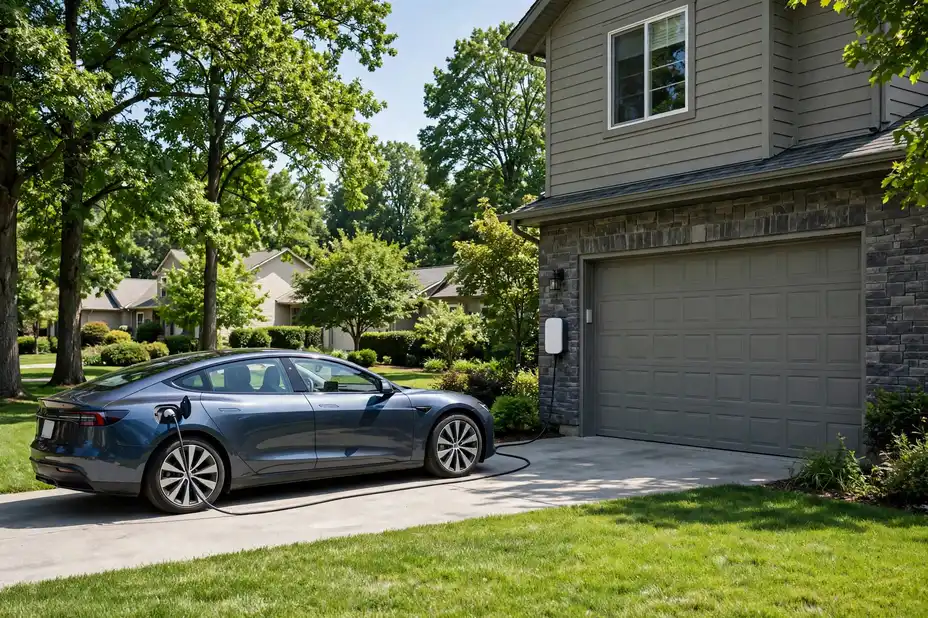
The Census Bureau's latest American Community Survey puts the median Pensacola home's build year at 1972: about 65% of the city's housing units were built before 1980, 70% are single-unit detached houses, and 64% of occupied homes are owner-occupied. Those three numbers predict most of what an installer will find. A housing stock this age leans on smaller electrical services — 100-amp panels are common, and fuse-era equipment still turns up in the oldest streets. For many of those homes the honest answer is a panel upgrade or a load-management device before the charger circuit goes in, and a good installer will show you the load calculation rather than asking you to take it on faith. Detached houses matter for a practical reason: a garage or driveway on your own lot means the charger, the car and the circuit are all under one roof and one owner's control, which is the simplest configuration there is.
The fuel table adds one more local fact: 18,009 Pensacola homes — 72% of the stock — heat with electricity. Those households already think in kilowatts through the winter, their panels carry the load to prove it, and a charger's overnight appetite joins a system that is, in the useful sense, already electrified.
Renters are the other constituency in these numbers: about 8,991 of Pensacola's occupied homes are rented rather than owned. Their charging route runs through a landlord conversation instead of a panel they control — a different project, covered by the rentals guide and the law section below, but a routine one in a city with this many renting households.
One more structural fact shapes Pensacola's charging map: 17% of the city's housing units sit in buildings of five or more units. Those households cannot simply book a circuit — their charger runs through a building, a board and a shared electrical service, which is why the multifamily service and the law section below carry unusual weight on this page.
EV charging services in Pensacola
Ten services cover the work installers do in Pensacola. Three lead the list here because of what this city's housing and law actually look like — each links to its national service page, where scope and process are set out in full.
Home EV Charger Installation in Pensacola
Start to finish, the domestic install is a half-day of electrical work wrapped in a week of scheduling: the survey, the circuit, the mounting, the configuration, the inspection. What the household experiences is simpler — a car that is full every morning and a cable that lives where the car does.
In Pensacola: the core residential job in Pensacola: circuit, mounting, configuration and inspection in one visit pattern.
Dedicated Circuit & Electrical Panel Upgrade in Pensacola
The capacity project behind the charger project. A load calculation decides whether the answer is a service increase, a panel replacement, a subpanel or load management — and the work is sequenced with the utility and the inspector so the house is live again the same day in most cases.
In Pensacola: relevant in Pensacola wherever a 100-amp panel already carries cooking, heating and hot water before a charger asks for room.
Multifamily & Condo EV Charging in Pensacola
Shared buildings convert charging from a purchase into a policy, and the installers fluent here speak both languages — amperage and agenda items. The electrical design that wins approval is the one whose metering and load answers arrive attached to the application.
In Pensacola: the service behind the law section below — boards, applications and shared electrical capacity in Pensacola buildings.
Utility programs and electricity in Pensacola
Electricity in Pensacola comes from Florida Power & Light Co. Parts of the wider metro are served by Escambia River Elec Coop, Inc. The utility matters twice over for a charger install: it sets the time-of-use rates that decide what overnight charging costs you, and it is the organisation that may — or may not — currently help pay for the equipment.
Do not budget for a rebate in Pensacola right now. As of the sources checked for this page, Florida Power & Light Co publishes no residential charger rebate, Florida offers no state program for typical home installs, and the federal 30C credit ended on September 30, 2025. If that changes, the utility's program page will say so with an as-of date — and this page will be updated to match. Until then, judge quotes on the work itself.
One more utility habit worth copying from Pensacola's EV owners: charge on the overnight rate window if your plan has one. The charger itself can usually be scheduled from the car or the station, so the habit costs nothing once it is set.
Condos, HOAs and the law in Florida
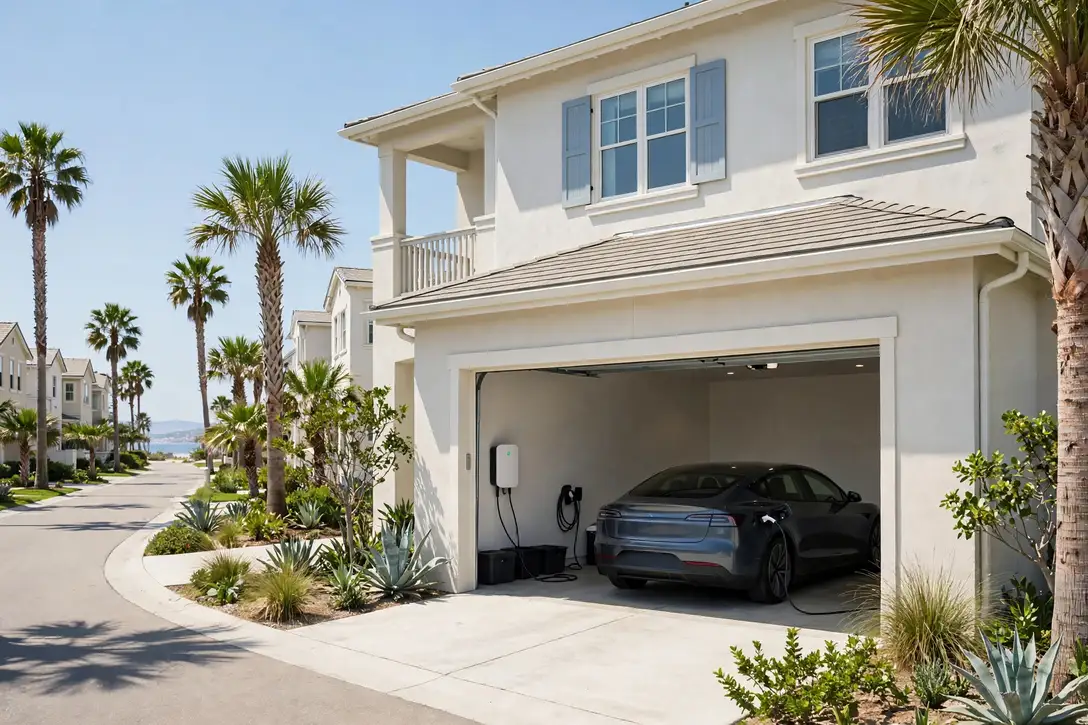
Florida law protects an owner's charger. Fla. Stat. §718.113(8) gives owners in association communities a statutory route to a charging station in their own space: the association may set reasonable conditions on how the installation looks, where exactly it sits, and how it is insured, but a flat prohibition is not one of its options. Owners fund the work, use licensed installers, and remain responsible for the equipment — the statute allocates the burdens; it does not remove them.
If your board is stalling, the sequence that works in Pensacola is boring and effective: cite the statute, submit a complete application (equipment, circuit, installer licence, insurance), and keep everything in writing.
The step-by-step version lives in our guide to installing an EV charger in a condo or HOA community — the application sequence, the metering designs and the questions boards ask, in order.
Climate, garages and charger placement
In this climate the overnight window does double duty — rates are kinder and so are temperatures. Scheduling the charge for the small hours lets the car and the station work in the coolest air the day offers, which is easier on both. An installer who raises scheduling unprompted during the site visit is telling you they install in this heat regularly.
Shade is a specification here, not a nicety. Outdoor stations belong under eaves or on the wall that escapes the afternoon sun; connectors left baking in a holder weather faster, and cables stiffen and crack on a shorter clock. The site walk should include a look at where the sun actually lands at four in the afternoon — that is the hour the equipment has to survive.

Permits and inspection in Pensacola
Bring the panel schedule up to date while the electrician is in it — the new circuit labelled, in the directory, in pen. Inspectors notice; future electricians bless you for it; and the load calculation for any second circuit starts from that card.

Neighbourhoods and ZIP codes served
The page covers 23 ZIP codes in and around Pensacola — including 32501, 32502, 32503, 32504, 32505, 32506, 32507, 32508, 32509, 32511, 32512, 32513, 32514, 32516, 32520, 32521, 32522, 32523, 32524, 32526, 32534, 32559, 32591 — across Escambia. If your ZIP is not in the first set shown, ask anyway: installer coverage follows the metro, not a postcode fence.
The same working area takes in the neighbouring localities of Gonzalez, Cantonment, Molino, Mc David, Century — the county ring an installer based in Pensacola actually drives. Requests from those communities route exactly as city requests do: same services, same permit discipline, same local facts where they differ.
Escambia County accounts for 28 of the ZIP codes and 6 named postal localities in the research file, the nearest of them Gonzalez, Cantonment, Molino, Mc David, Century. The survey counts 325,923 residents in the county, with a median household income of $67,500 and a median home value of $257,200. Measured across its ZIP codes, the Pensacola footprint runs about 14 miles north to south and 9 east to west, from ZIP 32501 to 32591 — the ground an installer based here actually covers in a working week.
Beyond the county seats, the working area takes in Gulf Breeze, Gonzalez, Milton, Lillian, Cantonment, Seminole, Bagdad, Navarre, Elberta, Molino, Orange Beach, Foley, Gulf Shores, Bon Secour, Mc David, Century — the named localities for which Pensacola is the nearest metro in the network (neighbouring metros' pages cover their own ground), each routing to the same installer-matching service.
The wider working area also reaches Robertsdale, Summerdale, Mary Esther, Hurlburt Field, Silverhill, Magnolia Springs, Loxley, Fort Walton Beach, Jay, Eglin Afb, Fairhope, Holt, Shalimar, Stapleton, Milligan, Point Clear, Niceville, Montrose, Daphne, Destin, Valparaiso, Spanish Fort, Baker, Crestview, Bay Minette, Flomaton, Atmore — ground shared with neighbouring metros, where installers cross the same county lines in both directions.
ZIP codes in that shared ground include 32531, 32536, 32537, 32540, 32541, 32542, 32544, 32547, 32548, 32549, 32564, 32565, 32569, 32578, 32579, 32580, 32588, 36441, 36503, 36504, 36507, 36526, 36527, 36532, 36533, 36536, 36551, 36555, 36559, 36564, 36567, 36576, 36577, 36578, 36580.
The largest communities in that working area after Pensacola itself, by the GeoNames populated-place file: East Pensacola Heights (population 54,104), Navarre (population 31,378), Ferry Pass (population 28,921), Cantonment (population 26,493), Bellview (population 23,355), Brent (population 21,804), West Pensacola (population 21,339), Ensley (population 20,602), Pace (population 20,039), Foley (population 17,218), Midway (population 16,115), Myrtle Grove (population 15,870), Warrington (population 14,531), Gonzalez (population 13,273), Gulf Shores (population 11,131), East Milton (population 11,074), Milton (population 9,628), Gulf Breeze (population 6,323), Orange Beach (population 5,850), Goulding (population 4,102). Charging demand follows those populations — the subdivisions and town centres where the next driveways, and the next panels, are.
Santa Rosa County reaches into the working area with 198,472 residents, a median household income of $91,922 and a median home value of $329,800; its localities on this page include Gulf Breeze, Milton, Bagdad.
| ZIP | Locality | County |
|---|---|---|
| 32501 | Pensacola | Escambia |
| 32516 | Pensacola | Escambia |
| 32521 | Pensacola | Escambia |
| 32522 | Pensacola | Escambia |
| 32523 | Pensacola | Escambia |
| 32524 | Pensacola | Escambia |
| 32591 | Pensacola | Escambia |
| 32502 | Pensacola | Escambia |
| 32520 | Pensacola | Escambia |
| 32503 | Pensacola | Escambia |
| 32505 | Pensacola | Escambia |
| 32511 | Pensacola | Escambia |
| 32512 | Pensacola | Escambia |
| 32506 | Pensacola | Escambia |
| 32504 | Pensacola | Escambia |
| 32559 | Pensacola | Escambia |
| 32561 | Gulf Breeze | Santa Rosa |
| 32562 | Gulf Breeze | Santa Rosa |
| 32508 | Pensacola | Escambia |
| 32507 | Pensacola | Escambia |
| 32526 | Pensacola | Escambia |
| 32509 | Pensacola | Escambia |
| 32514 | Pensacola | Escambia |
| 32534 | Pensacola | Escambia |
| 32513 | Pensacola | Escambia |
| 32563 | Gulf Breeze | Santa Rosa |
| 32560 | Gonzalez | Escambia |
| 32583 | Milton | Santa Rosa |
| 36549 | Lillian | Baldwin |
| 32533 | Cantonment | Escambia |
| 36574 | Seminole | Baldwin |
| 32530 | Bagdad | Santa Rosa |
| 32571 | Milton | Santa Rosa |
| 32566 | Navarre | Santa Rosa |
| 32572 | Milton | Santa Rosa |
| 32570 | Milton | Santa Rosa |
| 36530 | Elberta | Baldwin |
| 32577 | Molino | Escambia |
| 36561 | Orange Beach | Baldwin |
| 36535 | Foley | Baldwin |
| 36547 | Gulf Shores | Baldwin |
| 36511 | Bon Secour | Baldwin |
| 36542 | Gulf Shores | Baldwin |
| 32568 | Mc David | Escambia |
| 32535 | Century | Escambia |

Planning the install: from panel to parking
Homeowners sometimes ask why a job that looks like 'one outlet' needs a site visit at all. The visit exists because the three variables that set the scope — spare capacity, the run's route, and the property's approval layer — are all invisible from a photograph. In Pensacola an experienced installer reads them in minutes, in the panel's directory card, the garage's geometry and the community's documents. The quote that follows a visit is a different species from the quote that precedes one: it can be held to.
Future-proofing, in this trade, is mostly conduit and capacity: an oversized conduit run costs little during the first install and everything later; a panel position reserved is a breaker that never has to move. If a second EV, a workshop or an electrified water heater is anywhere in your five-year picture, say so at the site visit.
Home charging know-how for Pensacola households
Home as the road-trip base
A home charger changes road trips at both ends. Departure: the car leaves full, on the household's lowest-cost energy, at the household's chosen hour. Return: it arrives home low without anxiety, because the recovery is the driveway rather than a detour. The middle belongs to the public networks; the ends — the parts travellers actually remember — belong to the wall at home. Households that tour often find this, quietly, is the feature they would surrender last.
Amps, volts and kilowatts without tears
Three numbers describe every charging session. Volts are the pressure — 240 of them on a Level 2 circuit. Amps are the flow — the circuit's rating, of which the car may continuously use eighty percent. Kilowatts are the product of the two and the speedometer of charging: volts times amps, divided by a thousand. A 40-amp circuit at 240 volts delivers 9.6 kilowatts; over a ten-hour night that is roughly 96 kilowatt-hours before losses — more than most batteries hold. Once the multiplication is familiar, every quote and specification sheet becomes readable.
HOA rules and the single-family exterior
Owning the house does not always settle the charger's exterior chapter: architectural-approval clauses in many communities reach visible equipment, conduit runs on front elevations, and anything mounted streetside. The practical route is a five-minute check of the covenants before the install, and, where approval applies to exterior work, a small application — equipment photo, mounting position, conduit path — that reads as a courtesy because it is one. Interior garage installs in most single-family communities are entirely the owner's affair; it is the visible fraction that earns the paperwork.
The driveway is shared infrastructure
In households where the charger serves a shared driveway, the install acquires a social protocol alongside its electrical one: whose night, which side, how the cable crosses, what happens when guests park across the route. The designs that work settle the protocol physically — a station reachable from both bays, a cable path that crosses no one's door swing — rather than relying on nightly negotiation. Infrastructure that requires diplomacy every evening was under-designed in the morning.
The charger among workshop loads
Garages that double as workshops put the charger in interesting company: welders, compressors, dust collectors — loads with appetites and opinions. The load calculation for such a house reads the whole tenancy, and the honest conversation includes which loads genuinely coincide. A station scheduled into the workshop's quiet hours lives peacefully; one competing with the table saw's startup surge teaches the household about breaker curves the experiential way.

Frequently asked questions
Is the federal charger tax credit still available in Pensacola, FL?
No. The federal Alternative Fuel Refueling Property Credit (30C) ended for equipment placed in service after September 30, 2025. In the sources checked for this page, Florida Power & Light Co had no verified residential charger rebate running either — if an installer names a current program, ask for its published terms.
Can my association in Pensacola, FL say no to a home charger?
Florida law (Fla. Stat. §718.113(8)) limits that: associations cannot prohibit an owner's charger outright, though they can impose reasonable conditions on placement, insurance and restoration, and the owner pays for the installation. The process section above walks through it.
Will my Pensacola, FL home need a panel upgrade for a Level 2 charger?
Start from the median, then verify: the median Pensacola home was built in 1972, and 65% of the stock predates 1980, so 100-amp panels are a normal sight here — and a normal candidate for either an upgrade or a load-management device. The load calculation distinguishes the two in one visit, and any quote that skips it is guessing with your money.
How quickly will a Level 2 charger fill my car in Pensacola, FL?
Think of it in parked hours. Level 1 gives you back 3–5 miles for each of them; Level 2 gives back about 25–40, set by the circuit's amperage and what the car can accept. Overnight, that is the gap between 'enough for tomorrow' and 'full, every morning'.
How does the installer matching on this page work?
Three steps: the request routes to installers who work Pensacola, Florida; one contacts you to walk the property; the walk produces the written quote. Everything on this page — the utility position, the law, the housing data — is yours to check that quote against.
Can a charger be added to a detached garage in Pensacola?
Yes — and detached garages are common in Pensacola, where about 70% of homes are single-unit detached. The run out to the building is the substance of the job: a buried conduit from the house panel, or a subpanel in the garage where the distance and future loads justify it. The station itself then behaves like any garage install.
Nearby cities in Florida
- EV charger installation in Crestview — about 42 miles from Pensacola, metro population 290,000
- EV charger installation in Panama City — about 89 miles from Pensacola, metro population 195,000
- EV charger installation in Tallahassee — about 164 miles from Pensacola, metro population 390,000
- EV charger installation in Gainesville — about 276 miles from Pensacola, metro population 350,000
- EV charger installation in Homosassa Springs — about 280 miles from Pensacola, metro population 155,000
- EV charger installation in Ocala — about 296 miles from Pensacola, metro population 400,000
- EV charger installation in Mobile, AL — about 49 miles from Pensacola, metro population 425,000
- EV charger installation in Gulfport, MS — about 103 miles from Pensacola, metro population 420,000
- EV charger installation in Dothan, AL — about 114 miles from Pensacola, metro population 155,000
Ready to charge at home in Pensacola?
Send the essentials — what you need, where, and what kind of property — and a licensed local installer will pick it up from there.