EV Charger Installation in Portsmouth, NH
Everything a Portsmouth homeowner needs before booking a charger install — the panel question, the utility's current programs, the HOA law and the permit — sourced, dated and local.
Every home charger installation is the same four decisions wearing local clothes: capacity in the panel, a route for the circuit, a position for the station, and paperwork that proves it was done properly. What changes from city to city is the content of those decisions — and in Portsmouth the content is specific. Portsmouth itself is home to about 22,545 people. New Hampshire's registered fleet stood at 16,100 battery-electric vehicles and 9,500 plug-in hybrids at the end of 2025, and this page works through the local version of each decision: your utility and its programs, your state's association law, your permit counter, and your housing stock's electrical habits.
How PlugReady USA works, in one breath: you describe the job once, licensed local installers who cover Portsmouth receive it, and the conversations happen with them directly. The rest of this page exists so those conversations start from facts — yours about the house, ours about the metro — rather than from a sales script.
The registration ledger for the Portsmouth metro reads: Seacoast affluence. Ledgers like this are what installer rounds are built from — they show where the cars already are, which is where the circuits get requested, permitted and inspected week after week.
Context from the Census Bureau's survey of Portsmouth: median household income $106,219; 52% of occupied homes are owner-occupied; 39% of housing units are single-unit detached houses. It is the profile of a city where the typical charger job is a homeowner job — scoped by the panel and the wire run, not by permissions.

The composite picture matters more than any single statistic. In Portsmouth: an older housing fabric, where panel archaeology is a normal part of the first visit; a genuinely mixed city — houses, townhouses and larger buildings all carry weight; buildings of five or more units hold a substantial share of homes, which keeps the multifamily sections of this page in daily use; meanwhile, owners hold a working majority, with renters a significant minority. A page that ignored that profile would give the same advice everywhere; this one is ordered by it.
In absolute terms, the survey counts 11,370 housing units in Portsmouth — 10,902 occupied, 5,661 of them by their owners. The stock resolves into 4,479 single-unit detached houses, 7,551 homes standing since before 1980, and 3,845 units in larger buildings. Those six counts are the city's charging map drawn without percentages, and every section of this page is a consequence of one of them. The page's geography is equally concrete: 4 ZIP codes across Rockingham, centred near 43.07 degrees north latitude. The city anchors the Portsmouth metropolitan area, home to roughly 205,000 people on the research file's metro estimate — the wider labour and housing market this page's installers work across.
The same survey release fills in the household economics around the housing stock: a median home value of $688,500, median gross rent of $1,869, per-capita income of $72,411, and a median resident age of 43. The movement data matters as much as the money data: 69% of Portsmouth workers drive to work alone — the commute pattern home charging is built around; 22% work from home, a population whose cars charge on daytime and overnight schedules alike; 1% commute by public transit; 64% of adults hold a bachelor's degree or higher. And the fleet in the driveways: 4,314 households in Portsmouth have exactly one vehicle, 6,054 have two or more, and 534 have none.
Household structure, from the same release: 48% of Portsmouth households are family households. The burden shares behind the housing stock: 49% of renting households are cost-burdened at the 30%-of-income line, as are 0% of mortgaged owners — context for why the overnight rate window, once set, is treated here as a household fixture rather than a hobby.
The signature matters because installs follow it, street by street. Pre-war and immediate post-war streets dominate the map, and their electrical fabric is stratified — original services beneath mid-century additions beneath modern subpanels, an archaeology the load calculation reads layer by layer. Multifamily weight changes the installer market too — the firms that thrive here carry association paperwork fluency alongside their licences, and their references are buildings, not just households.
Where renting dominates, the successful install is a document before it is a device — installer licence, insurance, metering clarity, end-of-tenancy position — assembled to make a landlord's yes the path of least resistance. At these incomes the binding constraint is rarely money; it is scheduling — installer diaries, permit queues and the household's own calendar. Filed tariffs and public dockets give this territory a paper trail most markets lack: the diligent household can read the utility's own electrification plan and know which programmes are funded, piloted or merely proposed.
The state fleet is young, and Portsmouth's charging story is being written by its first draft of households — the ones whose installs will be the precedents boards and neighbours cite for a decade. Smaller metros adopt on their own clock: the fleet follows the dealers and the demographics, and each install is a visible event a street notices. Boards here decide without a statutory script, which makes precedent the currency: the first well-built application in a community quietly writes the policy for everyone after it.
The electrical reality in Portsmouth homes
The Census Bureau counts Portsmouth's housing in ways that turn out to be an installer's briefing: the median home dates to 1959, 66% of units stood before 1980, 39% are detached single-unit houses, and 52% of occupied homes belong to their occupants. Panel sizes, wire routes and even permit histories track those proportions street by street. A housing stock this age leans on smaller electrical services — 100-amp panels are common, and fuse-era equipment still turns up in the oldest streets. For many of those homes the honest answer is a panel upgrade or a load-management device before the charger circuit goes in, and a good installer will show you the load calculation rather than asking you to take it on faith. Detached houses matter for a practical reason: a garage or driveway on your own lot means the charger, the car and the circuit are all under one roof and one owner's control, which is the simplest configuration there is.
Heating fuel is the survey's quiet clue to panel life: in Portsmouth, 18% of homes heat electrically (1,949 households), against 56% heating with gas. A house already heating electrically has a service sized with that load in its history; a gas-heated house may have capacity to spare — either way the fuel mix is part of what the installer is reading.
Renters are the other constituency in these numbers: about 5,241 of Portsmouth's occupied homes are rented rather than owned. Their charging route runs through a landlord conversation instead of a panel they control — a different project, covered by the rentals guide and the law section below, but a routine one in a city with this many renting households.
One more structural fact shapes Portsmouth's charging map: 34% of the city's housing units sit in buildings of five or more units. Those households cannot simply book a circuit — their charger runs through a building, a board and a shared electrical service, which is why the multifamily service and the law section below carry unusual weight on this page.
EV charging services in Portsmouth
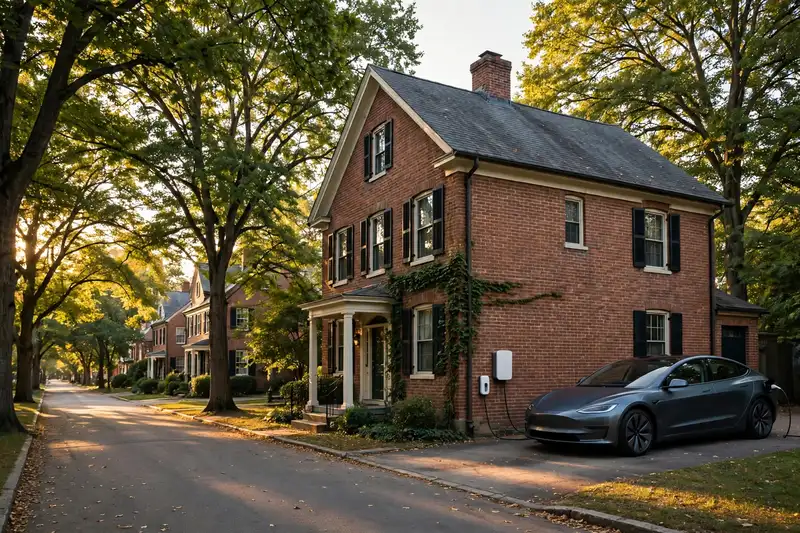
Installers in Portsmouth book the same ten services as everywhere — but not in the same proportions. The three leading cards below are this city's pattern, set by its panels, its buildings and its statute book.
Home EV Charger Installation in Portsmouth
For most households this is the whole project: a Level 2 station mounted where the car sleeps, fed by its own 240-volt circuit. The visit pattern is consistent — load calculation, route the run, mount and configure, inspect — and the variables are your panel, your parking and your permit office.
In Portsmouth: the core residential job in Portsmouth: circuit, mounting, configuration and inspection in one visit pattern.
Dedicated Circuit & Electrical Panel Upgrade in Portsmouth
Where the load calculation fails the existing service, the upgrade is not an upsell — it is the finding. Done under permit with the utility's meter work coordinated, it converts the charger project into the house's electrical reset, and every later project inherits the headroom.
In Portsmouth: service work that turns 'no room' into a circuit with headroom in Portsmouth homes.
Level 2 Charger Installation in Portsmouth
Level 2's numbers explain its dominance: several times the overnight recovery of a wall outlet, on equipment sized to the circuit by a factor the code fixes. The install is a circuit project with a station at the end of it, and it is quoted that way by anyone who does it weekly.
In Portsmouth: the 240-volt step that turns overnight charging in Portsmouth from a trickle into a full battery by morning.
Utility programs and electricity in Portsmouth
Electricity in Portsmouth comes from Public Service Co of NH. Parts of the wider metro are served by New Hampshire Elec Coop Inc, Unitil Energy Systems, Liberty Utilities (Granite State Electri. The utility matters twice over for a charger install: it sets the time-of-use rates that decide what overnight charging costs you, and it is the organisation that may — or may not — currently help pay for the equipment.
Program status is a snapshot, and this page dates its snapshot: sources checked at build time found no Public Service Co of NH residential charger rebate, no New Hampshire home-charger program, and a federal credit that ended September 30, 2025. Portsmouth households should treat that as the position until a utility announcement changes it — utilities publish openings prominently when budgets exist, because unspent program money is a problem for them too.
One more utility habit worth copying from Portsmouth's EV owners: charge on the overnight rate window if your plan has one. The charger itself can usually be scheduled from the car or the station, so the habit costs nothing once it is set.
Condos, HOAs and the law in New Hampshire
There is no New Hampshire right-to-charge statute to lean on. Some national roundups list protection that does not exist in this state's code; the statute indexes checked for this page are clear. In Portsmouth, a condo or HOA charger is approved — or not — under the community's own documents, which makes the quality of your application the whole ballgame.
Owners of single-family homes in HOA communities should also check the covenants before assuming the driveway is uncomplicated: exterior-equipment and architectural-approval clauses can apply to a visible wall-mounted station even where the garage interior is entirely the owner's business.
Our condo and HOA guide covers both kinds of state; in Portsmouth the chapters on complete applications and cost allocation are the operative ones.
Climate, garages and charger placement
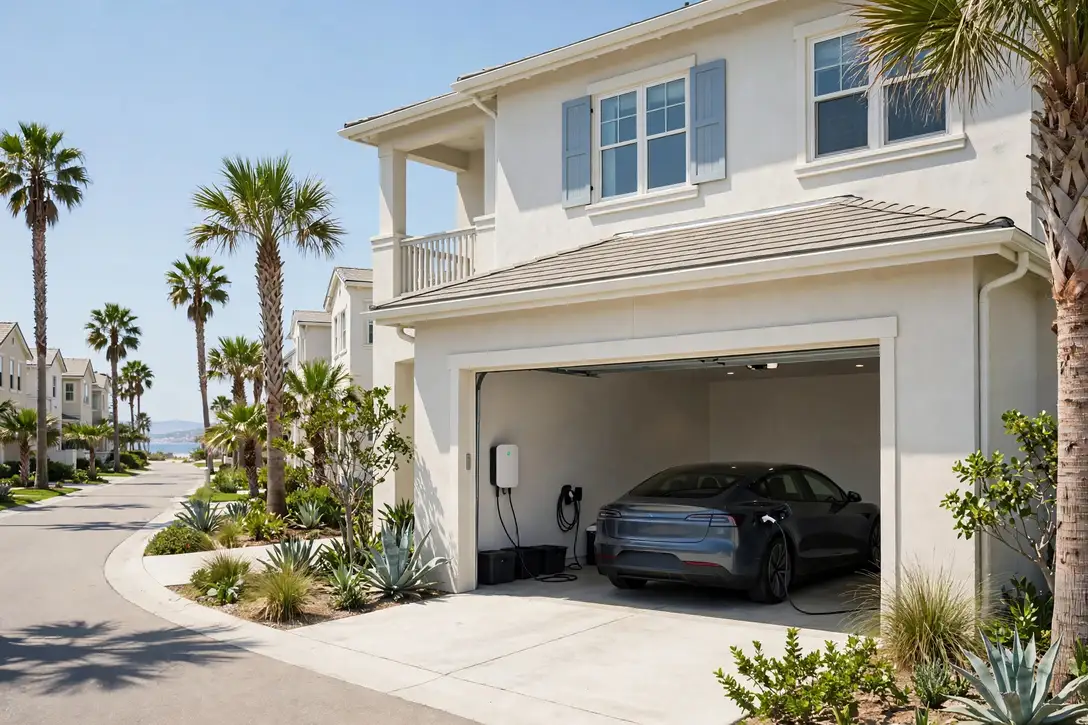
Coastal charging inherits the coast's oldest rule — everything metal near salt water is on a clock. Listed outdoor equipment, stainless fixings, sealed entries: the specification is short, and local installers recite it from memory.
Sea-breeze evenings are the coast's natural charging window: the car cools, the grid exhales after the afternoon peak, and the household's own routine is home. Matching the schedule to that rhythm is a settings-screen decision, made once.

Permits and inspection in Portsmouth
What the inspector is checking, in plain terms: conductor size against breaker size, the continuous-load calculation, terminations torqued, protection where the code wants it, and a station whose settings match the circuit it landed on. It is a short visit that validates everything you cannot see.
Neighbourhoods and ZIP codes served
The page covers 4 ZIP codes in and around Portsmouth — including 03801, 03802, 03803, 03804 — across Rockingham. If your ZIP is not in the first set shown, ask anyway: installer coverage follows the metro, not a postcode fence.
The same working area takes in the neighbouring localities of Greenland, New Castle, Rye, Stratham, Rye Beach, North Hampton, Newmarket, Hampton, Newfields, Exeter, Hampton Falls, Seabrook, Epping, East Kingston — the county ring an installer based in Portsmouth actually drives. Requests from those communities route exactly as city requests do: same services, same permit discipline, same local facts where they differ.
Rockingham County accounts for 44 of the ZIP codes and 40 named postal localities in the research file, the nearest of them Greenland, New Castle, Rye, Stratham, Rye Beach. The survey counts 319,082 residents in the county, with a median household income of $118,331 and a median home value of $497,500.
Beyond the county seats, the working area takes in Greenland, Kittery, Eliot, New Castle, Rye, Kittery Point, Stratham, Rye Beach, North Hampton, Durham, Newmarket, Dover, Hampton, York Harbor, Newfields, York, Exeter, Madbury, Rollinsford, South Berwick, Lee, Hampton Falls, York Beach, Somersworth, Cape Neddick, Seabrook, Epping, Berwick, East Kingston, Salisbury, Barrington, Rochester, Ogunquit, Amesbury, Nottingham, North Berwick, Kingston, Moody, Newburyport, Fremont, Newton, Newton Junction, Merrimac, West Nottingham, Newbury, Wells, Center Strafford, West Newbury, Plaistow, Byfield, Cape Porpoise, Strafford, Sanford, Haverhill, Groveland, Rowley, Georgetown, Farmington, Milton, Lebanon, Springvale, Rockport, Milton Mills, New Durham, Union, Acton, Sanbornville, East Wakefield, Wolfeboro, Wolfeboro Falls — the named localities for which Portsmouth is the nearest metro in the network (neighbouring metros' pages cover their own ground), each routing to the same installer-matching service.
The wider working area also reaches Danville, West Kennebunk, Candia, Auburn, Hamilton, Peabody, Essex, Center Barnstead, Lawrence, Barnstead, Windham, Manchester, Londonderry, Beverly, Biddeford Pool, Pelham, Saco, West Newfield, East Waterboro, North Reading, Alton Bay, Hollis Center, Litchfield, Dracut, Hudson, Tewksbury, Loudon, Concord, Bedford, Wilmington, Gilmanton, Swampscott, North Billerica, Billerica, Melrose — ground shared with neighbouring metros, where installers cross the same county lines in both directions.
ZIP codes in that shared ground include 01805, 01822, 01826, 01831, 01835, 01844, 01845, 01862, 01864, 01879, 01899, 01901, 01902, 01904, 01906, 01921, 01936, 01938, 01944, 03034, 03036, 03040, 03045, 03046, 03051, 03052, 03076, 03258, 03301, 03305, 03307, 04004, 04042, 04048, 04063, 04064, 04074, 04076, 04093, 05544.
The largest communities in that working area after Portsmouth itself, by the GeoNames populated-place file: Haverhill (population 62,765), Dover (population 30,880), Rochester (population 30,038), Sanford (population 20,893), Amesbury (population 18,313), Newburyport (population 17,982), York Beach (population 12,854), Somersworth (population 11,759), Durham (population 10,345), Wells Beach Station (population 10,162), Hampton (population 9,656), Exeter (population 9,242), Seabrook (population 8,679), Barrington (population 8,417), Plaistow (population 7,885), South Berwick (population 7,480), Stratham Station (population 6,949), Eliot (population 6,528), Merrimac (population 6,245), Kingston (population 6,225). Charging demand follows those populations — the subdivisions and town centres where the next driveways, and the next panels, are.
Strafford County reaches into the working area with 132,575 residents, a median household income of $88,570 and a median home value of $362,800; its localities on this page include Durham, Dover, Madbury. Carroll County reaches into the working area with 51,804 residents, a median household income of $86,463 and a median home value of $388,900; its localities on this page include Lee, Sanbornville, East Wakefield, Wolfeboro, Wolfeboro Falls.
| ZIP | Locality | County |
|---|---|---|
| 03801 | Portsmouth | Rockingham |
| 03802 | Portsmouth | Rockingham |
| 03803 | Portsmouth | Rockingham |
| 03804 | Portsmouth | Rockingham |
| 03840 | Greenland | Rockingham |
| 03904 | Kittery | York |
| 03903 | Eliot | York |
| 03854 | New Castle | Rockingham |
| 03870 | Rye | Rockingham |
| 03905 | Kittery Point | York |
| 03885 | Stratham | Rockingham |
| 03871 | Rye Beach | Rockingham |
| 03862 | North Hampton | Rockingham |
| 03824 | Durham | Strafford |
| 03857 | Newmarket | Rockingham |
| 03820 | Dover | Strafford |
| 03821 | Dover | Strafford |
| 03822 | Dover | Strafford |
| 03842 | Hampton | Rockingham |
| 03911 | York Harbor | York |
| 03856 | Newfields | Rockingham |
| 03909 | York | York |
| 03833 | Exeter | Rockingham |
| 03823 | Madbury | Strafford |
| 03869 | Rollinsford | Strafford |
| 03908 | South Berwick | York |
| 03861 | Lee | Carroll |
| 03844 | Hampton Falls | Rockingham |
| 03843 | Hampton | Rockingham |
| 03910 | York Beach | York |
| 03878 | Somersworth | Strafford |
| 03902 | Cape Neddick | York |
| 03874 | Seabrook | Rockingham |
| 03042 | Epping | Rockingham |
| 03901 | Berwick | York |
| 03827 | East Kingston | Rockingham |
| 01952 | Salisbury | Essex |
| 03825 | Barrington | Strafford |
| 03839 | Rochester | Strafford |
| 03907 | Ogunquit | York |
| 01913 | Amesbury | Essex |
| 03290 | Nottingham | Rockingham |
| 03906 | North Berwick | York |
| 03848 | Kingston | Rockingham |
| 04054 | Moody | York |
| 01950 | Newburyport | Essex |
| 03044 | Fremont | Rockingham |
| 03866 | Rochester | Strafford |
| 03867 | Rochester | Strafford |
| 03868 | Rochester | Strafford |
| 03858 | Newton | Rockingham |
| 03859 | Newton Junction | Rockingham |
| 01860 | Merrimac | Essex |
| 03291 | West Nottingham | Rockingham |
| 01951 | Newbury | Essex |
| 04090 | Wells | York |
| 03815 | Center Strafford | Strafford |
| 01985 | West Newbury | Essex |
| 03865 | Plaistow | Rockingham |
| 01922 | Byfield | Essex |
| 04014 | Cape Porpoise | York |
| 03884 | Strafford | Strafford |
| 04073 | Sanford | York |
| 01830 | Haverhill | Essex |
| 01834 | Groveland | Essex |
| 01969 | Rowley | Essex |
| 01833 | Georgetown | Essex |
| 03835 | Farmington | Strafford |
| 03851 | Milton | Strafford |
| 04027 | Lebanon | York |
| 04083 | Springvale | York |
| 01966 | Rockport | Essex |
| 03852 | Milton Mills | Strafford |
| 03855 | New Durham | Strafford |
| 03887 | Union | Strafford |
| 04001 | Acton | York |
| 03872 | Sanbornville | Carroll |
| 03830 | East Wakefield | Carroll |
| 03894 | Wolfeboro | Carroll |
| 03896 | Wolfeboro Falls | Carroll |

Planning the install: from panel to parking
Homeowners sometimes ask why a job that looks like 'one outlet' needs a site visit at all. The visit exists because the three variables that set the scope — spare capacity, the run's route, and the property's approval layer — are all invisible from a photograph. In Portsmouth an experienced installer reads them in minutes, in the panel's directory card, the garage's geometry and the community's documents. The quote that follows a visit is a different species from the quote that precedes one: it can be held to.
Finally, photograph the finished work — station, nameplate, panel directory with the new breaker labelled — and file it with the inspection record. When the car changes, the house sells or a second station joins the first, that folder is the difference between a five-minute answer and an archaeological dig.
Home charging know-how for Portsmouth households
Breaker spaces are not capacity
Two different shortages hide inside the phrase 'my panel is full'. A panel can run out of breaker spaces while its service still has honest capacity — answered with a subpanel or, where the listing permits, tandem breakers. Or it can run out of capacity while spaces remain — answered with a service increase or a management system. The load calculation distinguishes the two in minutes, and the distinction is worth real scope: one answer is an afternoon's work, the other is a project. Any quote that treats them as the same problem has skipped the arithmetic.
The school-run charge window
Households organised around school runs live on a distinctive charge curve: two short hops, a long parked day, an afternoon of activities. The car sits at home for the middle of the day — which, for solar households, is precisely the generation window, and for everyone else makes the overnight session almost an afterthought. Scheduling follows the family's actual day, not the tariff's assumption of one, and the installer who asks about the school run is designing, not chatting.
Garage layout: the unglamorous decider
More charging routines are decided by garage geography than by equipment. Which bay the EV takes, which side its port sits on, where the freezer, bikes and workbench have permanent tenure — the station belongs at the intersection of those facts, with a cable that reaches the port without crossing the walking line to the door. Installers who walk the layout with the car in place are not being thorough for its own sake; they are preventing the daily, decade-long annoyance of a station mounted for a parking pattern nobody uses.
The insurance conversation
A permitted charger installation is a short conversation with your insurer, and it is worth having before rather than after. The documented install — permit, inspection, listed equipment, licensed electrician — is the version insurers process without friction, because every question they ask is answered by the file. Undocumented electrical work is where claims go to become arguments. Tell the insurer the circuit exists, keep the paperwork with the policy documents, and the charger's insurance chapter closes in one phone call.

Frequently asked questions
What happened to the federal home-charger credit in Portsmouth, NH?
Nothing is currently on offer that you should plan around. The federal 30C credit ended on September 30, 2025; New Hampshire operates no replacement for typical home installs; and the sources checked for this page showed no live residential rebate from Public Service Co of NH. Programs do reopen — on the utility's own pages, with dates. Until one does, the install stands or falls on its own merits.
Can my association in Portsmouth, NH say no to a home charger?
They hold the stronger hand in New Hampshire: with no right-to-charge statute on the books, a Portsmouth association's covenants are the law of the car park. The applications that succeed anyway share a shape — owner-funded, licensed installer, metered energy, insured, reversible — because they answer the board's risk questions in advance and in writing.
Panel upgrade or not — how do Portsmouth, NH homeowners find out?
Nobody can answer that from a photograph of your panel's door, and you should be suspicious of anyone who tries. In a city where the median home dates to 1959 and about 66% of units predate 1980, the honest answer is a load calculation: what your service is, what it already carries, and what a continuous charger load does to the total. Then the options — circuit, load management, or upgrade — compare on paper.
Level 1 or Level 2 in Portsmouth, NH — what is the real difference?
Think of it in parked hours. Level 1 gives you back 3–5 miles for each of them; Level 2 gives back about 25–40, set by the circuit's amperage and what the car can accept. Overnight, that is the gap between 'enough for tomorrow' and 'full, every morning'.
How does the installer matching on this page work?
Your request is matched to licensed installers covering Portsmouth, New Hampshire — service, ZIP, property type and timing travel with it. The installer who takes it arranges the site visit and quotes in writing; PlugReady USA's part is the research on this page and the introduction, and your contract is with the installer throughout.
My Portsmouth home has no garage — where does the charger go?
Outdoor mounting is a standard configuration, not a compromise: stations listed for exterior use mount on the house wall by the drive or on a post at the pad. Your installer will check enclosure rating, drainage, cable reach to the port, and clearance from vehicle swing — the four things that decide whether an outdoor install feels designed or improvised.
Nearby cities in New Hampshire
- EV charger installation in Manchester — about 37 miles from Portsmouth, metro population 425,000
- EV charger installation in Lebanon — about 89 miles from Portsmouth, metro population 220,000
- EV charger installation in Portland, ME — about 51 miles from Portsmouth, metro population 550,000
- EV charger installation in Boston, MA — about 51 miles from Portsmouth, metro population 4,950,000
- EV charger installation in Lewiston, ME — about 78 miles from Portsmouth, metro population 110,000
Ready to charge at home in Portsmouth?
Send the essentials — what you need, where, and what kind of property — and a licensed local installer will pick it up from there.