How Home EV Charging Works: Level 1 vs Level 2
What the two home-charging levels actually deliver per hour, what each one needs from your electrical system, and how to tell which one your driving pattern requires.
Level 1 uses an ordinary household outlet and adds roughly 3–5 miles of range per hour. For a driver covering under 30 miles a day with a long overnight park, it can genuinely be enough — and it needs no installation at all.
Level 2 runs on a 240-volt circuit — the same class of circuit as an electric dryer or oven — and typically adds about 25–40 miles of range per hour depending on amperage. The circuit is dedicated, sized as a continuous load at 125% of draw, and installed under permit.
The decision is arithmetic, not fashion: daily miles, parked hours, and the size of the battery you are refilling. A commuter who parks ten hours a night and drives 45 miles a day sits at the boundary — Level 1 keeps up in summer and falls behind in winter, when range drops and charging slows.
Most households that install Level 2 never go back, because the charger stops being a constraint the household plans around. The installation itself is a half-day to a day of electrical work in the typical single-family case.
A worked example fixes the ideas. Take a car with a battery that takes about 60 kWh from empty, parked from 8 in the evening to 7 in the morning. Level 1 at roughly 1.4 kW adds about 15 kWh overnight — a quarter charge. A 40-amp Level 2 circuit at 7.7 kW adds the full 60 kWh in about eight hours. Most drivers never arrive home empty, so the practical question is narrower: does your overnight window, multiplied by your circuit's rate, cover your daily miles with margin for the cold week and the unexpected trip? If yes twice over, you are done deciding.
Two refinements matter more than the headline rates. First, charging slows as the battery fills — the last fifth arrives gently by design — so plan around replenishing the middle of the battery, not filling it. Second, the car's own onboard charger caps what it can accept from AC power; a circuit larger than the car's acceptance rate buys nothing today (though it may suit the next car). Your installer will check the acceptance rate as part of the site visit — it is one of the five-minute facts that separates a designed install from a hopeful one.
The overnight window is the unit of planning, and it is worth measuring honestly. Note when the car actually parks and when it actually leaves for a week — not the schedule in theory, the one in practice. Most households discover the window is longer than they assumed, because the car sits from early evening to morning even on busy days. That discovery is the difference between a circuit bought for a worst case and a circuit bought for a life: Level 2 at a modest rate inside a twelve-hour window replaces more range than most households use in two days.
Weather writes footnotes to the arithmetic. Batteries charge more slowly when cold — the car protects its chemistry — and cabin preconditioning on a plugged-in morning draws from the wall instead of the battery when the car is set up to do it. Households in cold metros learn to read winter range as the planning figure and summer as the bonus; households in hot metros learn the mirror lesson, that a shaded or garaged parking position is a charging feature, because a heat-soaked battery also accepts charge more conservatively.
The station is only half the system; the schedule is the other half. Nearly every vehicle and station can delay charging to a chosen start time, which lets the household charge inside the utility's overnight rate window and outside the home's evening peak. Set at installation, the schedule is invisible thereafter — the car is simply full each morning, bought at the day's lowest rate, without the household thinking about electricity at all. That invisibility is the mature state of home charging, and it is reached by settings, not by larger equipment.
A word about the public network's role in the decision. Home charging does not have to cover every mile a household drives — it has to cover the routine ones. The annual road trip and the unusual week are what public fast charging exists for, and planning the home install around the household's ninety-fifth percentile week rather than its maximum week keeps the project proportionate. The drivers who regret their home setup are rarely the ones who installed too little circuit; they are the ones who never measured their pattern at all.
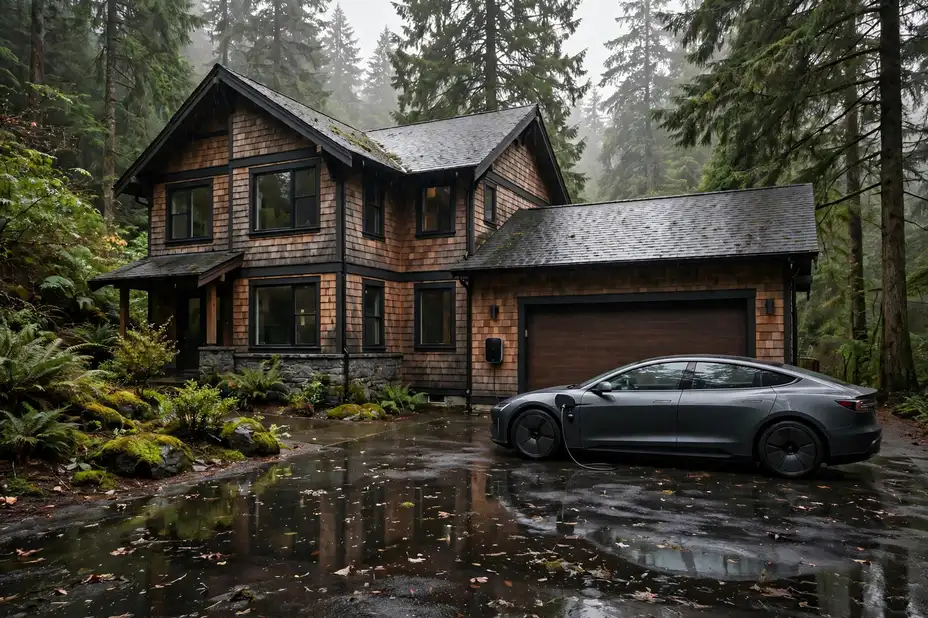
Battery care is the last refinement, and it is gentle. Lithium batteries are happiest spending their parked hours neither full nor empty, and most vehicles let the owner set a daily charge limit below the maximum — a setting worth using for the routine days, with the full range reserved for the trips that need it. None of this requires attention more than once: set the limit, set the schedule, and the system the guide opened with — a car that refuels while its owner sleeps — simply runs.
Level 1 deserves its footnote of respect before the guide closes. For the low-mileage household — the second car, the short urban commute, the retiree's local pattern — a household outlet and patience cover the driving with no project at all, and the honest adviser says so. The trigger points for upgrading are concrete: the morning the battery is not back, the winter week the margin vanished, the second driver sharing the car. Until one of those arrives, Level 1 is not a compromise; it is the correct engineering answer to a small requirement.
The arithmetic of a real week is worth doing once with honest numbers. Take a household driving two hundred and fifty miles a week — a normal figure, neither suburban-excessive nor urban-light. Spread across a fleet-average consumption, that week needs roughly seventy-five kilowatt-hours at the battery, eighty-odd at the wall. A 40-amp circuit delivers that in about nine hours of total charging across seven nights — barely more than an hour a night. The conclusion surprises most new owners: the overnight session is not a nightly marathon but a short appointment the car keeps while the house sleeps, and the margin for guests, detours and cold snaps is wide.
Public charging keeps a role in that week, and naming it keeps expectations honest. The home charger's job is the routine — the commute, the school run, the standing errands — and for those it is cheaper in effort than any public option because it asks for none of the driver's time. Public fast charging serves the exceptional: the long trip, the forgotten plug on a low night, the borrowed car. Households that understand the division stop judging the home install against road-trip standards, which is the confusion behind most early disappointment with charging speed.
Guests and second cars test the system socially before they test it electrically. A visiting vehicle can share the overnight window by arrangement — an evening hour for the guest, the small hours for the household's car — because both needs are usually partial. The second household car raises the same question permanently, and the answers ladder from scheduling, through a second station on shared capacity, to a second circuit, in rising order of permanence. Most households live happily on the first two rungs; the third exists for the genuinely high-mileage pair.
Finally, the setup deserves an occasional revisit, because everything around it moves. Mileage changes with jobs and children; tariffs change with the utility's seasons and the household's rate choices; vehicles change entirely. The install that was right for the hatchback and the short commute may be undersized for the truck and the new postcode — or oversized, quietly, for a household that now works from home. A five-minute reassessment when any of those change is the whole maintenance regime the thinking requires.
One comparison finally puts the home system's speed in its proper frame: the petrol station it replaces. A forecourt visit consumes ten or fifteen minutes of a human's attended time, weekly, forever; the home charger consumes none, exchanging attended minutes for unattended hours the household was not using. Judged as engineering the wall circuit is slower; judged as a claim on a life it is faster by the only measure that compounds. New owners who make this exchange consciously stop waiting for charging to feel quick, because they have noticed it no longer asks them to feel anything at all.
The system's ceiling, where one exists, is worth locating precisely so it is not imagined everywhere. For the ordinary household it is not the circuit, the cable or the car; it is the rare night that follows the rare day — the long return, the early departure, the second vehicle low at the same hour. The design's job is to make those nights rare and recoverable, not impossible: a margin in the circuit, a schedule that starts on arrival, a public fast charger known rather than searched for at midnight. Engineering the exceptions is what lets the routine be effortless, and the routine is ninety-nine nights in a hundred.

Frequently asked questions
What does the guide 'How Home EV Charging Works: Level 1 vs Level 2' cover?
What the two home-charging levels actually deliver per hour, what each one needs from your electrical system, and how to tell which one your driving pattern requires. It is written to be used alongside your city page, which carries the local version of every rule mentioned here.
After reading about how home ev charging works, where do I check my own city's position?
Your city's page on this site carries its utility, its state law position and its permit authority, with sources and as-of dates — start there, then your installer's site visit confirms the specifics of your property.
How many miles of range does an hour of Level 2 charging add?
Roughly 25 to 40 miles per hour for most vehicles on typical residential circuits — the figure follows the circuit's configured rate and the vehicle's acceptance rate and efficiency, which is why installers size from your driving pattern rather than from a national average. A car using about a third of a kilowatt-hour per mile gains about thirty miles in an hour at a 32-amp charge rate.
Does home charging work for a household with two EVs?
Yes — the overnight window is long and the two cars rarely both arrive empty. Households manage with one station and a swap, two stations on separate circuits, or two stations sharing one circuit through listed power-sharing equipment that divides the capacity between them. The right answer follows the panel's headroom and the household's schedules, and all three patterns are routine installations.
Next step: read your city page for the local numbers, or request an installer.